

What Is Debt Consolidation? Stop Paying 36% Interest on Credit Cards in India
Introduction
What is debt consolidation?
If you’re paying Rs. 12,000–Rs. 25,000 in EMIs every month and still watching your credit card balance barely move…
You’re not just “managing debt.”
This page covers the basic definition and math. Ready to compare real loan options? See Best Debt Consolidation Loans in India. Already have a damaged credit score? Debt Consolidation for Bad Credit covers your specific options instead.
You’re stuck in a system designed to keep you there.
Here’s the uncomfortable truth:
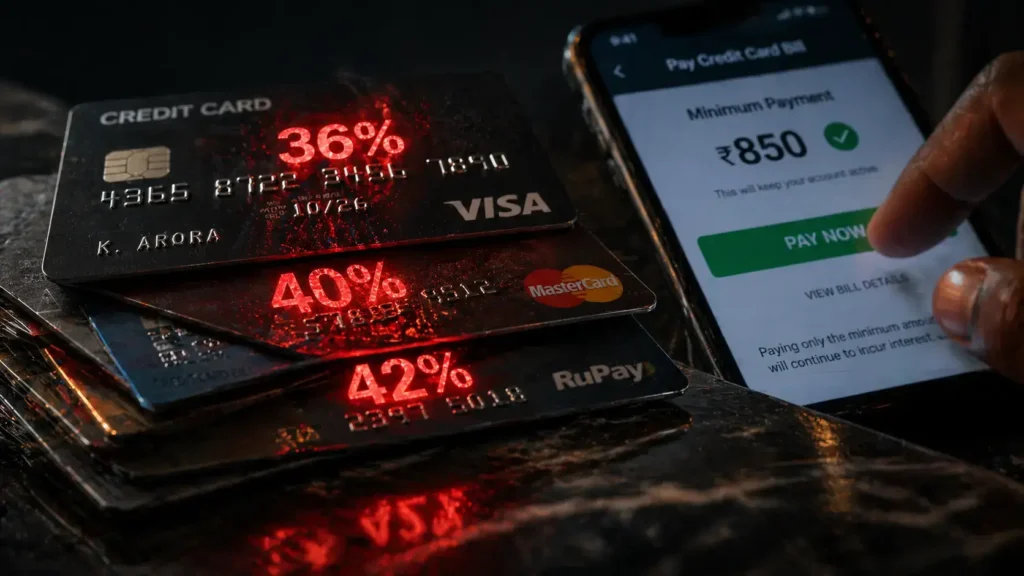
If your credit card charges 36–42% interest and you’re only paying minimum dues, you’re not reducing debt—you’re feeding it.
That’s exactly why understanding what is debt consolidation can be a turning point for many Indian salaried professionals.
Done right, it can:
- Reduce your EMI burden
- Cut your interest by lakhs
- Give you breathing space
Done wrong?
You’ll end up with one big loan + fresh debt—a worse situation than before.
Here’s the uncomfortable truth:
Paying minimum dues on a credit card charging 36–42% interest is not repayment. It’s slow financial damage.
And most salaried Indians don’t realise this until:
- Their savings are gone
- Their CIBIL score drops
- Banks start tightening access
That’s where debt consolidation enters the picture.
Done right, it can:
- Cut your interest burden
- Simplify your life into one EMI
- Help you recover control
Done wrong?
You’ll end up with one big loan + fresh credit card debt—a worse mess than before.
Let’s break this down properly. No fluff. Just reality.

Key Takeaways Box
- Debt consolidation = combining multiple debts into one loan
- Works best when replacing high-interest debt (30%+)
- Reduces EMI stress but does not fix bad habits
- Can improve CIBIL score over time
- Dangerous if you continue using credit after consolidation
What Is Debt Consolidation?
Debt consolidation means taking one new loan to pay off multiple existing debts.
Instead of managing:
- 2–3 credit cards
- Personal loans
- BNPL apps
You replace all of it with one single EMI at a lower interest rate.
Simple idea. Powerful impact.
But don’t confuse simplicity with safety.
Why Most Indians Need Debt Consolidation (But Don’t Admit It)
Let’s call it out.
The typical urban salaried setup:
- Swiggy + Amazon = lifestyle inflation
- Credit cards = convenience
- EMIs = “manageable”
Until it isn’t.
Real problem:
- Credit card interest: 36–42%
- Personal loan interest: 18–24%
You’re not borrowing.
You’re bleeding money.
And if you’re only paying minimum dues…
👉 Your debt can take years to clear.
Real Indian Scenarios (This Is Where It Gets Real)
Ravi (Software Engineer, Hyderabad)
- Salary: Rs. 70,000
- Credit Cards: Rs. 2 lakh total @ 38%
- Personal Loan EMI: Rs. 8,500
He was paying ~Rs. 18,000 monthly.
Still, total debt barely reduced.
Action: Took Rs. 2.5 lakh consolidation loan @ 14%
Result:
- EMI dropped to ~Rs. 10,500
- Interest burden reduced massively
- Became debt-free in 3 years
Priya (Marketing Executive, Bangalore)
- Debt: Rs. 1.5 lakh across cards + BNPL
- Took consolidation loan
Sounds smart, right?
Here’s what she did next:
- Continued shopping
- Used credit cards again
Result:
Now she has:
- Consolidation loan
- New credit card debt
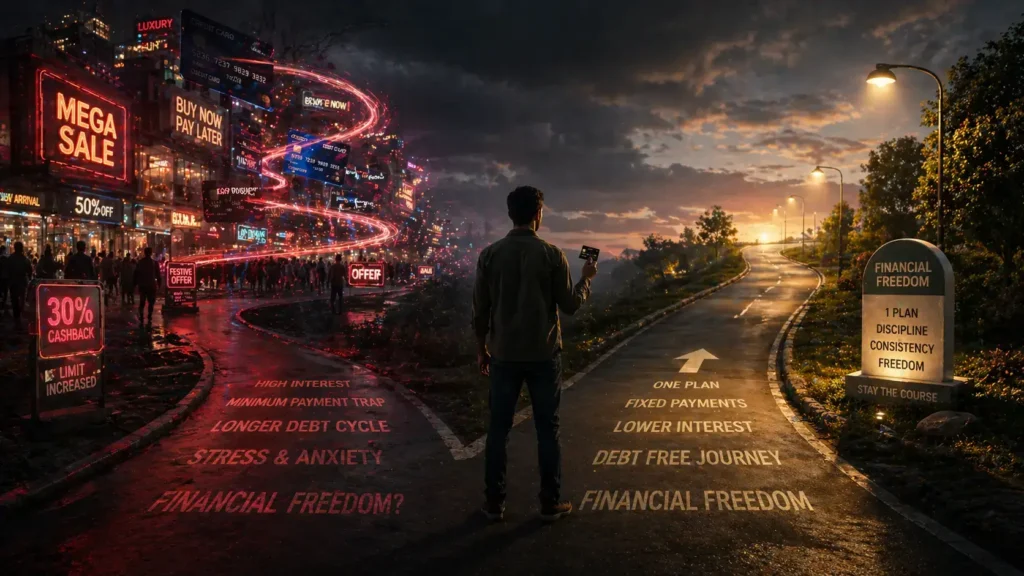
👉 This is the trap nobody talks about.
Mahesh (Govt Employee, Vijayawada)
- Used loan against FD @ 8%
- Closed all high-interest debts
Result:
- Lowest cost solution
- No financial stress
Smart doesn’t mean complex.
Smart means disciplined.
Rs. Calculation: Before vs After (This Is Where Money Is Saved)
Let’s break a real scenario.
Before Consolidation
| Debt | Amount | Interest | EMI |
|---|---|---|---|
| Credit Card 1 | Rs. 1,20,000 | 36% | Rs. 6,000 |
| Credit Card 2 | Rs. 80,000 | 40% | Rs. 4,000 |
| Personal Loan | Rs. 1,00,000 | 18% | Rs. 5,500 |
Total EMI: Rs. 15,500
And most of it? Interest.
After Consolidation
- New Loan: Rs. 3,00,000
- Interest: 14%
- Tenure: 3 years
New EMI: ~Rs. 10,300
What Changed?
- Monthly savings: ~Rs. 5,200
- Interest saved: Rs. 60,000–Rs. 80,000 approx
That’s not small.
That’s your emergency fund right there.
Types of Debt Consolidation Options in India
1. Personal Loan
- Fast approval
- Most common option
- Moderate interest
2. Balance Transfer Credit Cards
- Low initial interest
- Dangerous if misused
3. Loan Against Property
- Lower interest
- High risk (you’re pledging your home)
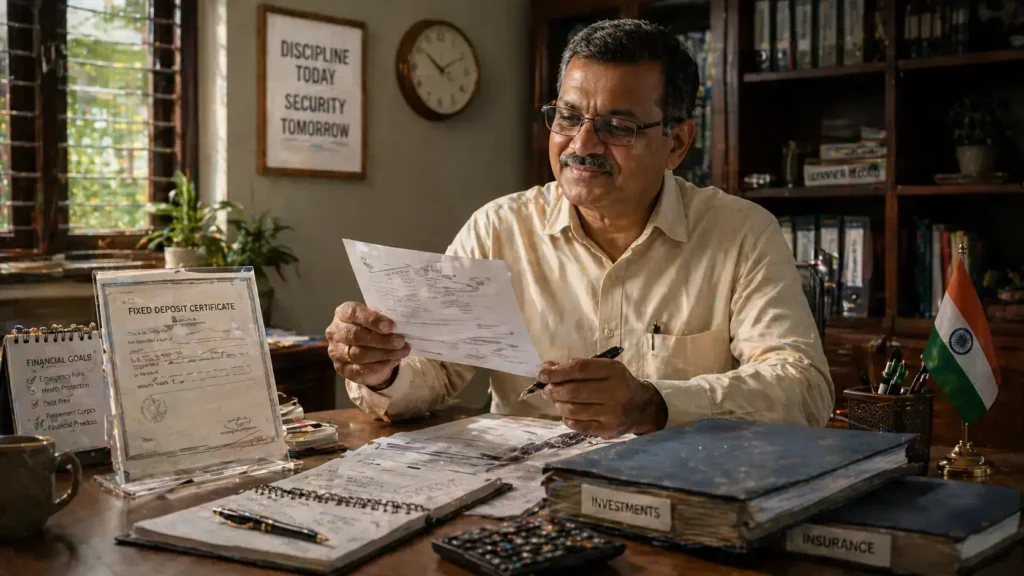
4. Loan Against FD
- Cheapest option (7–9%)
- Best for disciplined people
When Debt Consolidation Works
It works if:
- You stop new borrowing
- You follow a repayment plan
- You control expenses
Simple rules. Hard to follow.
Explore Debt Snowball vs Avalanche: Which Payoff Method Actually Works Better
When It Backfires (Reality Check)
Let’s be direct.
Debt consolidation fails when:
- You treat it like “extra money”
- You keep swiping credit cards
- You don’t track spending
Hard Truth:
If you’re spending Rs. 8,000/month on food delivery while paying 36% interest…
You’re not in a debt problem.
You’re in a behaviour problem.
Impact on CIBIL Score
Your CIBIL score reacts like this:
Short-term:
- Small dip due to new loan
Long-term:
- Improves with consistent EMI payments
Key factor:
Lower credit utilization = higher score
Step-by-Step: How to Consolidate Debt in India
Step 1: List everything
Every loan. Every card. No hiding.
Step 2: Check your credit score
Below 650? Expect higher interest.
Step 3: Compare lenders
Look beyond EMI:
- Processing fees
- Prepayment penalties
Step 4: Close all old debts immediately
No delays. No excuses.
Step 5: Cut access to easy credit
- Reduce limits
- Remove saved cards
- Uninstall shopping apps
Yes, it sounds extreme.
That’s because your situation probably is.
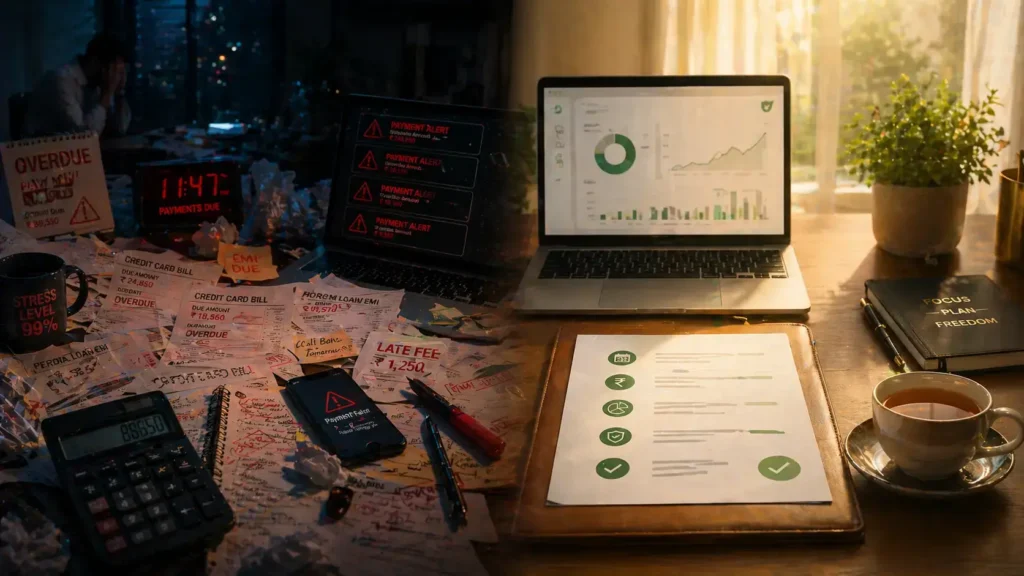
Before vs After Transformation (Mindset Shift)
Before:
- Multiple EMIs
- Constant stress
- No savings
After:
- One EMI
- Clear plan
- Financial breathing room
But only if you stay disciplined.
FAQ Section
1. What is debt consolidation in simple terms?
Debt consolidation means combining multiple debts into one loan with a single EMI and lower interest rate.
2. Is debt consolidation a good idea in India?
Yes, if used to replace high-interest debt and followed with disciplined repayment.
3. Will debt consolidation hurt my CIBIL score?
Short-term dip, but long-term improvement if managed well.
4. Can I consolidate only credit card debt?
Yes, and that’s the most common use case due to high interest rates.
5. Is what is debt consolidation the same as a personal loan?
Loan against FD is cheapest, personal loan is most accessible.
Conclusion
Now that you understand what is debt consolidation.
Your behavior is.
This is just a tool.
Used right → it can save you lakhs
Used wrong → it will bury you deeper
So don’t just ask:
“What is debt consolidation?”
Ask:
“Am I ready to fix my financial habits?”
Start today:
- List your debts
- Calculate your real interest
- Take control

This article is for educational purposes only and does not constitute financial advice. Figures, examples, and outcomes are illustrative and vary based on individual circumstances and lender policies. Always consult a certified financial advisor before making major financial decisions.
One Email a Week. Five Things Worth Knowing.
- One important financial change that actually affects you
- One practical money lesson
- One useful calculator
- One common mistake to avoid
- One guide worth reading