

How to Build Your First Emergency Fund on a ₹30,000 Salary
You don’t need a high salary to start an emergency fund. You need a first target you can reach and a plan that holds up through an ordinary, messy month.
That is easier said than done when rent, groceries and a family responsibility all compete for the same ₹30,000. A surprise clinic bill or a delayed salary can turn a tight budget into panic. Starting an emergency fund on a small salary is possible, but it works better as a series of reachable milestones than as one giant number.
This guide shows you how to calculate a starter target, make room for it without pretending your expenses are optional, and choose a place for the money where access matters more than returns. Whether you are starting an emergency fund on a small salary in a regular-pay job or with variable income, the core steps are the same: start with essentials, make the contribution manageable and protect access to the cash.
Job searches rarely go exactly as planned — here's your shortfall at three common lengths.
| Scenario | Search length | Shortfall |
|---|

Key Takeaways
- Base your emergency-fund target on essential expenses, not your entire salary.
- Begin with a starter buffer—such as ₹5,000 or one month of essentials—before aiming for several months.
- A ₹30,000 salary does not mean everyone can save the same amount; rent, dependants and debt change the maths.
- Small, regular transfers can build the habit, while irregular income or expenses may call for flexible contributions.
- Keep emergency money accessible and separate from day-to-day spending; high returns are not the main job of this fund.
- Use the fund for genuine urgent needs, then rebuild it after a withdrawal.
Work out what your emergency fund must cover
Use essential expenses, not a salary multiple
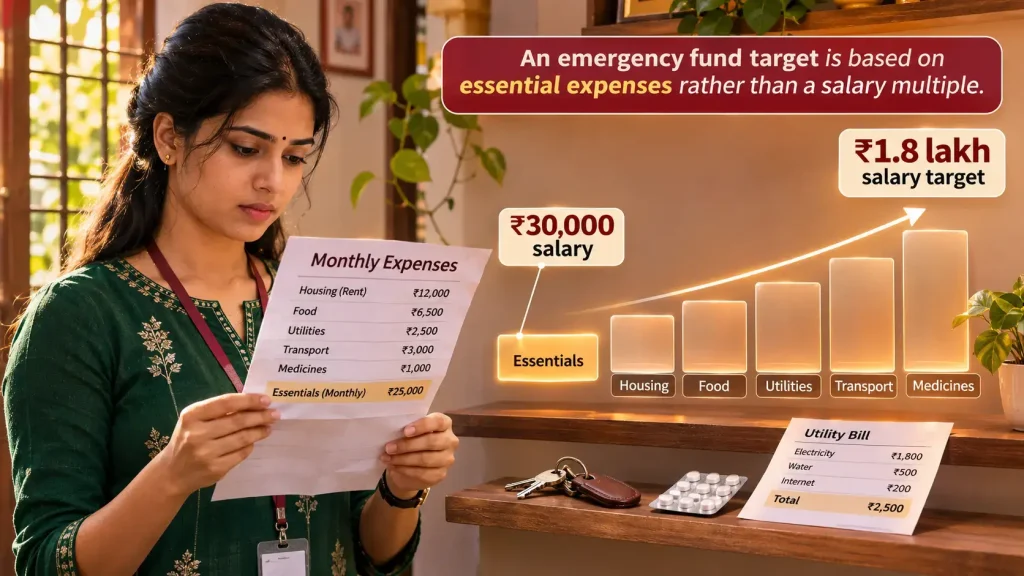
A common mistake: hear “save six months of salary” and land on a target of ₹1.8 lakh. That may be a useful reference for some households, but it ignores what you actually need to keep basic life running. An emergency fund is built around essential expenses: housing, basic food, utilities, transport to work, necessary medicines and minimum required loan payments.
Take Sentimongla, a 29-year-old school administrator in Kohima earning ₹30,000 a month. Her household budget sets aside ₹8,000 for rent, ₹5,500 for groceries, ₹2,000 for utilities and phone, ₹2,500 for transport, and ₹2,000 for a required loan payment. That adds up to ₹20,000 in essentials. A three-month reserve based on those costs would be ₹60,000, not ₹90,000 based on her full salary.
That distinction matters. A target based on survival costs can feel reachable sooner. It also leaves room for discretionary spending in the normal monthly budget, without confusing a want with an emergency. When you’re starting an emergency fund on a small salary, calculating essentials first keeps your first target grounded in what your household actually needs.
Choose a first milestone you can actually reach
Don’t let a long-term target keep you from starting. A first milestone of ₹5,000 can cover a modest urgent expense or reduce how much you might otherwise need to borrow. After that, a one-month essential-expense buffer is a practical next marker. Later, your household can assess whether two or three months—or more—is appropriate.
Consider Zosangliana, a 34-year-old nurse in Lunglei whose take-home pay is ₹30,000. His essential costs total about ₹22,000 a month. He’s worried one medical bill could force him to use a credit card. Instead of treating ₹66,000 as the only meaningful goal, he can track progress toward ₹5,000, then ₹22,000, then a larger reserve. Each step changes what a setback might cost him in borrowing. That step-by-step approach can make starting an emergency fund on a small salary feel less like an all-or-nothing challenge.
There’s no prize for picking a target that makes you abandon the plan in month two.
Make the monthly maths work on ₹30,000
Build the plan around your actual cash flow
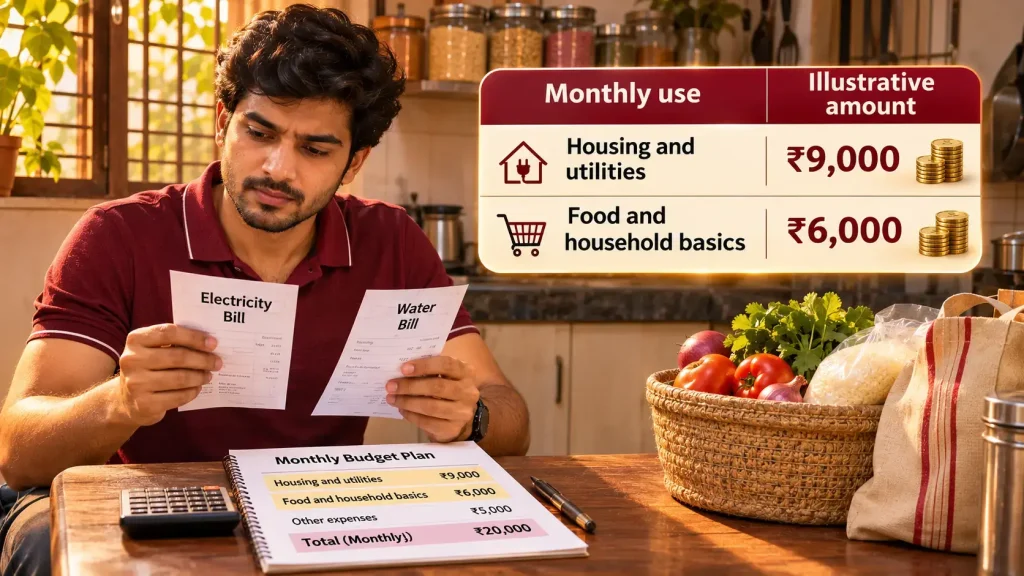
Here’s one possible monthly breakdown for someone earning ₹30,000. It’s an illustration, not a template. Your numbers will differ if rent is higher, a parent depends on your income, or you have a loan EMI. The point is to give every rupee a job before the month runs away with it.
| Monthly use | Illustrative amount | What it covers |
|---|---|---|
| Housing and utilities | ₹9,000 | Rent, electricity, water and basic phone costs |
| Food and household basics | ₹6,000 | Groceries and essential supplies |
| Transport and work costs | ₹3,000 | Commute and necessary work expenses |
| EMI or family commitments | ₹4,000 | Required payments or regular support |
| Personal and flexible spending | ₹5,000 | Small purchases, meals out and other variable costs |
| Emergency-fund contribution | ₹3,000 | Monthly transfer toward the reserve |
| Total | ₹30,000 | All monthly income assigned |
At ₹3,000 a month, you can reach the first ₹5,000 milestone in less than two months if no withdrawal interrupts it. A ₹22,000 one-month essentials buffer takes a little over seven months. But if ₹3,000 makes your budget crack, a smaller contribution is more useful than an ambitious one you reverse every payday. When you’re starting an emergency fund on a small salary, a contribution that fits your real budget is more sustainable than an impressive figure on paper.
Choose a contribution that survives a tight month
Gajanan, a 31-year-old pharmacy assistant in Mapusa, earns ₹30,000 and sends ₹4,000 home each month. He can set aside ₹1,000 in a typical month, though some months bring extra travel costs. A fixed transfer of ₹1,000 gives him a starting rhythm. An occasional top-up from overtime or a cash gift can speed up progress without turning the contribution into a promise he can’t keep.
Try it yourself: write down your take-home pay, essential expenses, minimum debt payments and what’s left after those. Test a contribution of ₹500, ₹1,000 and ₹1,500 against your spending over the last three months. Which amount would have stayed untouched even in the most expensive of those months? That’s a more honest starting point than picking a number because it sounds impressive. This practical test helps you approach starting an emergency fund on a small salary without guesswork.
If you’re paid on the 30th, transferring money soon after payday can reduce the temptation to spend the entire balance. But if your income arrives irregularly, a percentage of each payment or a flexible monthly minimum may fit better. Match the method to your pay pattern.
Keep the money accessible—and set clear boundaries
Separate emergency savings from everyday spending
Money sitting in the same account as Swiggy orders, ₹20 chai stops and routine UPI payments can disappear without a dramatic purchase. A separate savings account or another straightforward, accessible arrangement can make the boundary visible. Compare account conditions and access rules. Don’t assume every account has the same fees, minimum-balance requirements or withdrawal experience.
Emergency savings have a different job from long-term investments. This fund is for access during a disruption, not chasing a return. A product that can fluctuate in value or take time to redeem may be a poor fit for money you need quickly, even if its potential return looks appealing. The trade-off is plain: accessibility and stability of value matter more here than growth. That priority matters when you’re starting an emergency fund on a small salary, because a delay in accessing a small reserve can undermine its purpose.
For the separate question of investing before you have a full buffer, see “Should I Build an Emergency Fund Before Investing?” The right sequence can depend on your income stability, household responsibilities and existing debt. The core point: don’t treat emergency cash as a market bet. RBI’s financial education resources also offer basic personal-finance information to help you build your understanding of saving and budgeting.

Decide what counts before the pressure arrives
A genuine emergency is an urgent, necessary expense you couldn’t reasonably schedule: a critical repair needed to get to work, an unexpected medical cost, or a sudden gap in income. Annual insurance premiums, a planned festival purchase or a phone upgrade are real expenses, but they’re usually predictable enough to plan for separately.
This distinction can feel uncomfortable when you’ve been postponing something for months. Still, if every large purchase becomes an “emergency,” the fund can’t do its actual job. A simple note in your banking app or budget can record why you withdrew money and how much remains. Clear rules help when you’re starting an emergency fund on a small salary because they protect a modest balance from predictable costs.
When you use the fund, the first task isn’t guilt. It’s checking what’s left for essentials and restarting contributions at a pace your budget can support. If you need money immediately, don’t assume a transfer from every savings product will arrive instantly. Check access and settlement conditions before relying on it.
Adjust the plan when life does not follow the spreadsheet
Handle debt and irregular expenses without abandoning the buffer
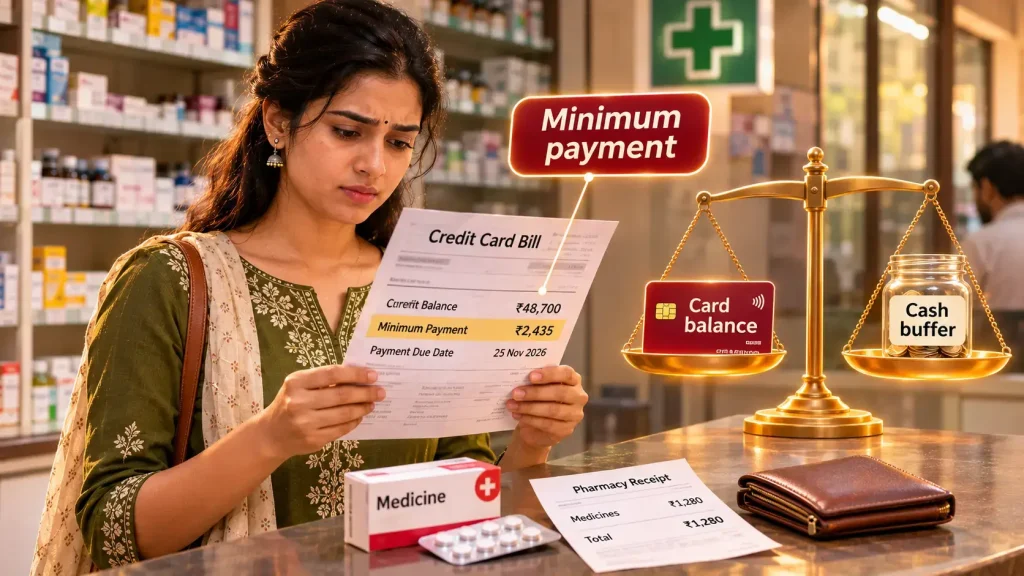
A high-interest credit-card balance creates a genuine tension: saving cash while interest accumulates can be costly, but having no accessible buffer may send the next surprise straight back onto the card. There’s no universal split for every household. List the interest and minimum payments on your debt, the consequences of missing them, and the size of your current cash cushion. That makes the trade-off visible instead of letting anxiety decide for you. If you’re starting an emergency fund on a small salary while carrying debt, this comparison can help you decide on a modest buffer and a realistic debt-payment plan.
Separate irregular-but-predictable bills from emergencies, too. School costs, insurance renewals, vehicle servicing and travel home may not arrive monthly, but they aren’t necessarily surprises. A small “known expenses” pot can stop those bills draining your emergency reserve. Even ₹500 a month set aside for a recurring annual cost creates ₹6,000 over a year.
Increase the target when your responsibilities change
A one-month buffer is a milestone, not a universal finish line. If you support children or elderly parents, work on contract, or face uncertain work hours, you may need a larger reserve than someone with steady income and fewer dependants. A job change, new EMI or move to a more expensive rental can also change your essential-expense number.
The Personal Finance Center covers saving and emergency-fund basics alongside other money fundamentals. For your own plan, revisit your essential-cost total when a major responsibility changes—not every time a grocery bill rises by ₹100. That keeps your target tied to real life, not daily noise. Review the plan from time to time so that starting an emergency fund on a small salary continues to reflect your current responsibilities.
FAQs
How much emergency fund should I have on a ₹30,000 salary?
Calculate your essential monthly costs first, then set staged targets such as ₹5,000, one month of essentials and a longer reserve. The right eventual amount depends on income stability, dependants, debt and access to other support.
Can I build an emergency fund if I can save only ₹500 a month?
Yes. At ₹500 a month, the first ₹5,000 takes ten months if there are no withdrawals. A small contribution that continues is more useful than a large target that repeatedly gets abandoned.
Should I use a fixed deposit for my emergency fund?
Check withdrawal rules, access time, penalties and any conditions before relying on a fixed deposit for urgent cash. The fund’s purpose is timely access, so convenience and the cost of early withdrawal matter alongside interest.
What counts as an emergency expense?
An urgent, necessary cost that could not reasonably be planned for—such as an unexpected medical bill or essential repair—may qualify. Predictable annual bills and planned purchases are usually better handled through separate savings.
Final Thoughts
A ₹30,000 salary can make saving feel like a contest between tomorrow’s security and today’s obligations. That tension is real. Don’t shame yourself for a tight budget. Turn “I need a safety net” into a first number you can track.
This week, total your essential expenses from one recent month and write down a first milestone beside them. If that first number is ₹500, it still counts. A visible buffer can turn the next unexpected bill from a full-blown crisis into a problem with at least one option. Starting an emergency fund on a small salary isn’t about saving a perfect amount immediately. It’s about building a reserve one affordable step at a time.
The examples above are simplified, and their figures are assumptions used to show how the numbers work.

This article is for educational purposes only and does not constitute financial advice. Figures, examples, and outcomes are illustrative and vary based on individual circumstances and lender policies. Always consult a certified financial advisor before making major financial decisions.
One Email a Week. Five Things Worth Knowing.
- One important financial change that actually affects you
- One practical money lesson
- One useful calculator
- One common mistake to avoid
- One guide worth reading