
EPF Advance Rules 2026: 7 Proven Ways to Withdraw Your Money Early
You check your salary slip on the last day of the month, stare at the statutory deduction line, and watch a chunk of your earnings disappear into your retirement corpus. For most salaried professionals, the Employee Provident Fund is an invisible safety net. But when a sudden medical crisis hits, or when an aggressive builder demands the next installment for your apartment flat, that locked-away balance suddenly looks like the easiest exit ramp.
Can you pull money out of your provident fund while still employed? Yes, absolutely. However, understanding the exact EPF advance rules India operates under is the difference between a clean, stress-free claim payout and a rejected Form 31 application. Many salaried workers treat their EPF passbook like an emergency savings account with ICICI Bank or HDFC Bank. It isn’t. The Employees’ Provident Fund Organisation sets strict, non-negotiable boundaries on when, how much, and why you can access your cash.
Raiding your provident fund comes at a staggering long-term price. Before you log into the Member e-Sewa portal and drain your hard-earned retirement money, you need to understand every restriction, every eligibility condition, and the brutal math of interrupted compound interest. This guide breaks down the legal pathways, limits, and steps you must know before taking an early EPF pay-out.
Key Takeaways
- Under current EPF advance rules India, an advance is a non-refundable withdrawal—you do not have to pay it back to your PF account.
- Medical emergencies permit the fastest payouts without any mandatory minimum service requirement, including auto-settlement modes for urgent treatment.
- Housing purchases, home construction, and home loan prepayments carry strict service milestones, usually requiring at least 5 continuous years of EPF contributions.
- Draining your provident fund early wipes out sovereign-backed, compound interest that is virtually impossible to replace through ordinary debt instruments.
- Most legitimate advance claims submitted via Form 31 are completely tax-exempt, unlike premature final account closures before 5 years of service.
- Never tap an EPF advance to pay off high-interest credit cards before consulting your broader cash flow or exploring balanced debt management options.
The Foundations: How EPF Advance Rules India Work in 2026
Before examining individual grounds, you must understand the legal definition of an EPF advance. In corporate terminology, an “advance” usually means a temporary loan you repay via monthly salary deductions. Under the statutory framework of EPF advance rules India, an advance is actually a permanent, non-refundable partial withdrawal. You do not repay it. The money leaves your PF balance permanently, reducing your eventual retirement corpus.
Every partial withdrawal requires filing online Form 31 through the EPFO Member e-Sewa portal. You can only draw from your own employee share and the accrued interest on that share for most reasons, though specific housing grounds permit tapping into the employer’s accumulated contribution balance as well. The pension bucket—the Employees’ Pension Scheme—remains completely untouched until formal superannuation or exit.
The Difference Between Partial Advance and Complete Settlement
A partial advance is designed for mid-career emergencies while you remain on an Indian company payroll. A complete settlement (Form 19 and Form 10C), by contrast, requires you to either retire after age 58 or remain officially unemployed for at least two consecutive months. Attempting to withdraw your entire provident fund balance while actively employed is illegal and automatically flagged by the system through your linked Universal Account Number.
Auto-Claim Processing Timelines
The EPFO has modernized its back-end infrastructure significantly over the past two years. Medical emergency claims up to ₹1,00,000 processed under the auto-mode settlement framework routinely clear within 72 hours, without human clerical intervention, provided your Know Your Customer details match your Aadhaar record. For non-medical grounds like wedding expenses or property construction, physical documentation verification remains active, taking between 7 to 15 working days for direct bank disbursement.
Permitted Grounds Under EPF Advance Rules India
You cannot request an advance simply because you overspent on weekend dining or booked an expensive international holiday. Under official EPF advance rules India, you must pick a predefined reason categorized within Form 31. Each ground carries distinct service tenure requirements and numeric withdrawal caps.
| Withdrawal Purpose | Minimum Continuous Service | Maximum Eligible Amount | Permitted Frequency |
|---|---|---|---|
| Medical Treatment (Self/Family) | No minimum service required | 6 months’ basic wages + DA, or employee share with interest (lower of the two) | No limit, subject to medical validity |
| House Purchase or Construction | 5 years | Up to 36 months’ basic + DA, or total PF contribution with interest | Once in an entire career |
| Home Loan Repayment | 10 years | Up to 36 months’ basic + DA, or total PF balance (employee + employer share) | Once in an entire career |
| Marriage (Self, Sibling, Child) | 7 years | Up to 50% of employee’s own contribution with interest | Maximum 3 times across career |
| Post-Matric Education of Child | 7 years | Up to 50% of employee’s own contribution with interest | Maximum 3 times across career |
| Special Circumstances (Layoff/Natural Calamity) | No minimum service required | Varies (typically up to 3 months’ wages or predefined caps) | Event-driven per incident |
1. Medical Emergencies
Medical claims remain the most flexible provision within EPF advance rules India. If you, your spouse, your dependent children, or your parents face major illness—such as cancer, cardiac surgery, kidney disorders, or unexpected hospitalization—you can withdraw up to 6 months of basic wages and Dearness Allowance, or your entire personal employee balance, whichever is less. You do not need to hit a 5-year or 7-year service record to qualify.
2. Housing, Land Purchase, and Construction
EPFO treats homeownership as an approved asset-building activity. Under the housing framework, if you have completed 5 continuous years of service, you can withdraw money to buy a residential plot, purchase a ready-to-move apartment, or build a house. For outright home purchases, the maximum withdrawal can include both employee and employer shares, capped at 36 times your monthly basic pay plus DA. This withdrawal is permitted only once in your lifetime.
3. Repaying an Active Home Loan
Struggling under the weight of an aggressive floating home loan interest rate from your bank? If you have completed 10 years of continuous service, the system allows a one-time partial withdrawal to pay down the principal balance of a registered housing loan taken in your name, your spouse’s name, or joint ownership. This can drastically reduce your monthly interest outflow, but it completely strips away your principal compound engine.
4. Weddings and Higher Education
If you have clocked at least 7 continuous years under the EPF ecosystem, you can access up to 50% of your own contributions plus accrued interest to fund higher education for your children after Class 10. The same 50% ceiling applies if you need funds for your own wedding, a sibling’s wedding, or your child’s marriage. EPFO restricts these lifestyle-related advances to a maximum of 3 times in your working lifespan.
The Real Cost: Why Tapping Your EPF Can Ruin Your Retirement
Just because EPF advance rules India allow you to access the money does not mean pulling it out is a smart financial move. The biggest hidden cost of an EPF advance isn’t administrative fees—it is lost compound interest guaranteed by the sovereign government.
Consider an actual Indian household scenario. Priya, a 31-year-old product manager in Pune, earns a basic salary of ₹60,000 per month. Her total accumulated EPF corpus stands at ₹6,50,000. She wants to clear off an accumulated personal loan and home renovation bill, so she decides to apply for an advance of ₹4,00,000 under Form 31.
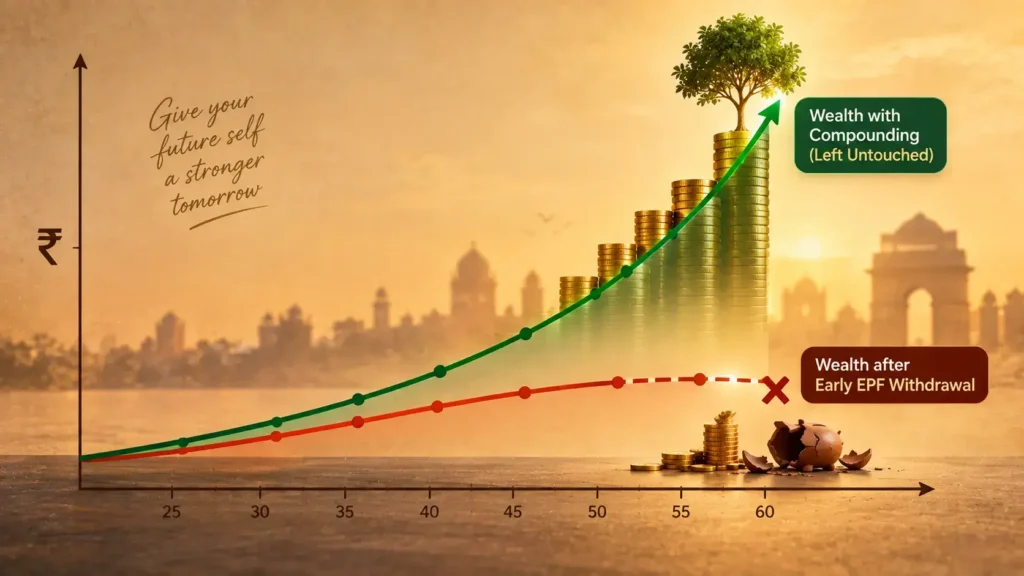
To Priya, withdrawing ₹4,00,000 feels painless because it is “her own money.” But here is the brutal mathematical reality she overlooked:
| Financial Metric | Option A: Leave EPF Untouched | Option B: Take ₹4,00,000 Advance |
|---|---|---|
| Initial EPF Balance at Age 31 | ₹6,50,000 | ₹2,50,000 (after advance) |
| Assumed Annual EPF Interest Rate | 8.25% | 8.25% |
| Time Horizon Until Age 58 | 27 years | 27 years |
| Future Value of the Withdrawn ₹4 Lakh Alone | ₹34,18,655 | ₹0 (spent immediately) |
| Estimated Final Portfolio Deficit | Baseline Projection | ₹34.18 Lakhs smaller at retirement |
By pulling ₹4,00,000 out today, Priya does not just lose ₹4,00,000. She permanently robs her 58-year-old self of more than ₹34 lakh in tax-free, guaranteed returns. No conservative fixed-income instrument available in the market matches the risk-adjusted safety of EPF interest backed by the central government. When debt begins creeping in, many salaried workers abandon core personal finance fundamentals, raiding their retirement rather than fixing household operational spending.
If you find yourself running short of liquidity, look at your monthly budget before submitting Form 31. Tapping into emergency cash balances or restructuring everyday expenses according to the 50 30 20 rule india households use can often plug a small deficit without destroying your retirement foundation. If your financial balance is stretched by bad loan structures, exploring structured debt management India programs or checking an Emergency Fund Calculator India tool should always come before breaking open your EPF vault.
Form 31 Step-by-Step Filing and KYC Traps
Navigating the practical mechanics of EPF advance rules India requires an active Universal Account Number that is properly seeded with your credentials. If your administrative records contain even a minor clerical mismatch, your online claim will be rejected immediately by the EPFO regional portal.
Pre-Claim Checklist
- Your UAN must be activated on the Unified Member Portal.
- Your Aadhaar must be linked, verified, and match your name and date of birth exactly.
- Your active bank account number and IFSC code must be seeded and approved digitally by your employer.
- Your mobile number linked to Aadhaar must be operational to receive one-time passwords.
- A scanned copy or clear image of a canceled cheque leaf or the front page of your bank passbook showing your name, account number, and IFSC must be ready (under 500 KB, in JPEG format).
Try it yourself: Log into the Unified Member Portal right now, navigate to the “Manage” tab, and click on “KYC.” Check the verification status column. If your bank details show “Pending Employer Approval,” do not submit Form 31 yet. Any advance filed with pending KYC will remain stuck in limbo for weeks.
Online Claim Submission Process
Once your profile reflects 100% verified status, go to the “Online Services” menu and select “Claim (Form-31, 19, 10C & 10D).” Confirm your registered bank account number to authenticate your identity. Next, choose “PF Advance (Form 31)” from the dropdown menu.
Select the exact purpose of your withdrawal from the available options. Enter the requested amount, fill in your permanent home address, and upload your canceled cheque. Finally, click “Get Aadhaar OTP,” enter the six-digit code sent to your phone, and submit. You will receive a tracking acknowledgment ID instantly.
Tax Rules Surrounding EPF Advances
A frequent point of confusion among young corporate employees involves taxation. If you pull out funds early, will the Income Tax Department levy Tax Deducted at Source on the proceeds? Under standard EPF advance rules India, genuine advances drawn under Form 31 are treated as non-taxable partial withdrawals, provided they comply with the statutory caps outlined in the scheme.
Tax complications generally arise during complete account closures, not advances. If an employee terminates employment and liquidates their entire EPF account before completing 5 years of continuous service, the total amount withdrawn is added back to their taxable income under Section 192A of the Income Tax Act, triggering TDS deductions. However, a partial emergency advance taken under Form 31 during your service period remains free from income tax liability. Even so, the loss of tax-free compounding interest remains the real penalty you pay.
Before deciding whether to touch this money to cover immediate loan dues, consider how institutional lenders evaluate your overall profile. If you have an active housing loan, taking an advance to prepay might save you interest, but you must evaluate whether that liquidity is better preserved in case of job loss. When assessing whether to draw down your retirement balance or restructure obligations, reviewing tools like the Debt Freedom Calculator can help quantify your true debt position without acting impulsively.
FAQs
Can I withdraw my EPF advance while still working at my company?
Yes. EPF advance rules India specifically permit non-refundable partial withdrawals via online Form 31 while you remain actively employed, provided you satisfy the required service tenure for your chosen withdrawal reason.
Do I need to repay an EPF advance back to the EPFO?
No, an EPF advance is a non-refundable withdrawal rather than a loan. The money is deducted permanently from your PF balance and never needs to be repaid.
How many times can I apply for an EPF advance?
For medical emergencies, there is no statutory limit on the number of claims you can submit. For weddings and higher education, the limit is strictly capped at three withdrawals across your entire working lifetime.
Will my EPF advance claim be rejected if I haven’t completed 5 years of service?
It depends entirely on the purpose of your withdrawal. Medical emergency claims do not require any minimum service length, whereas housing, marriage, and education advances require between 5 to 10 continuous years of service.
Final Thoughts
Your Employee Provident Fund is not a piggy bank for spontaneous splurges, weekend vacations, or discretionary lifestyle upgrades. It represents one of the few remaining investment avenues in India that offers guaranteed, sovereign-backed, compounding returns that outpace baseline inflation without stock market volatility. When an unavoidable medical crisis strikes or you are crossing the final hurdle to own a primary home, using the EPF advance rules India provides can provide genuine, debt-free relief.
Every rupee you take out of your PF balance today is multiple rupees stolen from your retired self thirty years from now. Before you open the Member e-Sewa portal and generate that Aadhaar OTP, review your short-term liquid savings, cut discretionary outflows, and determine if an emergency fund buffer can handle the pressure instead. Treat your provident fund balance as an impenetrable fortress, and breach its walls only when every other practical alternative has been exhausted.

This article is for educational purposes only and does not constitute financial advice. Figures, examples, and outcomes are illustrative and vary based on individual circumstances and lender policies. Always consult a certified financial advisor before making major financial decisions.
One Email a Week. Five Things Worth Knowing.
- One important financial change that actually affects you
- One practical money lesson
- One useful calculator
- One common mistake to avoid
- One guide worth reading