


The 50/30/20 Rule in India: How to Budget Your Salary
It happens every single month. Your salary hits your bank account on the 30th, and for about forty-eight hours, you feel rich. You order that premium meal on Swiggy, pay off your outstanding credit card dues, and maybe buy a shirt you don’t really need. Then, the automated home loan or car loan EMI strikes. By the 15th, you are staring at your bank app, wondering where ₹70,000 vanished. That is where the 50 30 20 rule india comes in.
The reality is brutal. Most Indians do not have an income problem; they have a distribution problem. We are taught how to study and how to work, but no one teaches us how to allocate a paycheck. If you are tired of living paycheck-to-paycheck and want a system that does not require you to track every single ₹20 chai, you need a simple framework.
That is where the 50 30 20 rule india comes in. This classic personal finance formula, popularized by US Senator Elizabeth Warren, is not just some Western academic concept. When adjusted for Indian realities like high rent in Bengaluru, crazy fuel prices, and our cultural obsession with gold and mutual funds, it becomes the ultimate financial survival tool. This guide will show you exactly how to split your Indian salary to build wealth without living like a monk.
Key Takeaways
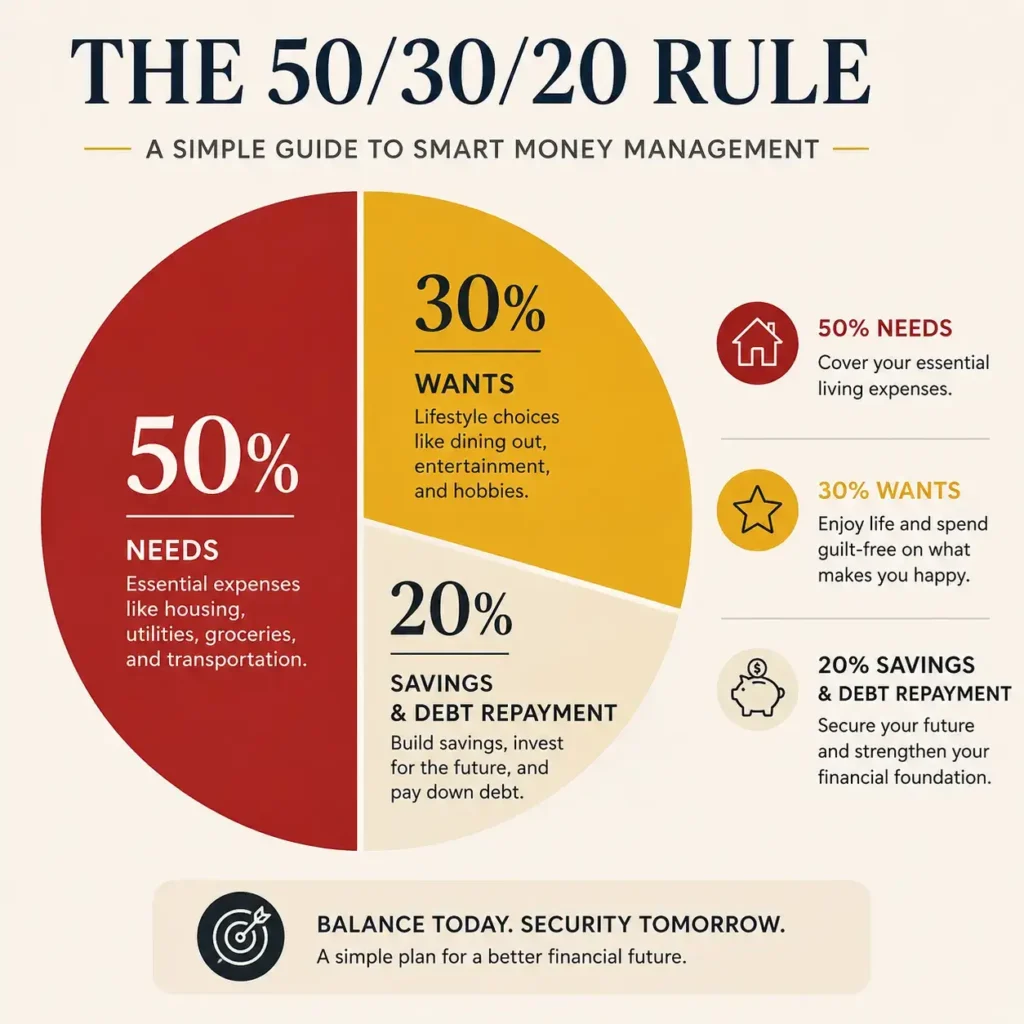
- The Core Formula: The 50 30 20 rule splits your post-tax income into 50% Needs, 30% Wants, and 20% Savings.
- Indian Context Matters: High EMIs and rising rent in metro cities mean you must define “Needs” strictly to avoid overspending.
- Automate Your Savings: The easiest way to succeed is to move your 20% savings into SIPs or recurring deposits the day your salary hits.
- Debt First: High-interest credit card debt must be treated as a “Need” and cleared before you aggressively fund your “Wants”.
- Flexibility is Key: If you live in an expensive city like Mumbai, you might need a temporary 60-20-20 split while you work on lowering your fixed costs.
What is the 50 30 20 Rule India Actually?
At its heart, the 50 30 20 rule is a simple budgeting framework. It takes your net take-home salary—the actual cash that lands in your bank account after Provident Fund (PF) and Professional Tax are deducted—and divides it into three distinct buckets. No complex spreadsheets required. You do not need to master Master Your Money with a Winning Budget Plan in Microsoft Excel just to see where your cash goes.
When applying the 50 30 20 rule india, you gain immediate clarity over your financial life without the anxiety of restrictive diets. It is a sustainable way to build long-term wealth.
The 50% Bucket: Your Absolute Needs
Needs are the expenses you absolutely cannot avoid if you want to keep your life running. If you do not pay these, there will be serious consequences. This bucket includes your house rent or home loan EMI, society maintenance, electricity and water bills, basic groceries (not gourmet cheese), school fees for your kids, minimal insurance premiums, and basic commuting costs like petrol or metro card recharges.
The 30% Bucket: Your Wants
Wants are things you spend money on that are completely optional. You want them, but you do not need them to survive. This is where your lifestyle lives. It includes your weekend dinners, subscriptions to Netflix and Hotstar, upgrading to the latest iPhone, weekend trips to Lonavala or Coorg, and your daily designer coffee. Be honest here—Swiggy gourmet deliveries are a want, not a need.
The 20% Bucket: Your Savings and Debt Payoff
This is your ticket to financial freedom. This 20% must go toward your future self. It includes building an emergency fund, investing in equity mutual funds via a monthly What Is Personal Finance? 7 Powerful Basics for a Secure Financial Future (Beginner Guide), contributing to Public Provident Fund (PPF), buying gold, or prepaying the principal on high-interest loans. If you have credit card debt, this is also the bucket you use to aggressively destroy it.
How the 50 30 20 Rule India Works on a Real Indian Salary
Let us look at a concrete scenario. Meet Lalruata, a 28-year-old software engineer living in Pune. Lalruata’s monthly in-hand salary after tax and PF deductions is exactly ₹80,000. He feels like he earns well, yet he constantly struggles to save. Here is how Lalruata’s current chaotic spending compares to the structured 50 30 20 rule india framework.
| Category | Lalruata’s Current Spending (Chaotic) | The 50-30-20 Target Budget | The Reality Check |
|---|---|---|---|
| Needs (50%) | ₹45,000 (Overspending on rent & car EMI) | ₹40,000 | Needs to renegotiate rent or limit car use. |
| Wants (30%) | ₹31,000 (Too many weekend parties & gadgets) | ₹24,000 | Must cut back on dining out and subscriptions. |
| Savings (20%) | ₹4,000 (Leftover loose change) | ₹16,000 | Needs to automate a ₹16,000 SIP on payday. |
For Lalruata, the change is eye-opening. By simply shifting ₹7,000 from his “Wants” and ₹5,000 from his bloated “Needs” (like switching from premium petrol to regular, or cooking at home more often), he can instantly scale his savings from a pathetic ₹4,000 to a solid ₹16,000 per month. Over ten years, that extra ₹12,000 invested monthly in a basic index fund could grow into lakhs of rupees.
3 Common Mistakes Indians Make with This Budget
While the rule sounds incredibly simple on paper, applying it to Indian household dynamics can get messy. Our spending habits are culturally unique, which leads to a few common traps.
Mistake 1: Treating EMIs as Savings
A massive mistake is thinking your car loan EMI or your smartphone EMI counts as “savings” because you are acquiring an asset. It does not. A car is a depreciating asset. An EMI is a fixed legal obligation. If you do not pay it, your credit score, regulated by bodies like RBI, will take a massive hit, and recovery agents will call. EMIs are a “Need” because they are mandatory monthly outflows. If your EMIs consume 40% of your salary, you only have 10% left for your actual survival needs like food and rent.
Mistake 2: The “Leftover” Savings Strategy
Most people spend on their needs, indulge in their wants, and then save whatever is left at the end of the month. This is backward. When you do this, your savings will almost always be zero. To make the 50 30 20 rule india work, you must pay yourself first. The moment your salary is credited, transfer that 20% directly into your investment accounts. Spend what is left, not the other way around.
Mistake 3: Misclassifying Wants as Needs
Is your broadband connection a need? Yes, if you work from home. Is a premium 4K streaming subscription a need? Absolutely not. Many Indians trick themselves by labeling luxury groceries, gym memberships they rarely use, and expensive commutes as absolute needs. Be brutally honest with yourself. If you can live without it for a month without your life falling apart, it is a want.
How to Build Your Monthly Budget in 5 Steps
- List your income: salary, freelance work, side income and any recurring bonuses.
- Track your expenses: fixed costs (rent, utilities, subscriptions) and variable costs (groceries, dining out), plus irregular ones like insurance premiums.
- Categorise your spending: housing, transport, food, savings, so patterns become visible.
- Set spending limits: a limit for each category, with total expenses never above income.
- Review monthly: adjust for changing costs and note what worked.
Another popular method is zero-based budgeting, where every rupee is assigned a purpose before the month begins. See our zero-based budgeting guide for how it compares.
FAQs
Can I use the 50-30-20 rule if I have heavy debt?
No, you should modify it. If you have high-interest credit card debt or personal loans, shrink your “Wants” to 10% and redirect that extra cash to aggressively pay off your debt first.
Does my EPF contribution count toward the 20% savings?
Yes, your Employee Provident Fund (EPF) is a forced saving. However, you should still aim to save 20% of your take-home pay to build liquid wealth that you can access before retirement.
What if my rent alone takes up 40% of my salary?
In expensive metro cities like Mumbai or Gurgaon, this is common. Temporarily adjust your budget to a 60-20-20 split, but actively look for ways to increase your income or find a roommate to bring costs down.
Final Thoughts
The 50 30 20 rule india is not a financial straightjacket; it is a roadmap. It does not tell you that you cannot enjoy your life or that you must stop ordering your favorite food online. Instead, it gives you guilt-free permission to spend 30% of your hard-earned money on whatever makes you happy, provided you have secured your future first with that crucial 20% savings bucket.
Do not wait for the perfect financial year or your next big appraisal to start budgeting. Take a look at your bank statement from last month. Categorize your expenses into Needs, Wants, and Savings. See where your leaks are, and make the adjustment today. Your future self will thank you.
The examples above are simplified, and their figures are assumptions used to show how the numbers work.
Part of our complete guide: Budgeting and Money Management
See every related article in one place.
RBI & Your Money: Rights, Budgeting & Safety (step 1 of 4)
Navigate your financial life with confidence. Learn essential budgeting, protect your rights against credit card delays, understand debt funds, and spot market scams.

This article is for educational purposes only and does not constitute financial advice. Figures, examples, and outcomes are illustrative and vary based on individual circumstances and lender policies. Always consult a certified financial advisor before making major financial decisions.
One Email a Week. Five Things Worth Knowing.
- One important financial change that actually affects you
- One practical money lesson
- One useful calculator
- One common mistake to avoid
- One guide worth reading