

7 Proven Steps to Handle a Delayed Credit Card Closure and Claim Your ₹500 Daily Compensation
You sent the email. You cleared every single paisa on your outstanding statement. You even got a confirmation ticket number from the bank’s automated portal. If your credit card closure delayed bank compensation India is what you are dealing with, you are legally entitled to a daily cash penalty paid directly to you. You assumed your relationship with that high-interest credit card was officially over. Then, three weeks later, you open your email to find a new statement with a random “annual fee” or a mysterious Rs. 50 charge. Even worse, you log into your portal and see the card is still active.
This is not just an annoying administrative glitch. It is a direct threat to your financial peace of mind. A lingering, unclosed credit card leaves you vulnerable to identity theft, stray annual charges, and unexpected hits to your credit score India. Many banks intentionally drag their feet, hoping you will change your mind or simply forget about it while they continue to report an open line of credit on your profile. Securing your credit card closure delayed bank compensation India is the best way to make sure lenders face consequences for these delays.
But here is the hard truth they do not want you to know: the Reserve Bank of India (RBI) has put a strict, legally binding clock on this process. If your credit card closure delayed bank compensation India is what you are dealing with, you are legally entitled to a daily cash penalty paid directly to you. This guide will show you exactly how to hold your lender accountable and claim every rupee you are owed.

Key Takeaways
- The 7-Day Rule: Banks must close your credit card within 7 working days of receiving your request, provided all dues are cleared.
- Daily Compensation: Under RBI guidelines, the bank must pay you ₹500 per day for every day of delay beyond the 7-day limit.
- Zero Outstanding is Key: You must clear all pending transactions, EMIs, and recurring charges before submitting your request.
- Your CIBIL is Protected: Banks cannot report a card as “active” or “defaulted” if the delay in closure is entirely on their end.
- Three-Step Escalation: If the customer care team ignores you, you can escalate to the Grievance Redressal Officer, and finally to the RBI Ombudsman.
The RBI Master Direction: Your Shield Against Bank Laziness
For years, Indian banks treated credit card closures like a bad breakup. They would ignore your emails, make endless retention calls, and make you jump through bureaucratic hoops. All while your credit utilization ratio fluctuated. That changed when the RBI issued its Master Direction on Credit Cards and Debit Cards.
The central bank realized that lenders were intentionally delaying closures to keep their active card user metrics high for stock market valuations. Under the current RBI framework, the rules are brutally simple and entirely in your favor. Once you submit a closure request through an official channel, the countdown begins. If the timeline is breached, the credit card closure delayed bank compensation India guidelines protect you.
Let us look at a real-world scenario. Meet Rohit, a software engineer in Bengaluru. Rohit had an active credit card with a private bank that he decided to close to streamline his finances. He cleared his entire outstanding balance of ₹14,200 and submitted a formal closure request on October 1st. According to RBI rules, the bank had until October 8th (7 working days) to shut down the account.
Instead, the bank ignored his request, and his card remained active until October 28th. Because his credit card closure delayed bank compensation India rules were triggered, Rohit was entitled to compensation. The bank delayed the closure by 20 days past the legal limit. At ₹500 per day, the bank had to credit ₹10,000 directly to Rohit’s savings account. This is not a courtesy discount; it is your legal right.
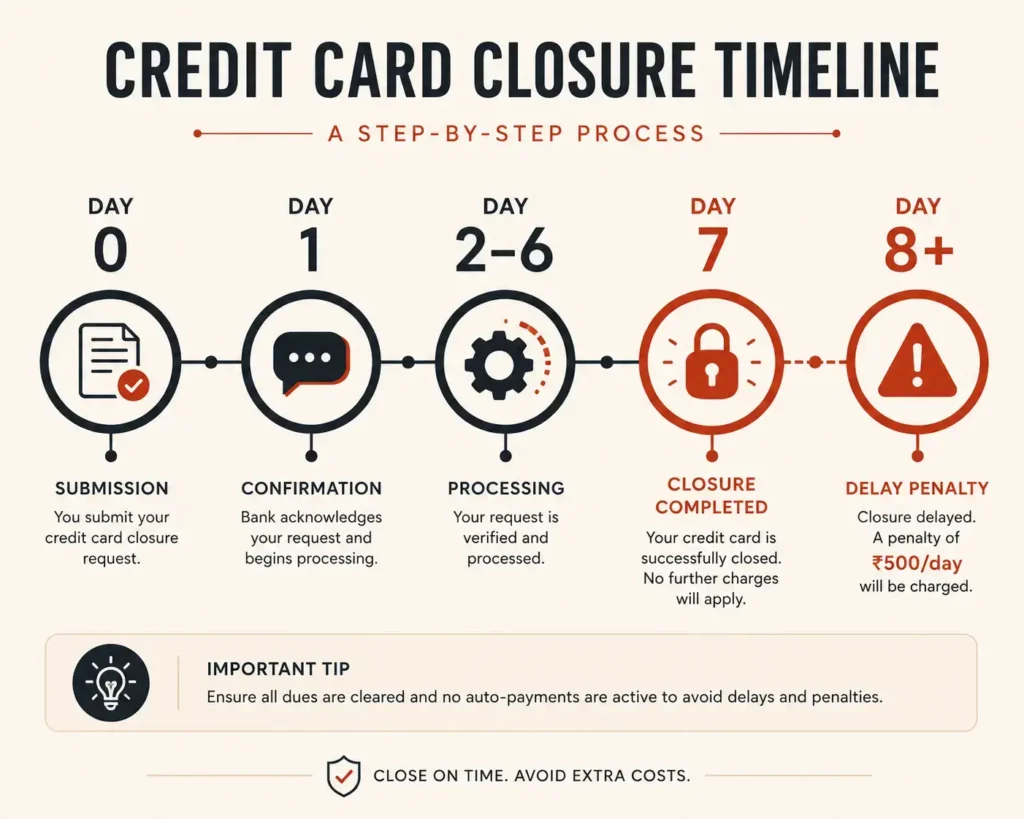
| Timeline Stage | Standard RBI Expectation | What Happens If Violated |
|---|---|---|
| Submission of Request (Day 0) | Bank must acknowledge immediately via email/SMS | Violation of customer service guidelines |
| Processing Window (Days 1 to 7) | Bank verifies zero outstanding and initiates closure | No penalty yet, but card must be unusable |
| Day 8 onwards | Card must be fully closed and reported to credit bureaus | ₹500 per day penalty starts accruing to the customer |
How to Initiate a Bulletproof Credit Card Closure
You cannot claim compensation if you do not request closure correctly. If you just mention to a phone banker during a casual call that you are “thinking about closing the card,” the clock does not start. You need a paper trail that no bank lawyer can dispute. Having a formal record is vital when claiming your credit card closure delayed bank compensation India.
1. Clear Every Single Paisa (Including Unbilled Dues)
The most common excuse banks use to reject a closure request is “pending dues.” This does not just mean the total amount on your last statement. It includes any transactions you made after the statement generation date, pending EMIs, and annual fees that might have accrued. Log into your net banking app, check your unbilled transactions, and pay the exact amount. It is always safer to pay a few rupees extra to keep your balance in the negative (which the bank must refund to you anyway).
2. Use Official, Trackable Channels
Do not rely on verbal promises. Use the bank’s dedicated portal, send an email from your registered email address to the card services division, or use their official mobile app. If you are submitting a physical letter at a branch, ensure you get a stamped and signed acknowledgment receipt from the branch manager. The date on this receipt or the timestamp on your email is Day 0 of your 7-day window. If they fail to meet this window, you can officially file for credit card closure delayed bank compensation India.
3. Cancel Recurring Mandates
If you have linked your credit card to auto-pay your Netflix subscription, your utility bills, or your Swiggy One membership, cancel them immediately. If an auto-debit hits your card on Day 3 of your closure request, the bank has a valid reason to halt the closure process. They will claim the account has active transactions, and your 7-day clock resets to zero.
Step-by-Step Guide to Claiming Your Credit Card Closure Delayed Bank Compensation India
If the 7-day window has closed and your card is still active, you are now in the compensation zone. Do not expect the bank to voluntarily credit this money. You have to demand it. Here is the exact escalation path to ensure you get paid.
Step 1: Write to the Principal Nodal Officer (PNO)
Skip the standard customer care line. The entry-level agents on the phone do not have the authority to approve compensation payouts, and they will likely waste your time with scripted apologies. Instead, find the email address of the bank’s Principal Nodal Officer (PNO). You can easily find this on the bank’s “Grievance Redressal” page.
Send a direct, emotionless email. State your card details, the date of your closure request, the date the card was actually closed (or state that it is still open), and calculate the exact number of days of delay. Quote the RBI Master Direction on Credit and Debit Cards. Demand that the accrued credit card closure delayed bank compensation India of ₹500 per day be credited to your linked bank account within 3 working days.
Step 2: File a Complaint on the RBI CMS Portal
If the PNO ignores your email or rejects your claim with a flimsy excuse, do not argue. Immediately file a complaint on the RBI’s Complaint Management System (CMS) portal. This is the ultimate weapon for Indian banking consumers.
Upload your original closure request email, the acknowledgment receipt, and your follow-up emails to the PNO. When a complaint enters the RBI CMS system, it is flagged at the highest levels of the bank’s compliance department. Banks hate RBI complaints because too many unresolved complaints can lead to regulatory audits and penalties that far exceed your credit card closure delayed bank compensation India claim.
Step 3: Monitor Your CIBIL Score
While fighting for your compensation, check your CIBIL score. Lenders are legally required to report the closure of a credit card to credit bureaus within 30 days of closure. If the bank delayed your closure and then reported you as an “active” cardholder with zero usage, or worse, reported late fees on a card you tried to close, raise a dispute on the CIBIL portal immediately. You can learn more about managing your credit health in our guide on how to Build or Restore an Emergency Fund Without Feeling Broke in 2026, which covers the fundamentals of maintaining a clean credit profile.
FAQs
Can the bank refuse to close my card if I have reward points left?
No, the bank cannot refuse closure over unused reward points. However, under RBI rules, they must give you the option to redeem those points before closure or explain how those points will be handled upon termination of the account.
What if I have a credit balance on my card at the time of closure?
The bank must transfer any credit balance (extra money you paid) back to your linked bank account. They cannot use a credit balance as an excuse to delay the closure of your card past the 7-day limit. Any such delay will make them liable under the credit card closure delayed bank compensation India framework.
Does the ₹500 daily penalty apply to co-branded credit cards?
Yes, the RBI guidelines apply to all credit cards issued by banks and NBFCs in India, including co-branded cards issued in partnership with brands like Amazon, Flipkart, or airline partners.
Final Thoughts
Your financial journey is defined by what you tolerate. Letting a bank ignore your closure request because “it’s too much hassle to follow up” is a quiet drain on your financial energy. It leaves your credit profile messy and exposes you to administrative errors that can damage your CIBIL score for years.
The RBI created these compensation rules to shift the power back to you, the consumer. If a bank took 15 days to close your card, they owe you ₹4,000. That is not a small fee; it is your money, legally protected by the central bank under the credit card closure delayed bank compensation India mandate. Take thirty minutes today to audit your open accounts, identify any old cards you no longer use, and initiate the closure process with confidence.
If you want to take complete control of your financial life beyond just managing credit cards, start by laying a solid foundation. Take a look at our detailed breakdown of the 50 30 20 Rule India: 5 Proven Steps to Budget Your Salary to ensure your cash flow is working for you, not your lenders.

This article is for educational purposes only and does not constitute financial advice. Figures, examples, and outcomes are illustrative and vary based on individual circumstances and lender policies. Always consult a certified financial advisor before making major financial decisions.