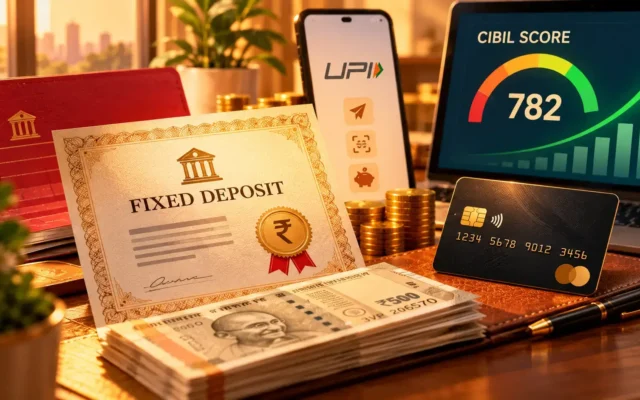


CIBIL Score Explained – 7 Important Facts Indians Must Know
What Is a CIBIL Score and How Does It Work in India?
If you’ve ever applied for a credit card, personal loan, bike loan, or home loan in India, chances are the bank checked your CIBIL score before making a decision.
For many Indians, this number quietly controls major financial opportunities.
A low CIBIL score can lead to:
- Loan rejection
- Higher interest rates
- Lower credit card limits
- Delayed approvals
- Financial stress during emergencies
Meanwhile, a strong CIBIL score can make banks trust you faster.
But most people still don’t fully understand how CIBIL actually works.
Let’s break it down in simple language.
What Is CIBIL?
TransUnion CIBIL is India’s oldest and most widely used credit bureau.
CIBIL stands for:
Credit Information Bureau (India) Limited
It collects and maintains records of your borrowing and repayment history from:
- Banks
- NBFCs
- Credit card companies
- Financial institutions
Based on this data, CIBIL generates your credit score, usually ranging from 300 to 900.
The higher your score, the safer you appear to lenders.
What Is a CIBIL Score?
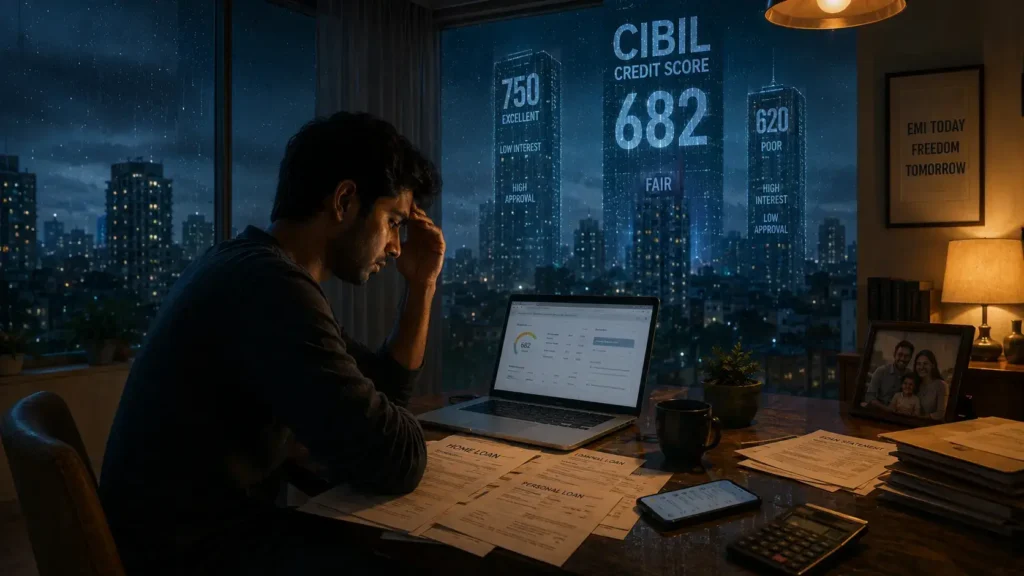
A CIBIL score is a 3-digit number that reflects your creditworthiness.
In simple words:
It tells banks how responsibly you handle borrowed money.
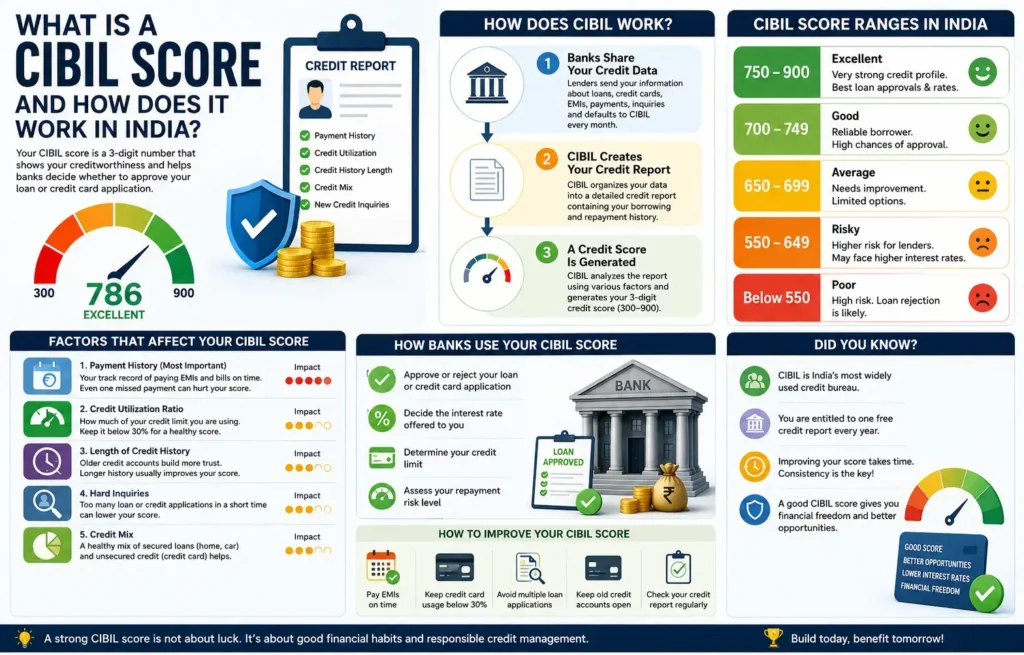
General CIBIL Score Ranges in India
| CIBIL Score | Meaning |
|---|---|
| 750–900 | Excellent |
| 700–749 | Good |
| 650–699 | Average |
| 550–649 | Risky |
| Below 550 | Poor |
Most Indian banks prefer borrowers with a score above 750.
How Does CIBIL Work?
Here’s the process in a simple step-by-step format.
Step 1: Banks Share Your Credit Data
Whenever you:
- Use a credit card
- Pay EMIs
- Take a loan
- Miss a payment
- Settle debt
- Apply for new credit
your lender sends this information to CIBIL.
This usually happens every month.
Step 2: CIBIL Creates Your Credit Report
CIBIL organizes all your financial borrowing activity into a detailed credit report.
This includes:
- Active loans
- Closed loans
- Credit card usage
- EMI payment history
- Late payments
- Loan inquiries
- Credit limits
- Defaults or settlements
Step 3: A Credit Score Is Generated
Using this data, CIBIL calculates your score using various risk factors.
The exact formula is private, but these factors matter most:
Factors That Affect Your CIBIL Score
1. Payment History (Most Important)
This has the biggest impact.
If you regularly:
- Miss EMIs
- Delay credit card payments
- Default on loans
your score can drop sharply.
Even one missed payment can stay on your report for years.
2. Credit Utilization Ratio
This means:
How much of your credit card limit you are using.
Example:
- Credit limit = Rs. 1 lakh
- Spending = Rs. 80,000
Your utilization is 80%.
Experts usually recommend staying below 30%.
High usage signals financial stress.

3. Length of Credit History
Older accounts improve trust.
Someone responsibly using a credit card for 8 years usually looks safer than someone who started 6 months ago.
4. Hard Inquiries
Every time you apply for a loan or credit card, lenders check your report.
Too many applications in a short period can reduce your score.
Banks may think:
“This person urgently needs money.”
5. Credit Mix
Having different types of credit helps.
Example:
- Home loan
- Credit card
- Car loan
A balanced mix is viewed positively compared to only unsecured debt.
How Banks Use Your CIBIL Score
Banks use your score to decide:
- Whether to approve your loan
- What interest rate to offer
- Your credit card limit
- Your repayment risk level
For example:
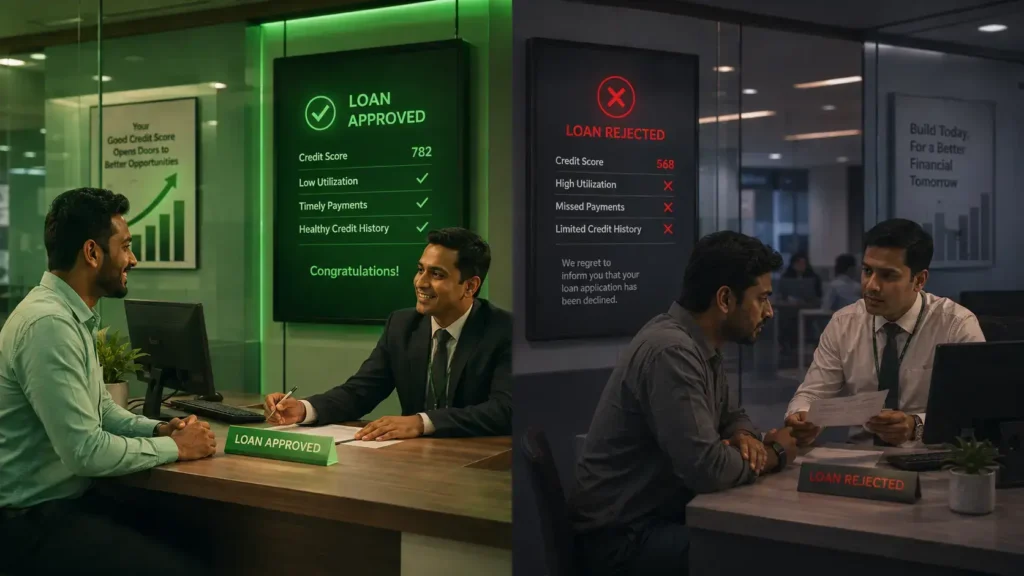
A salaried employee in Hyderabad earning Rs. 85,000 monthly may still face loan rejection if their CIBIL score is below 650 due to past missed payments.
Meanwhile, another applicant earning less but maintaining a score above 780 may get faster approvals and lower interest rates.
That’s how powerful this number becomes.
What Happens If Your CIBIL Score Is Low?
A poor score can create multiple problems:
- Personal loan rejection
- Home loan delays
- Higher EMI burden
- Security deposit requirements
- Lower negotiation power with lenders
And emotionally, it can become exhausting.
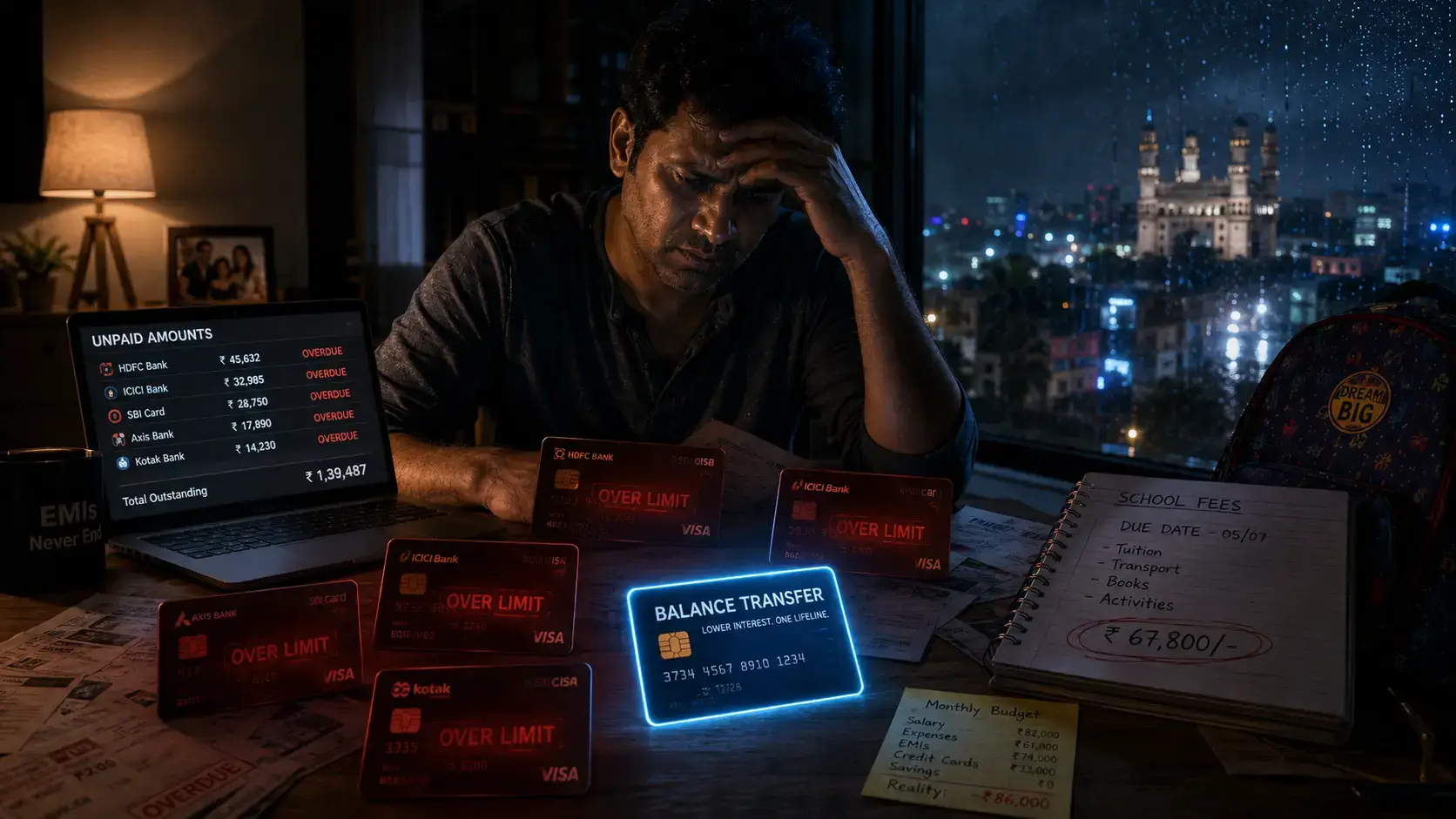
Many Indian families appear financially stable from outside while silently struggling with credit card debt, EMI pressure, and rising living costs.
A damaged CIBIL score often becomes the hidden consequence of that pressure.
How to Improve Your CIBIL Score
Here are practical steps that genuinely help.
Pay Every EMI on Time
Payment history is one of the major factors generally considered in credit scoring — bureaus don’t publish exact weightings, but consistent on-time payments are widely understood to matter a great deal.
Even minimum delays hurt your profile.
Set:
- UPI reminders
- Auto-debit mandates
- Calendar alerts

Reduce Credit Card Usage
Try to keep utilization below 30%.
If your limit is Rs. 1 lakh:
Avoid regularly crossing Rs. 30,000.
Explore What Is Debt Consolidation? Stop Paying 36% Interest on Credit Cards in India
Avoid Multiple Loan Applications
Applying everywhere damages your score.
Instead:
Research eligibility first.
Don’t Close Old Credit Cards Quickly
Old accounts help build credit history.
Closing your oldest card can sometimes reduce your score.
Check Your Credit Report for Errors
Mistakes happen surprisingly often.
Incorrect late payments or outdated loan status can hurt your score unfairly.
You should review your report periodically.
How Long Does It Take to Improve a CIBIL Score?
Usually:
- Small improvements: 2–3 months
- Significant recovery: 6–12 months
- Severe damage recovery: 1–2 years
Consistency matters more than shortcuts.
There’s no instant “hack.”
Difference Between CIBIL and Credit Report
People often confuse these terms.
CIBIL Score
A 3-digit summary number.
Credit Report
A detailed document containing your entire borrowing history.
Banks usually check both.
Is CIBIL the Only Credit Bureau in India?
No.
India has multiple licensed credit bureaus:
However, CIBIL remains the most recognized among lenders.
Can You Check Your CIBIL Score for Free?
Yes.
You can check your score through:
- Official CIBIL website
- Banking apps
- Fintech platforms
Under RBI rules, consumers are entitled to free annual credit reports.
You can also verify details from the Reserve Bank of India (RBI) and TransUnion CIBIL Official Website.
Common Myths About CIBIL Scores
“Checking my own score reduces it.”
False.
Self-checks are considered soft inquiries and do not reduce your score.
“Debit card usage improves CIBIL.”
False.
Only credit-related products affect your score.
“Closing all loans improves score.”
Not always.
Responsible long-term credit behaviour matters more.
Why CIBIL Matters More Today
India’s credit ecosystem is expanding rapidly.
Today, people rely heavily on:
- Credit cards
- BNPL apps
- Instant loans
- Consumer durable EMIs
- App-based lending
This means your financial reputation is increasingly digital.
A strong CIBIL score can quietly save lakhs of rupees through lower interest rates over time.
A weak score can make financial emergencies even harder.
Related reading: how a credit card works and how banks respond to a missed payment.
Related reading: this article explains how a CIBIL score is built. To see how specific actions would change it, use the CIBIL Score Impact Simulator, and see the CIBIL & Credit Center for all our credit-score guides and tools.
Frequently Asked Questions (FAQs)
What is a good CIBIL score in India?
A good CIBIL score in India is usually considered 750 or above. Most banks and NBFCs prefer borrowers with scores in this range because it signals responsible repayment behaviour and lower lending risk.
Can I get a loan with a low CIBIL score?
Yes, but it becomes more difficult. If your CIBIL score is below 650, lenders may:
Reject your application
Offer smaller loan amounts
Charge higher interest rates
Ask for additional documentation or guarantors
Some banks may still approve secured loans even with a low score.
How often does the CIBIL score update?
Your CIBIL score generally updates every 30–45 days after lenders submit fresh repayment and credit usage data to the credit bureau.
If you recently cleared dues or reduced credit card balances, improvements may take a few weeks to reflect.
Does checking my own CIBIL score reduce it?
No. Checking your own CIBIL score is considered a soft inquiry, which does not impact your score.
Only lender checks during loan or credit card applications are treated as hard inquiries.
How can I improve my CIBIL score quickly?
You can improve your CIBIL score faster by:
Paying EMIs and credit card bills on time
Reducing credit utilization below 30%
Avoiding multiple loan applications
Clearing overdue balances
Keeping older credit accounts active
Most people start seeing noticeable improvements within 3–6 months of disciplined repayment behaviour.
What happens if I miss one EMI payment?
Even a single missed EMI can negatively affect your CIBIL score, especially if the delay crosses 30 days.
The impact depends on:
How late the payment was
Your previous repayment history
Existing debt levels
Consistent on-time payments afterward can gradually rebuild your score.
Is CIBIL score important for credit cards?
Yes. Banks heavily use your CIBIL score when approving credit cards.
A higher score can help you get:
Premium cards
Higher credit limits
Better rewards
Lower interest rates
A poor score may lead to rejection or lower limits.
How long does bad credit history stay in CIBIL?
Negative records like defaults, settlements, or missed payments can remain in your credit history for several years, depending on lender reporting and bureau policies.
However, their impact reduces gradually if you maintain healthy repayment habits afterward.
Is CIBIL different from Experian and Equifax?
Yes. TransUnion CIBIL, Experian, and Equifax are separate credit bureaus operating in India.
Different lenders may use different bureaus, although CIBIL remains the most widely recognized.
Can salaried employees and self-employed people both have CIBIL scores?
Yes. Both salaried and self-employed individuals can build and maintain CIBIL scores if they use credit products such as:
Credit cards
Personal loans
Business loans
Home loans
Consumer durable EMIs
Your profession does not matter as much as your repayment behaviour.
Conclusion
Your CIBIL score is not just a number.
It’s a financial trust signal.
And for many Indians dealing with rent pressure, rising fuel prices, family responsibilities, and EMI stress, maintaining that trust can feel difficult sometimes.
But improvement is absolutely possible.
Even small habits help:
- Paying bills on time
- Lowering credit card usage
- Avoiding unnecessary loans
- Monitoring your report regularly
Most people ignore their credit health until a loan gets rejected.
That’s usually when the panic begins.
Checking your score early is far easier than repairing major financial damage later.
Money mistakes feel heavy when you’re carrying them alone. But they can be fixed — one disciplined step at a time.
DISCLAIMER: Loan approval, interest rates, and credit policies vary by lender and applicant profile. Verify directly with banks and official credit bureaus before applying.
Author
InvestingLens Editorial Team
The InvestingLens Editorial Team creates deeply researched, India-first personal finance content focused on credit scores, loans, investing, banking, taxation, and financial planning. Our content is designed to simplify complex financial topics using practical Indian examples, RBI guidelines, and real-world money situations faced by salaried employees, freelancers, and middle-class families.
This article was researched using official banking resources, RBI guidelines, and current Indian credit bureau practices as of May 2026.
For official verification and consumer awareness, readers are encouraged to refer to:

This article is for educational purposes only and does not constitute financial advice. Figures, examples, and outcomes are illustrative and vary based on individual circumstances and lender policies. Always consult a certified financial advisor before making major financial decisions.
One Email a Week. Five Things Worth Knowing.
- One important financial change that actually affects you
- One practical money lesson
- One useful calculator
- One common mistake to avoid
- One guide worth reading