


How Credit Counseling Works in India
A note on the examples: the people named in this article (Rahul, Sneha, Arvind, Priya, Amit) are imagined characters with round-number figures, used to show how the calculations and risks work. They are not real individuals or documented cases.
How Credit Counseling Works: The Indian Middle-Class Survival Guide to Escaping Debt Traps
Introduction
How Credit Counseling Works is something most Indians only search for after the damage is already done. Usually after the third recovery call, after the credit card EMI bounces, or after realizing that the “minimum due” trap quietly doubled their debt.
Here’s the blunt truth: credit counseling is not magic. It will not erase your loans overnight. But if used correctly, it can stop financial bleeding, help restructure debt, improve repayment discipline, and slowly rebuild your CIBIL score before your finances collapse completely.
In India, millions of middle-class families are silently drowning in personal loans, Buy Now Pay Later apps, and credit card debt. RBI data already shows rising unsecured lending pressure, especially among salaried urban households. One bad year — job loss, medical emergency, startup failure, divorce, or even reckless lifestyle inflation — can push a ₹3 lakh debt into a ₹7 lakh nightmare.
This guide explains How Credit Counseling Works using illustrative Indian examples, RBI-backed frameworks, Rupee calculations, debt settlement risks, CIBIL impact, and the costly mistakes most families make too late.

Key Takeaways Box
- How Credit Counseling Works starts with a complete review of your income, expenses, debts, and repayment behavior.
- Good credit counseling focuses on budgeting, repayment restructuring, and financial discipline — not fake “loan waivers.”
- RBI-authorized counseling centers exist through banks and financial literacy programs.
- Credit counseling can help avoid loan defaults and long-term CIBIL damage.
- Minimum due payments on credit cards are one of the biggest financial traps in India.
- Debt settlement and credit counseling are NOT the same thing.
- Families earning ₹50,000–₹1.5 lakh monthly are the most vulnerable to lifestyle-driven debt spirals.
- Genuine counselors educate first. Scammers promise “instant debt removal.”
- Credit counseling works only if spending behavior changes permanently.
- Emotional stress, shame, and denial destroy finances faster than interest rates.
What Is Credit Counseling and Why Indians Are Suddenly Searching for It
Most people searching How Credit Counseling Works are not financially irresponsible. They are financially overwhelmed.
That’s an important difference.
A Bengaluru IT employee earning ₹1.2 lakh monthly can still end up broke. A Hyderabad couple earning ₹18 lakh annually can still default on EMIs. Why? Because debt problems in India rarely start with stupidity. They usually start with optimism.
One personal loan becomes two.
One credit card becomes four.
One EMI becomes twelve.
Then suddenly 65% of monthly salary disappears before the month even begins.
That is where understanding How Credit Counseling Works becomes critical.
Credit counseling is a structured financial guidance process where trained counselors help borrowers:
- Analyze debt
- Review spending patterns
- Create repayment plans
- Negotiate manageable structures
- Improve financial habits
- Prevent defaults
- Rebuild financial stability
Unlike social media “finance gurus,” real counselors don’t scream “invest in crypto” or “10X your money.” They focus on survival first.
In India, many counseling programs are linked to financial literacy initiatives supported by the Reserve Bank of India and banks under borrower assistance frameworks. Genuine counselors help people understand repayment obligations, interest calculations, credit behavior, and budgeting.
You can also learn more about debt management through SEBI Investor Education.
Internal resources:
The Indian Debt Explosion Nobody Wants to Admit
Let’s talk reality.
In 2012, most middle-class Indian households feared debt.
In 2026, debt has become normalized.
Swiggy installments.
iPhone EMIs.
Travel-now-pay-later schemes.
Instant personal loans on apps.
Zero-cost EMI televisions.
Wedding loans.
Bike upgrades.
Furniture financing.
The average salaried Indian today is running a mini-banking ecosystem from their phone.
That’s why searches for How Credit Counseling Works are exploding.

Rahul Story From Pune (Imagined)
Rahul, 33, worked in a multinational IT company earning ₹92,000 monthly after taxes.
Sounds stable, right?
Here’s where things collapsed:
| Expense Type | Monthly EMI |
|---|---|
| Car Loan | ₹16,500 |
| Credit Card EMI | ₹12,000 |
| Personal Loan | ₹14,800 |
| Furniture EMI | ₹5,500 |
| BNPL Apps | ₹4,200 |
| Bike Loan | ₹6,100 |
Total fixed obligations: ₹59,100
After rent and groceries, Rahul had almost nothing left.
Then layoffs hit.
His income dropped to ₹58,000 through freelance work.
Now the math became deadly.
He started paying only minimum dues.
His ₹1.8 lakh card balance carried nearly 36–42% annualized interest.
Within 24 months:
| Item | Amount |
|---|---|
| Original Debt | ₹1.8 lakh |
| Interest + Penalties | ₹1.1 lakh |
| Total Outstanding | ₹2.9 lakh |
This is exactly why understanding How Credit Counseling Works matters before panic begins.
A counselor eventually helped Rahul:
- Freeze unnecessary spending
- Consolidate high-interest debt
- Negotiate repayment sequencing
- Build a survival budget
- Avoid full default
But the painful part?
He could have avoided almost all damage one year earlier.
The Uncomfortable Truth
Here’s the uncomfortable truth.
Most Indians don’t have an income problem.
They have an identity problem.
People earning ₹70,000 try to look like people earning ₹2 lakh.
Instagram lifestyles are now financed through EMIs.
The real danger is not debt itself.
The real danger is normalized debt.
When people stop feeling emotional pain while borrowing, disaster starts quietly.
How Credit Counseling Works Inside Banks and Financial Institutions
To truly understand How Credit Counseling Works, you need to know what actually happens during a counseling session.
Most people imagine:
- a scary bank officer
- humiliation
- recovery threats
- legal notices
Good counseling is supposed to be the opposite.
The process usually includes:
- Financial Assessment
- Debt Analysis
- Budget Planning
- Repayment Strategy
- Negotiation Guidance
- Financial Education
- Credit Behavior Correction
Some banks in India offer structured borrower assistance programs aligned with RBI financial literacy frameworks.
You can check official borrower awareness initiatives through:
Internal reading:
Step 1: Full Financial Autopsy
The first thing counselors do is uncomfortable but necessary.
They open every number.
No hiding.
No emotional excuses.
No “next month will be better.”
A proper counseling session examines:
| Category | What Gets Reviewed |
|---|---|
| Salary | In-hand income |
| Fixed Costs | Rent, EMI, school fees |
| Debt | Loans, cards, BNPL |
| Savings | Emergency reserves |
| Insurance | Health & life coverage |
| Spending Habits | Food delivery, shopping |
| Credit Score | CIBIL behavior |
| Late Payments | Existing defaults |
This stage alone shocks many borrowers.
Why?
Because most Indians never calculate their total debt burden honestly.

Sneha and Arvind Story From Hyderabad (Imagined)
Combined monthly salary: ₹1.85 lakh.
Looked financially successful.
Reality:
- 3 credit cards
- ₹11 lakh personal loans
- ₹28 lakh home loan
- International vacation EMI
- Wedding gold loan
They were spending ₹1.34 lakh monthly before groceries.
When the counselor mapped their finances, the couple realized:
- 72% income already committed
- savings rate nearly zero
- emergency fund = ₹18,000 only
One medical emergency could have destroyed them financially.
This is exactly where How Credit Counseling Works becomes life-changing.
Not because the counselor magically removed debt.
Because the counselor forced financial clarity.
Step 2: Debt Prioritization Strategy
Not all debt is equally dangerous.
A good counselor identifies:
- highest interest loans
- legal-risk loans
- emotionally destructive debt
- short-term survival priorities
Example:
| Debt Type | Interest Rate |
|---|---|
| Credit Card | 42% |
| Personal Loan | 18% |
| Home Loan | 9% |
| Gold Loan | 14% |
The biggest emergency is usually revolving credit card debt.
Why?
Because compounding works against you violently.
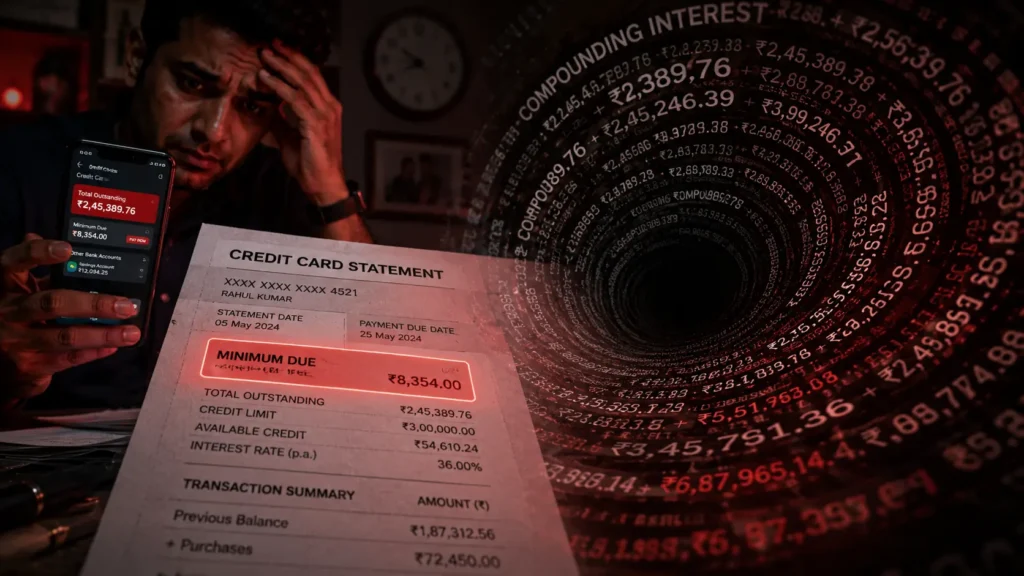
Minimum Due Trap
Suppose:
- Outstanding card balance = ₹3 lakh
- Interest = 3.5% monthly
- Minimum payment = 5%
If borrower keeps paying minimum due:
| Year | Approx Balance Paid |
|---|---|
| 1 | ₹1.1 lakh |
| 3 | ₹3.8 lakh |
| Remaining Debt | Still active |
This is financial quicksand.
Understanding How Credit Counseling Works means understanding how repayment sequencing changes outcomes dramatically.
Step 3: Budget Reconstruction
This is the part people hate most.
Because this is where lifestyle fantasies die.
Counselors often force hard conversations:
- downgrade apartment?
- sell second car?
- stop luxury subscriptions?
- reduce eating out?
- pause vacations?
- delay gadget upgrades?
It’s Not About the Coffee
The ₹450 coffee is not the real problem.
The problem is needing emotional validation through spending.
Debt counseling fails when behavior stays unchanged.
A person cannot finance:
- premium lifestyle
- luxury travel
- expensive gadgets
- high SIP goals
- social comparison
all at the same time on a middle-class salary.
Math always wins eventually.
Budget Reset Example
Before Counseling
| Category | Monthly Spend |
|---|---|
| Dining Out | ₹14,000 |
| EMI | ₹63,000 |
| Shopping | ₹11,500 |
| OTT & Apps | ₹4,200 |
| Groceries | ₹13,000 |
| Fuel | ₹9,500 |
Total = ₹1.15 lakh
After Counseling
| Category | Monthly Spend |
|---|---|
| Dining Out | ₹4,500 |
| EMI | ₹63,000 |
| Shopping | ₹2,500 |
| OTT & Apps | ₹800 |
| Groceries | ₹11,000 |
| Fuel | ₹7,000 |
Total = ₹88,800
Monthly savings improvement = ₹26,200
That single difference can prevent long-term default.
And that is one of the most practical outcomes of understanding How Credit Counseling Works properly.
The Hidden Psychology Behind Debt: Why Most Credit Counseling Fails
By now, you understand the technical side of How Credit Counseling Works. But here’s the uncomfortable reality most financial blogs avoid saying:
Debt is rarely just a math problem.
Debt is usually:
- stress
- ego
- comparison
- denial
- emotional spending
- family pressure
- lifestyle addiction
That’s why many people complete counseling sessions… and still end up back in debt two years later.
Understanding How Credit Counseling Works properly means understanding behavioral finance first.

The Emotional Debt Spiral Most Indians Never Notice
A lot of middle-class Indians don’t borrow because they’re irresponsible.
They borrow because they’re exhausted.
Long office hours.
Family obligations.
Social pressure.
Children’s school fees.
Wedding expectations.
Then spending becomes emotional relief.
A ₹3,000 Swiggy order feels “deserved.”
A ₹1.2 lakh iPhone becomes “motivation.”
A Goa trip becomes “mental health.”
The problem is not one expense.
The problem is repeated emotional borrowing.
That’s where How Credit Counseling Works becomes deeper than just budgeting.
Good counselors identify:
- emotional triggers
- impulsive spending patterns
- financial denial behavior
- lifestyle inflation habits
Without fixing those, repayment plans collapse eventually.
Official financial literacy programs from the Reserve Bank of India repeatedly stress responsible borrowing and financial awareness.
You can also study investor discipline frameworks via AMFI India.
Internal reading:
Priya (Imagined) Story From Chennai
Priya earned ₹78,000 monthly in a pharmaceutical company.
No major family responsibilities.
No medical emergency.
No job loss.
Yet she accumulated:
- ₹4.6 lakh credit card debt
- ₹2 lakh BNPL liabilities
- ₹1.8 lakh app-based instant loans
What happened?
Emotional spending.
Every stressful work week triggered online shopping.
Every bad month triggered vacations.
Every anxiety phase triggered food delivery spending.
When she finally explored How Credit Counseling Works, the counselor identified something shocking:
Her debt problem was actually a stress management problem.
The financial plan included:
- spending tracking
- autopay discipline
- debt snowball strategy
- removing shopping apps
- reducing credit limits
- therapy recommendation
That combination slowly stabilized her finances.
Not instantly.
But realistically.
The Real Problem
Here’s the real problem.
A lot of people say:
“I deserve this.”
But debt does not care what you deserve.
Interest compounds regardless of emotions.
Banks don’t calculate EMIs based on your intentions.
They calculate based on outstanding balance.
The middle class often tries to reward itself before building financial stability.
That sequence destroys long-term wealth.
Debt Management Plans: The Core Engine Behind How Credit Counseling Works
One of the most misunderstood parts of How Credit Counseling Works is the Debt Management Plan (DMP).
People hear “debt management” and imagine:
- loan waivers
- debt cancellation
- legal escape routes
That’s not how legitimate systems work.
A Debt Management Plan is usually a structured repayment strategy designed to:
- organize debt
- reduce financial chaos
- prioritize repayments
- avoid default escalation
- improve repayment consistency
Some counseling agencies help borrowers negotiate revised payment schedules with lenders.
But understand this clearly:
No genuine counselor promises “100% debt removal.”
That’s usually a scam.
You can verify borrower protection and grievance frameworks through:
Internal resources:
How Debt Management Plans Actually Work
Here’s the typical flow inside a structured counseling process.
Step 1: Debt Mapping
All liabilities are listed.
Example:
| Debt Type | Outstanding | Interest |
|---|---|---|
| Credit Card A | ₹2.2 lakh | 42% |
| Credit Card B | ₹1.1 lakh | 39% |
| Personal Loan | ₹4.5 lakh | 17% |
| Consumer EMI | ₹85,000 | 15% |
Total debt = ₹8.65 lakh
Step 2: Essential Expense Protection
Before repayment planning, counselors calculate survival expenses.
| Essential Category | Monthly Cost |
|---|---|
| Rent | ₹18,000 |
| Groceries | ₹12,000 |
| School Fees | ₹8,000 |
| Insurance | ₹4,000 |
| Utilities | ₹5,000 |
Total essentials = ₹47,000
Suppose salary = ₹82,000.
Available for debt repayment:
₹35,000.
This becomes the realistic repayment base.
That is a core reason understanding How Credit Counseling Works matters — because most borrowers attempt impossible repayment schedules emotionally instead of mathematically.
Step 3: Repayment Prioritization
Counselors may recommend:
- highest interest first
- smallest balance first
- legal-risk first
- settlement evaluation
- restructuring requests
Different borrowers require different strategies.
Example: Avalanche Strategy
| Debt | Interest | Priority |
|---|---|---|
| Credit Card A | 42% | 1 |
| Credit Card B | 39% | 2 |
| Personal Loan | 17% | 3 |
Eliminating high-interest debt first saves huge amounts long-term.
Hard Math: Why Timing Matters
Suppose someone delays repayment action by 24 months.
Scenario A — Immediate Action
| Debt | Amount |
|---|---|
| Initial Credit Card Debt | ₹3 lakh |
| Interest Burden | ₹1.1 lakh |
| Total Repayment | ₹4.1 lakh |
Scenario B — Delayed Action
| Debt | Amount |
|---|---|
| Initial Debt | ₹3 lakh |
| Interest + Penalties | ₹3.8 lakh |
| Legal & Collection Costs | ₹60,000 |
| Total | ₹7.4 lakh |
That’s the hidden danger people ignore until too late.
This is exactly why understanding How Credit Counseling Works early matters enormously.
The 9-Layer Transformation Story
1. Status Quo
Amit Verma, 37, lived in Gurgaon with his wife and daughter. Salary: ₹1.45 lakh monthly.
Outwardly successful.
Inside? Financial collapse.
Three credit cards maxed out.
Personal loan for wedding expenses.
SUV EMI.
Luxury apartment rent.
International vacation debt.
Monthly obligations crossed ₹1.08 lakh.
Still, Amit kept telling himself:
“Next appraisal will fix this.”
2. Trigger
Then his company restructured.
Salary dropped by 28%.
Suddenly:
- EMIs bounced
- recovery calls started
- CIBIL score crashed below 650
That’s when he first searched:
How Credit Counseling Works
3. Mistake
Instead of reducing spending immediately, Amit made classic panic decisions:
- took another instant loan
- transferred balances repeatedly
- paid minimum dues
- hid debt from family
Debt climbed from ₹9 lakh to ₹14.7 lakh.
4. Wake-Up Call
One evening, his daughter asked:
“Why are bank people calling every day?”
That emotional hit broke denial.
5. The Painful Part
The counselor told Amit something painful:
“You don’t have an income problem. You have a lifestyle alignment problem.”
That sentence changed everything.
6. Calculation
The counselor mapped his reality.
| Category | Amount |
|---|---|
| Salary | ₹1.05 lakh |
| Fixed Survival Expenses | ₹48,000 |
| Available for Debt | ₹57,000 |
Then debt prioritization began.
Luxury spending stopped completely.
Second car sold.
Vacation canceled.
Credit cards frozen.
7. Pivot
Amit followed a structured repayment plan:
- avalanche strategy
- strict budgeting
- side freelance consulting
- debt tracking spreadsheet
- emergency fund creation
Most importantly: no new debt.
8. Result
After 32 months:
- personal loan closed
- two credit cards cleared
- CIBIL improved to 742
- emergency fund reached ₹4.8 lakh
Financial peace returned slowly.
Not magically.
9. Lesson
The biggest lesson Amit learned about How Credit Counseling Works was this:
Counseling cannot save someone committed to denial.
But it can completely transform someone willing to face reality honestly.
The Cost of Appearances
Middle-class Indians often spend years protecting appearances while silently destroying financial stability.
The irony?
Nobody actually cares about your luxury lifestyle as much as you think.
But your future self will absolutely care about compound debt.
Frequently Asked Questions About How Credit Counseling Works
Conclusion: The Real Truth About How Credit Counseling Works
The biggest misunderstanding about How Credit Counseling Works is believing it’s a shortcut.
It’s not.
Credit counseling is not:
- magic
- debt deletion
- instant freedom
- financial hacking
It’s structured financial honesty.
That’s what makes it powerful.
For many Indian middle-class families, the real breakthrough is not reducing debt.
The real breakthrough is finally facing the numbers honestly for the first time.
That moment changes everything.
The counselor becomes:
- part teacher
- part accountability partner
- part financial mirror
But none of it works unless behavior changes permanently.
A ₹1 lakh salary with discipline can create wealth.
A ₹3 lakh salary with denial can create disaster.
That’s the hard math modern India is learning.
If you’re already struggling:
- stop hiding
- stop emotional borrowing
- stop minimum-due dependency
- stop pretending next month will magically fix everything
Face the numbers early.
The earlier you understand How Credit Counseling Works, the more options you still have.


This article is for educational purposes only and does not constitute financial advice. Figures, examples, and outcomes are illustrative and vary based on individual circumstances and lender policies. Always consult a certified financial advisor before making major financial decisions.
One Email a Week. Five Things Worth Knowing.
- One important financial change that actually affects you
- One practical money lesson
- One useful calculator
- One common mistake to avoid
- One guide worth reading