

Emergency Fund Calculator India: How Much Is Your True Safety Net?
You are one medical emergency, one sudden corporate restructuring, or one critical car breakdown away from financial panic. It sounds harsh, but it is the reality of living in urban India today. When your income stops or an unexpected bill arrives, where do you turn? If your answer is to swipe your credit card or withdraw from your long-term mutual funds, you are setting yourself up for a painful debt cycle.
Most mainstream financial advice tells you to save a generic “three to six months of expenses” and call it a day. But that advice is dangerously incomplete. It does not account for your specific job security, your family dependants, or the rising cost of private healthcare in India. To build a bulletproof safety net, you need a personalized blueprint that reflects your actual life.
This guide will strip away the generic advice. By using our practical framework and the math behind a reliable emergency fund calculator India tool, you will discover exactly how many months of expenses you must keep in liquid cash to protect your family from financial ruin.
Try it yourself: Plug in your own numbers below.
Job searches rarely go exactly as planned — here's your shortfall at three common lengths.
| Scenario | Search length | Shortfall |
|---|
Key Takeaways
- Ditch the generic rules: A standard three-month safety net is often dangerously inadequate for single-income Indian households.
- Calculate true survival expenses: Your emergency fund should cover mandatory needs, not your lifestyle wants like Swiggy or weekend movie trips.
- Factor in your career risk: Tech professionals, freelancers, and business owners require a larger cash cushion than government employees.
- Keep it liquid: Emergency money belongs in high-yield savings accounts, sweeps, or liquid funds, not locked in volatile equities or long-term FDs with heavy premature withdrawal penalties.
- Protect your investments: Having a dedicated emergency fund prevents you from selling your long-term mutual funds during a market downturn.
Emergency fund calculator India
Use the calculator below, then read the rest of this guide to decide where to keep the money and how to build it.
Still to save: ₹0
Time to reach your target: –
Emergency fund targets: 3, 6, 9 and 12 months
If you are searching for a 6 month emergency fund calculator, this table shows the target for different monthly expenses. Pick the row closest to your essential expenses, not your total spending.
| Monthly essential expenses | 3 months | 6 months | 9 months | 12 months |
|---|---|---|---|---|
| ₹30,000 | ₹90,000 | ₹1,80,000 | ₹2,70,000 | ₹3,60,000 |
| ₹50,000 | ₹1,50,000 | ₹3,00,000 | ₹4,50,000 | ₹6,00,000 |
| ₹80,000 | ₹2,40,000 | ₹4,80,000 | ₹7,20,000 | ₹9,60,000 |
How long will it take to build?
Divide the gap by what you can save each month. For example, if your target is ₹3,00,000 and you have ₹50,000, the gap is ₹2,50,000. Saving ₹10,000 a month takes 25 months, and saving ₹5,000 takes 50 months. Start with one month of expenses, then grow it step by step. If you also have credit card debt, read our guide on emergency fund vs debt to decide what to do first.
The Brutal Reality of Financial Emergencies in India
We like to believe that bad things only happen to other people. We look at our monthly salary credit notification from ICICI Bank or HDFC Bank and feel secure. But economic shifts are highly unpredictable. If you lose your job tomorrow, how long can your household survive before you have to borrow money from relatives or take a high-interest personal loan?

The Double Whammy of Job Loss and Inflation
In the Indian corporate landscape, especially within high-paying sectors like IT and startups, job security is highly variable. Finding a comparable job with the same pay scale can take anywhere from three to nine months. During this job-hunting phase, your landlord still expects rent on the first of the month, your children’s school fees remain due, and your monthly grocery bill reflects persistent food inflation.
The Medical Expense Trap
While you might have corporate health insurance, those policies often come with clauses, co-payments, or exclusions for certain treatments. Furthermore, if you lose your job, your corporate cover vanishes instantly. Without cash on hand to pay hospital admission deposits, you may be forced to compromise on healthcare quality or borrow from predatory lenders. This is why having a dedicated cash reserve is non-negotiable.
Why Your CIBIL Score Depends on It
If you do not have liquid cash when an emergency strikes, you will likely default on your existing EMIs or miss credit card payments. This immediately damages your credit history. If you want to understand how these defaults harm your borrowing power, you can read about how to Build or Restore an Emergency Fund Without Feeling Broke in 2026 to see why protecting your CIBIL score is so critical.
How Many Months of Expenses Do You Actually Need?
There is no one-size-fits-all answer. The number of months you need to survive depends entirely on your household risk profile. To use an emergency fund calculator India framework effectively, you must first categorize your household into one of three risk categories.
Scenario 1: The Double-Income, Low-Risk Household (3 to 6 Months)
Consider Anirban and Sulochana, a married couple living in Bengaluru. Anirban is a government school teacher with high job security, and Sulochana works as a senior manager in an established public sector bank. They have no dependants and their combined monthly income is ₹1,50,000. Because their jobs are highly secure and they have two independent income streams, their risk profile is low. A 3 to 6-month emergency fund of survival expenses is perfectly adequate for them.
Scenario 2: The Single-Income, Moderate-Risk Household (6 to 9 Months)
Now consider Joaquim, a software engineer in Hyderabad. Joaquim earns ₹1,20,000 per month. His wife is a homemaker, and they have a four-year-old daughter. Joaquim also supports his retired parents. Since Joaquim is the sole breadwinner, his household risk is moderate to high. If he faces a layoff, his family’s entire financial engine stops. Joaquim needs a minimum of 6 to 9 months of expenses parked safely in liquid instruments.
Scenario 3: The Variable-Income, High-Risk Household (9 to 12 Months)
Finally, consider Khorshed, a freelance UI/UX designer based in Mumbai. Her monthly income fluctuates wildly—some months she makes ₹2,00,000, while other months she struggles to make ₹40,000. Because her cash flow is highly unpredictable and she has no corporate benefits, Khorshed is in the high-risk category. She needs a robust 9 to 12-month survival fund to manage the dry spells without experiencing severe anxiety.
Step-by-Step Guide to Calculating Your Emergency Fund
You cannot build a proper safety net if you do not know your actual survival number. To make this practical, let us look at how to calculate your bare-bones survival expenses. Your emergency fund does not need to cover your weekend dining out, premium streaming subscriptions, or luxury shopping. It only needs to cover the essentials required to keep your life running.
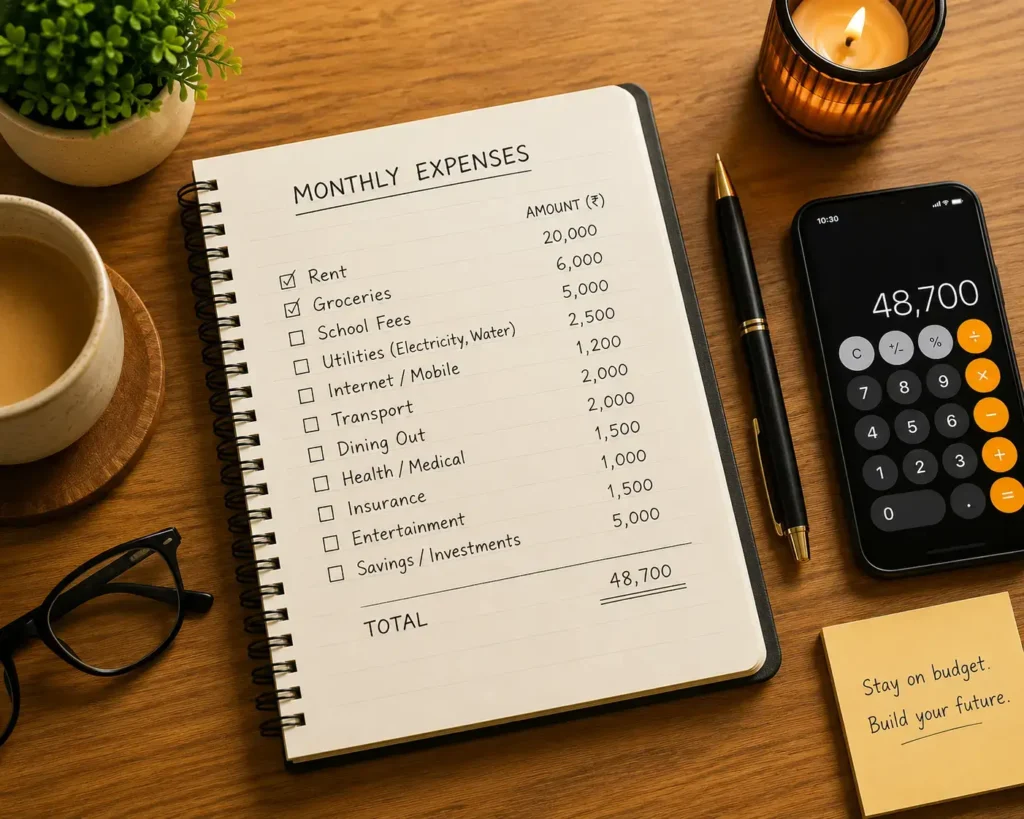
Let us look at a realistic monthly expense breakdown for a typical urban Indian family of three:
| Expense Category | Standard Monthly Cost (₹) | Emergency Survival Cost (₹) |
|---|---|---|
| Rent / Home Loan EMI | 25,000 | 25,000 |
| Groceries & Household Essentials | 12,000 | 8,000 |
| Children’s School Fees | 8,000 | 8,000 |
| Utilities (Electricity, Water, Internet, Mobile) | 5,000 | 3,500 |
| Medicines & Basic Insurance Premiums | 4,000 | 4,000 |
| Dining Out, Swiggy, & Entertainment | 10,000 | 0 |
| Total Monthly Expenses | 64,000 | 48,500 |
In this scenario, while the family’s regular monthly outflow is ₹64,000, their actual survival expense is ₹48,500. If they determine that their risk profile requires a 6-month safety net, they do not need to save ₹3,84,000 (which is 64,000 x 6). Instead, they need to target ₹2,91,000 (which is 48,500 x 6). Knowing this realistic target makes the savings goal far more achievable.
How to Use an Emergency Fund Calculator India Method
To find your target using this emergency fund calculator India methodology, use this simple three-step formula:
Step 1: List all your non-negotiable monthly payments (Rent, EMIs, basic food, utilities, insurance, school fees).
Step 2: Determine your risk multiplier based on your job stability and family dependants (3, 6, 9, or 12 months).
Step 3: Multiply your survival expenses by your risk multiplier. This is your target safety net goal.
Once you know this number, you can adjust your budget to start accumulating this cash. If you are trying to find the extra cash to fund this safety net, mastering your monthly allocations is key. You can learn how to structure your income effectively by reading about the The 50/30/20 Rule in India: How to Budget Your Salary.
Where Should You Keep Your Emergency Fund?
The primary purpose of an emergency fund is capital preservation and instant liquidity. This is not money you are trying to grow aggressively; this is money that must be there when everything else is falling apart. Do not chase high returns with this cash. When choosing where to park this money, it is wise to stick to highly regulated options approved by the RBI (Reserve Bank of India) or SEBI.
1. High-Yield Savings Accounts and Sweep-In FDs
Keeping your entire emergency fund in a standard savings account earning 3% interest is inefficient. Instead, consider using a sweep-in facility (also known as a multi-option deposit scheme) with your primary bank. This automatically transfers any balance above a certain threshold into a Fixed Deposit (FD) earning higher interest, while keeping the funds instantly accessible if you swipe your debit card or withdraw cash.
2. Liquid Mutual Funds
Liquid funds invest in highly secure, short-term debt instruments. They offer slightly better returns than a standard savings account and typically allow redemption within 24 hours. However, ensure you do not confuse liquid mutual funds with debt mutual funds that carry duration risk or credit risk. Keep it simple and low-risk, choosing funds regulated strictly by SEBI.
3. Physical Cash at Home
Never underestimate the power of physical cash during a local crisis, network outage, or natural disaster. Keep at least ₹10,000 to ₹20,000 in physical cash at home in a secure location. If ATMs are down or UPI systems face a temporary glitch, this cash will keep your household running.
Step-by-Step: How to Build Your Emergency Fund
1. Stop Pretending Every Expense Is “Necessary”
This is where most people fail.
Netflix, premium phones, impulsive Amazon shopping, expensive cafés — these are lifestyle choices, not essentials.
If you genuinely want to build or restore an emergency fund, you need temporary discomfort.
There’s no shortcut.
2. Start With a Small Survival Goal
Don’t obsess over Rs. 10 lakh immediately.
Start with:
- Rs. 10,000
- Then Rs. 50,000
- Then 1 month expenses
- Then 3 months
- Then 6 months
Momentum matters more than perfection.

3. Automate Savings Immediately
The best emergency fund system is invisible.
Set an automatic transfer the same day salary arrives.
Example:
- Salary date: 1st
- Auto-transfer to emergency account: 2nd
Even Rs. 5,000 monthly builds discipline.
4. Use Windfalls Smartly
When Indians receive:
- Bonus
- Tax refund
- Freelance income
- Incentives
- Gifts
Most immediately upgrade lifestyle.
That’s exactly backwards.
Use at least 50% of windfall income to build emergency savings first.
5. Cut One Financial Leak Aggressively
You don’t need to suffer everywhere.
Just kill one major leak.
Examples:
- Rs. 7,000 monthly food delivery
- Rs. 15,000 unnecessary car EMI
- Rs. 4,000 unused subscriptions
That single correction can accelerate emergency fund growth massively.
Biggest Emergency Fund Mistakes
Using Credit Cards as Emergency Funds
A credit card is debt.
Not savings.
There’s a massive difference.
Paying 36% annualized interest after emergencies can destroy years of progress.
Know More About What Is Debt Consolidation? Stop Paying 36% Interest on Credit Cards in India
Investing Before Building Safety
People rush into:
- Options trading
- Crypto
- penny stocks
…while having zero emergency reserve.
That’s financial gambling, not investing.
Mixing Emergency Money With Spending Account
If emergency savings sits beside your daily UPI account, you’ll slowly “borrow” from yourself.
And usually never repay it.
Separate account. Always.
Ignoring Inflation
Your emergency fund should grow over time.
A Rs. 3 lakh corpus today may not cover the same expenses five years later.
Review yearly.
How to Rebuild Your Emergency Fund After Using It
Many people use their emergency savings correctly and then never rebuild them, which is risky because emergencies rarely arrive one at a time. A simple timeline:
- First 30 days: pause luxury spending
- First 60 days: redirect bonuses and increments
- 3 to 6 months: restore at least 50% of the corpus
- 6 to 12 months: fully rebuild it
FAQs
Should I pay off my credit card debt before building an emergency fund?
Yes, you should build a small starter fund of ₹25,000 first, then aggressively pay off high-interest credit card debt before building your full multi-month safety net.
Can I invest my emergency fund in equity mutual funds?
No, equity mutual funds are highly volatile and can drop 20% to 30% in value right when you need the cash most. Keep your safety net in low-risk, liquid options.
How often should I review my emergency fund size?
Review your emergency fund once a year or whenever you experience a major life event, such as a salary hike, marriage, or the birth of a child.
Final Thoughts
Building an emergency fund is not about maximizing your investment returns. It is about buying yourself peace of mind. When you have a dedicated cash reserve sitting safely in your bank account, your relationship with money changes. You no longer make career decisions out of desperation. You no longer panic when the stock market dips, because you do not need to liquidate your investments to pay your rent.
Start small. If your target survival number feels impossibly large, do not get discouraged. Focus on saving your first month of survival expenses. Once you hit that milestone, aim for three months. Over time, consistent saving habits will get you to your goal. If you want to understand how to build long-term wealth once your safety net is fully funded, explore our foundational guide on What Is Personal Finance? 7 Powerful Basics for a Secure Financial Future (Beginner Guide).
The examples above are simplified, and their figures are assumptions used to show how the numbers work.
Part of our complete guide: Budgeting and Money Management
This article covers "Money Management Skills". See every related article in one place.
ICICI Bank: Borrow, Build & Stay Secure (step 3 of 4)
This journey takes you from smart personal loan strategies and early EPF withdrawals to building a robust emergency fund and spotting financial fraud — giving you a complete picture of managing money safely with ICICI Bank.
- Personal Loan Interest Rates: 9 Expert Tips for 2026
- EPF Advance Rules 2026: 7 Proven Ways to Withdraw Your Money Early
- Emergency Fund Calculator India: How Much Is Your True Safety Net?
- MHA Warning: Malicious Android Porn Apps Are Hijacking Phones for Financial Fraud in India

This article is for educational purposes only and does not constitute financial advice. Figures, examples, and outcomes are illustrative and vary based on individual circumstances and lender policies. Always consult a certified financial advisor before making major financial decisions.
One Email a Week. Five Things Worth Knowing.
- One important financial change that actually affects you
- One practical money lesson
- One useful calculator
- One common mistake to avoid
- One guide worth reading