
Personal Loan Interest Rates: 9 Expert Tips for 2026
When you are looking for quick funds, finding a reliable personal loan interest rates comparison india is the first step toward safeguarding your financial health. You are sitting on your sofa, scrolling through your phone at 11:00 PM, and your screen flashes with an SMS: “Pre-approved personal loan of ₹5,00,000 disbursed in 3 seconds!” It looks like an instant escape hatch for your pending credit card bill or that sudden medical expense. But before you tap that shiny orange button on your banking app, let us take a cold, hard breath. That instant money is not a gift. It is a premium product with a steep price tag.
In India, taking an unsecured loan without checking the fine print is like walking into a crowded Mumbai local train blindfolded. You will get pushed around, and you will certainly lose your balance. The interest rate a bank advertises on its homepage is almost never the rate you actually get. Lenders customize their offers based on your salary, your employer, and that three-digit number called your credit score.
This guide is your ultimate, unfiltered look at the market. We have stripped away the marketing jargon to give you a real-world, side-by-side personal loan interest rates comparison india so you do not end up paying double what you should. Let us look at what Indian banks are actually charging in 2026 and how you can protect your wallet.
Key Takeaways
- Wide Range: Personal loan interest rates in India currently range from a sweet 10.25% to a punishing 36% per annum depending on your profile.
- Public vs. Private: Public sector banks generally offer the lowest rates but require extensive paperwork, while private banks and NBFCs charge more for instant, digital convenience.
- The CIBIL Factor: A CIBIL score of 750 or above is your golden ticket to unlocking the lowest advertised rates in any personal loan interest rates comparison india.
- Hidden Costs: Processing fees, documentation charges, and prepayment penalties can quietly add thousands of rupees to your total loan cost.
- Flat vs. Reducing: Always ask for the “effective reducing rate” rather than the misleading “flat rate” to understand your true interest burden.
The 2026 Personal Loan Interest Rates Comparison India
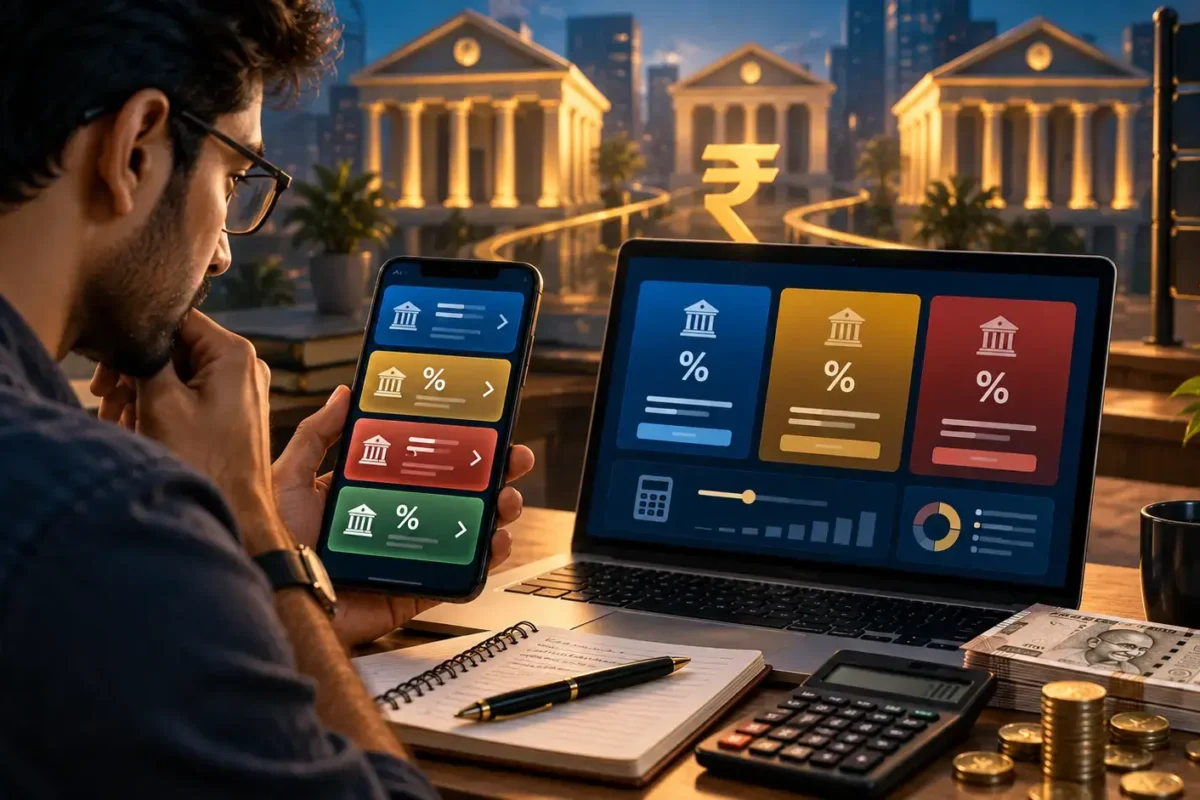
To make an informed financial decision, you must look at the numbers side by side. Different institutions cater to different risk profiles. A state-owned giant will treat you differently than a modern fintech app that approves loans on your lunch break. Conducting a thorough personal loan interest rates comparison india helps you identify which lenders offer the most competitive terms for your specific bracket.
Ravi, a software employee in Hyderabad, earns Rs. 95,000 per month and has a healthy CIBIL score of 765. When he needed ₹3,00,000 for a home renovation project, he assumed all banks would offer him the same deal. He was wrong. The table below shows the stark difference in what various lenders offer for a similar profile in 2026.
| Lender Name | Type of Institution | Indicative Interest Rate (p.a.) | Average Processing Fee |
|---|---|---|---|
| State Bank of India (SBI) | Public Sector Bank | 11.15% – 15.30% | 0.5% to 1.5% of loan amount |
| HDFC Bank | Private Sector Bank | 10.75% – 22.00% | Up to 2.50% |
| ICICI Bank | Private Sector Bank | 10.80% – 16.25% | Up to 2.25% |
| Bajaj Finserv | NBFC | 11.00% – 25.00% | Up to 3.99% |
| Tata Capital | NBFC | 10.99% – 28.00% | Up to 3.00% |
1. Public Sector Banks: The Low-Cost, Slow-Moving Giants
Public sector banks like SBI, Bank of Baroda, and Punjab National Bank are traditionally the cheapest options in any personal loan interest rates comparison india. Because they are backed by the government, they are less aggressive with high-interest consumer lending and focus on stable, salaried applicants. If you have a salary account with them or work for a government department, you can negotiate rates close to 11%. The catch? Their digital onboarding can still feel clunky, and the physical verification process might take several working days.
2. Private Sector Banks: Speed At a Premium Price
Private giants like HDFC Bank, ICICI Bank, and Axis Bank have mastered the art of “one-click” pre-approved loans. If you maintain a healthy balance in your account, they will bombard you with instant loan offers. While their starting rates look highly competitive at around 10.75%, these rates are reserved exclusively for super-prime customers working in top-tier multinational corporations. If you work for a lesser-known startup or have a moderate credit profile, your rate can easily climb to 16% or 18% in your personal loan interest rates comparison india.
3. NBFCs and Fintech Apps: The Last Resort for Fast Cash
Non-Banking Financial Companies (NBFCs) and digital lending apps are incredibly lenient. They will give you a loan even if your credit history is thin or slightly damaged. However, this leniency comes at a brutal cost. Interest rates can soar up to 30% or even 36% per annum. Furthermore, their processing fees are notoriously high, sometimes eating up 4% of your principal amount before the money even hits your bank account.
How Lenders Determine Your Personal Loan Interest Rate
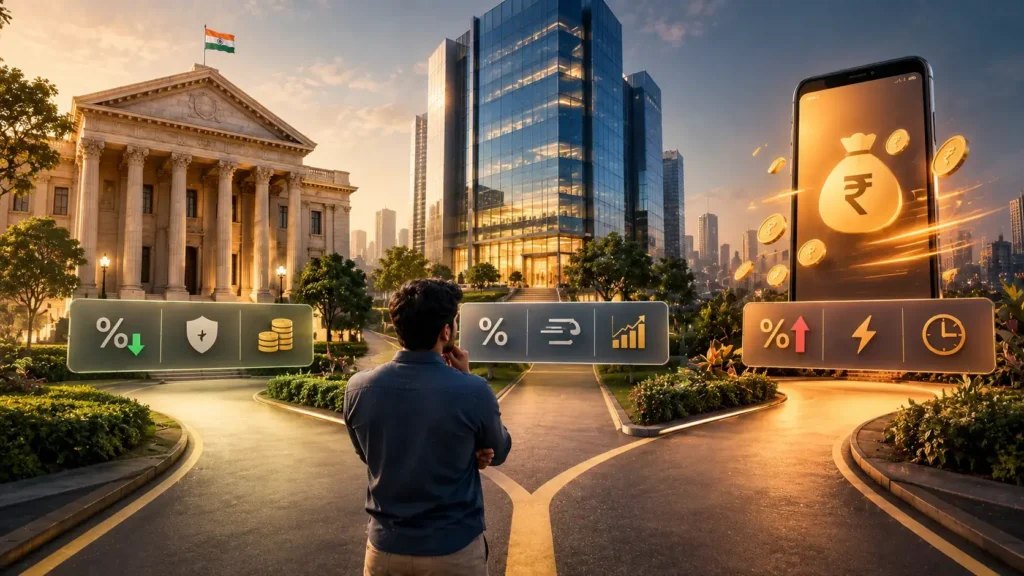
Banks do not roll a dice to decide your interest rate. They use a highly calculated risk-pricing model. Understanding how this model works is the key to winning any personal loan interest rates comparison india and driving down your EMI. According to guidelines from the RBI, banks must maintain transparency in how they benchmark their lending rates, though individual risk premiums still vary widely.
1. Your CIBIL Score is Your Financial Passport
Your credit score is the first thing a lender looks at. It tells them how responsibly you have handled debt in the past. If your credit history shows missed credit card payments or delayed loan EMIs, you are marked as high-risk. A score above 750 tells the bank you are safe, allowing you to demand their lowest slab. If your score is below 650, you will either face outright rejection or be offered a loan with an interest rate so high it feels like a penalty. For those looking to build up their credit profile first, reviewing our guide on How to Build Credit in India can provide actionable steps to secure better rates.
2. Your Employer’s Reputation Matters
Indian banks maintain internal lists categorizing employers into Category A, B, and C. If you work for an established IT giant, a major public sector undertaking, or a multinational firm, you are placed in Category A. Banks assume your job is highly secure, reducing the risk of default. Consequently, they will offer you lower rates. If you work for an unrated startup or a small local business, the bank views your income as less predictable, which pushes your rate upward in any personal loan interest rates comparison india.
3. The Fixed Obligation to Income Ratio (FOIR)
Banks do not just look at how much you earn; they look at how much of your salary is already spoken for. FOIR calculates the percentage of your monthly income that goes toward paying existing debts like home loans, car loans, or credit card EMIs. Ideally, lenders want your total monthly debt payments to be under 40% to 50% of your net monthly salary. If you are already stretched thin, they will charge you a higher interest rate to offset the risk of you defaulting on the new loan.
The Hidden Costs That Ruin a Cheap Loan Offer
Many borrowers make the mistake of focusing solely on the interest rate. They run a quick personal loan interest rates comparison india, pick the lowest percentage, and sign the papers. This is a costly mistake. Lenders are experts at hiding fees in the fine print.
Let us look at what these extra charges actually mean for your wallet:
1. Processing Fees and Documentation Charges
This is a one-time fee charged by the bank to process your application. It can range from a flat ₹999 to 3% of your total loan amount. If you take a loan of ₹5,00,000 with a 3% processing fee, you lose ₹15,000 on day one. Always negotiate to have this fee capped or waived, especially during festive seasons when banks run special promotions.
2. Prepayment and Foreclosure Penalties
If you get a bonus or a sudden windfall, you might want to pay off your personal loan early to escape the interest. However, banks hate losing out on future interest earnings. Many private banks charge a foreclosure penalty of 2% to 5% on the outstanding principal if you close the loan before the tenure ends. Some banks even lock you in, preventing any prepayment for the first 12 months.
3. Bounce Charges and Late Payment Fees
If your bank account does not have sufficient funds on the day your EMI auto-debit triggers, you get hit from both sides. Your own bank will charge you an ECS bounce fee (usually ₹250 to ₹500), and the lender will slap you with a late payment fee alongside penal interest (often 2% per month) on the overdue amount. This can quickly derail your budget if you do not plan your monthly cash flow carefully.
FAQs
What is a good interest rate for a personal loan in India?
In the current 2026 market, any interest rate between 10.5% and 12.5% per annum is considered excellent and is usually reserved for salaried individuals with a CIBIL score above 750.
Can I negotiate personal loan interest rates with my bank?
Yes, if you have a long-standing relationship, a high salary account balance, and a spotless repayment history, you can actively negotiate for lower interest rates and waived processing fees.
Is a flat interest rate better than a reducing balance rate?
No, a flat rate is highly misleading because you pay interest on the entire original loan amount for the whole tenure, making it much more expensive than a reducing balance rate where interest is calculated only on the remaining unpaid principal.
Final Thoughts
A personal loan is a highly convenient tool when you are in a tight spot, but it is also one of the most expensive forms of credit available. Before you sign on the dotted line, perform a thorough personal loan interest rates comparison india, calculate your exact monthly EMI burden, and read the schedule of charges carefully. Do not let the promise of instant money blind you to the long-term cost.
If you do decide to take a loan, aim to pay it off as quickly as possible without triggering heavy prepayment penalties. Your goal should always be to return to a state of debt-free financial health where your hard-earned money works for your future, not your lender’s profit margins.

This article is for educational purposes only and does not constitute financial advice. Figures, examples, and outcomes are illustrative and vary based on individual circumstances and lender policies. Always consult a certified financial advisor before making major financial decisions.