


Home Loan EMI Calculator India: 7 Proven Ways a 0.5% Rate Difference Can Cost You Lakhs
You may be comparing two home-loan offers and thinking, “What difference can 0.5% really make?” Quite a lot. On a ₹50 lakh loan, that tiny-looking rate gap can add several lakhs to your total repayment, especially if you choose a 20-year tenure.
A lower EMI can also be misleading. A longer tenure may make the monthly payment feel comfortable while forcing you to pay interest for years longer than necessary. The bank shows you the EMI. You need to calculate the full damage.
This home loan EMI calculator India guide shows you the exact formula, a fully worked example, the effect of rate changes, the role of tenure and prepayments, and the questions you should ask before accepting a sanction letter.

Key Takeaways
- A 0.5% interest-rate difference can add more than ₹3 lakh to the cost of a ₹50 lakh, 20-year home loan.
- The EMI formula uses the loan amount, monthly interest rate and number of monthly instalments.
- For a ₹50 lakh loan at 8.5% for 20 years, the approximate EMI is ₹43,391 and total interest is about ₹54.14 lakh.
- Comparing only the EMI is a mistake. Compare total repayment, reset frequency, processing charges, insurance and foreclosure terms.
- Floating-rate borrowers should stress-test the loan at 1% and 2% higher interest before buying a house.
- A 20-year tenure gives flexibility, but regular part-prepayments can reduce the interest burden dramatically.
- Your credit score, income stability, down payment and lender profile can influence the rate you receive.
Why a Home Loan EMI Calculator India Is More Than an EMI Tool
A home loan EMI calculator India is often treated like a quick gadget: enter ₹50 lakh, select 8%, choose 20 years, and check the monthly number. That is only the starting point.
The useful output is not just the EMI. You need three numbers:
- Monthly EMI
- Total amount repaid to the lender
- Total interest paid over the full tenure
Those numbers expose the trade-off between affordability today and cost over time. A ₹40,000 EMI may appear safer than a ₹45,000 EMI, but if it extends your loan by five years, the cheaper-looking option can cost ₹8 lakh or ₹10 lakh more.
What the calculator actually measures
The calculator estimates the repayment schedule for the principal you borrow. It assumes a particular interest rate and tenure. For a floating-rate loan, it is a snapshot rather than a permanent promise because your rate may change after an RBI policy adjustment, a lender reset or a change in the benchmark.
That does not make the calculation useless. It gives you a baseline. You can then run higher-rate scenarios and see whether your household budget survives. A home loan EMI calculator India is particularly useful here because it lets you compare those scenarios without changing the loan amount or tenure.
Ravi’s Hyderabad home-loan decision
Ravi earns ₹1,35,000 per month in Hyderabad. His wife earns ₹70,000. They are considering a ₹50 lakh loan for a ₹72 lakh flat after arranging the down payment and purchase costs.
At an assumed 8.5% rate for 20 years, the approximate EMI is ₹43,391. That looks manageable against their combined income. But Ravi also pays ₹18,000 for a car loan, ₹12,000 for childcare, ₹8,000 for insurance and around ₹45,000 for regular household expenses.
The couple is not merely asking, “Can we pay ₹43,391?” They should ask, “Can we pay it if the rate rises, one income pauses, or school fees jump?” That is where a calculator becomes a planning tool rather than a sales prop.
Home Loan EMI Calculator India Formula Explained
The standard EMI formula is:
EMI = P × r × (1 + r)n ÷ [(1 + r)n − 1]
Here:
- P is the principal, or the amount borrowed.
- r is the monthly interest rate. Convert the annual rate into a monthly rate by dividing it by 12 and then by 100.
- n is the total number of monthly instalments. A 20-year loan has 240 instalments.
Worked example: ₹50 lakh at 8.5% for 20 years
Assume you borrow ₹50,00,000 at an annual interest rate of 8.5% for 20 years.
- Principal, P = ₹50,00,000
- Annual interest rate = 8.5%
- Monthly rate, r = 8.5 ÷ 12 ÷ 100 = 0.0070833
- Tenure = 20 years
- Total instalments, n = 20 × 12 = 240
Putting these values into the formula gives an approximate EMI of ₹43,391. The total repayment is approximately ₹1,04,13,840. Subtract the principal of ₹50,00,000 and the estimated interest is approximately ₹54,13,840.
Try it yourself: enter the same loan amount into a home loan EMI calculator India, then change only the interest rate. Keep the tenure fixed. This isolates the cost of the rate difference instead of mixing three variables together.
Why the first EMIs feel unfair
Early EMIs contain a larger interest component because interest is calculated on the outstanding principal. As you repay principal, the interest component gradually falls.
For the ₹50 lakh example, the first month’s interest at 8.5% is approximately ₹35,417. If the EMI is ₹43,391, only around ₹7,974 initially reduces the principal. This is why making a prepayment early in the loan can have an outsized effect.
Do not panic when you see this split. It is normal amortisation. But understand it before you assume that five years of EMIs have reduced your loan by one-fourth. They have not.
How a 0.5% Rate Difference Can Cost You Lakhs
Now compare the same ₹50 lakh loan for 20 years at different interest rates. The following figures are approximate and intended for planning. Your lender’s exact EMI may differ slightly because of rounding, daily interest calculations or the date of disbursal.
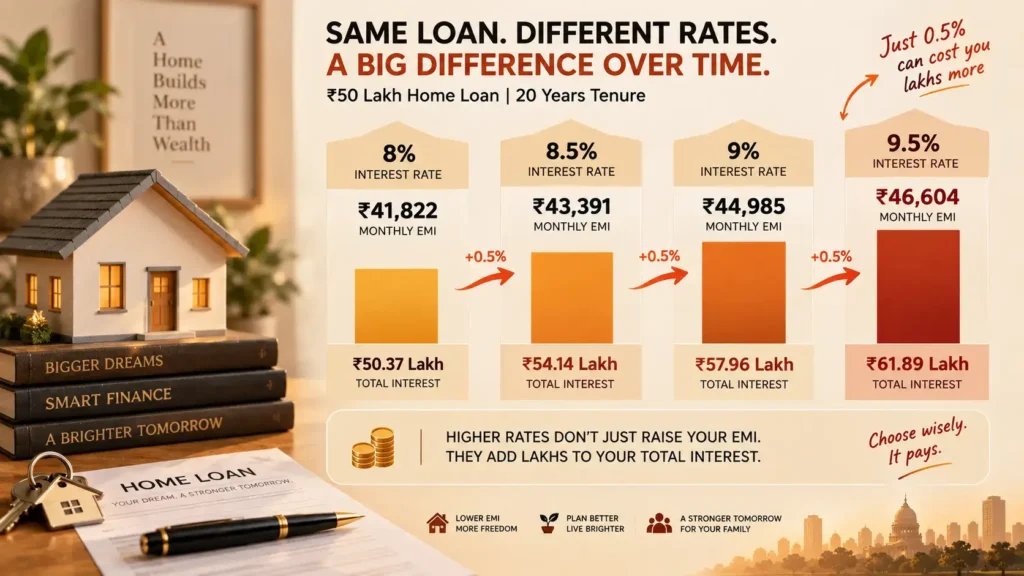
| Annual interest rate | Approximate EMI | Approximate total interest | Difference from 8.5% |
|---|---|---|---|
| 8.0% | ₹41,822 | ₹50.37 lakh | Interest saved: about ₹3.77 lakh |
| 8.5% | ₹43,391 | ₹54.14 lakh | Baseline |
| 9.0% | ₹44,986 | ₹57.97 lakh | Extra interest: about ₹3.83 lakh |
| 9.5% | ₹46,608 | ₹61.86 lakh | Extra interest: about ₹7.72 lakh |
The 0.5% increase from 8.5% to 9% raises the EMI by roughly ₹1,595 per month. That may look manageable. Over 240 months, however, the approximate additional interest is nearly ₹3.83 lakh.
This is the trap. Borrowers notice the EMI change first and ignore the total repayment change. A small monthly difference becomes a large lifetime cost because it repeats 240 times.
The rate gap becomes larger on bigger loans
Suppose Neha in Pune borrows ₹80 lakh instead of ₹50 lakh. The same 0.5% gap affects a larger principal, so the rupee impact rises sharply. A rate negotiated from 9% down to 8.5% may save her roughly ₹6 lakh or more over a 20-year schedule, depending on the lender’s calculation and future resets.
That is why a rate negotiation is worth your time. Asking the bank to review your offer, improving your CIBIL score before applying, comparing a bank with a housing finance company, or transferring the loan later can have a real financial payoff. Use a home loan EMI calculator India to quantify that payoff before relying on a lender’s rounded illustration.
Do not compare floating and fixed rates casually
A fixed-rate offer and a floating-rate offer are not automatically comparable. Some fixed-rate products are fixed only for a limited period. Others may include conditions that change the cost of switching or prepaying.
Ask the lender:
- What benchmark determines the floating rate?
- How often can the rate reset?
- Will the EMI change, the tenure change, or both after a reset?
- What happens if the rate rises by 1%?
- Are there conversion or switching charges?
RBI rules and lender policies can change, so verify the current terms in the sanction letter and loan agreement rather than relying on a salesperson’s verbal assurance.
Tenure Is the Hidden Multiplier in Your Home Loan
Interest rate gets the attention. Tenure often does more damage.

For a ₹50 lakh loan at 8.5%, shortening the tenure reduces total interest but increases the EMI. Extending the tenure does the opposite. Here is the trade-off:
| Tenure | Approximate EMI | Approximate total interest | Practical effect |
|---|---|---|---|
| 10 years | ₹61,991 | ₹24.39 lakh | High EMI, much lower interest |
| 15 years | ₹49,237 | ₹38.63 lakh | Balanced repayment period |
| 20 years | ₹43,391 | ₹54.14 lakh | Lower EMI, high lifetime interest |
| 25 years | ₹40,263 | ₹70.79 lakh | Comfortable EMI, very expensive loan |
| 30 years | ₹38,435 | ₹88.37 lakh | Small EMI reduction, enormous interest cost |
Moving from a 20-year tenure to a 30-year tenure reduces the EMI by only around ₹4,956 in this example. But it may add more than ₹34 lakh in interest.
Choose the shortest tenure you can survive
Do not choose a 10-year tenure if the EMI leaves your family with no emergency reserve. That is reckless. But do not automatically choose 25 or 30 years just because the bank approves it.
A sensible approach is to choose a tenure that keeps your fixed obligations manageable and then make planned prepayments when your income rises. Your target should be flexibility with a clear exit plan, not an EMI so low that the loan follows you into retirement.
Meera’s Bengaluru budget test
Meera earns ₹1,10,000 per month and wants a ₹45 lakh home loan. The bank says she can take a 25-year loan with an EMI near ₹36,000. She prefers the lower payment because her rent and parents’ medical expenses already consume a large part of her salary.
Instead of accepting the 25-year tenure blindly, Meera runs three scenarios through a home loan EMI calculator India:
- 20 years: higher EMI, lower total interest
- 25 years: lower EMI, higher total interest
- 25 years with a ₹75,000 annual prepayment: lower required EMI with a planned reduction in principal
The third option may work if she actually commits the annual prepayment. A calculator can show the saving, but only her bank account can make it happen.
How to Use a Home Loan EMI Calculator India Correctly
Most errors happen because people enter optimistic inputs or fail to test the loan after an interest-rate reset. Use the calculator in a fixed sequence. A home loan EMI calculator India gives the clearest result when you keep the principal and tenure consistent while testing one variable at a time.

Step 1: Calculate the real loan amount
Do not enter the property price as the loan amount unless you are certain the lender will finance that much. Start with the purchase price, subtract your down payment and account for the lender’s loan-to-value limit.
Then separately budget for stamp duty, registration, brokerage, legal checks, interiors, moving costs and initial repairs. These expenses can be substantial and are not always included in the home loan.
For example, if Arjun buys a ₹70 lakh flat and contributes ₹20 lakh, he may assume the loan is ₹50 lakh. But if he uses part of that ₹20 lakh for registration and interiors, the actual loan requirement could be ₹54 lakh or ₹56 lakh. That small increase changes the EMI and the interest cost.
Step 2: Run three interest-rate scenarios
Enter the quoted rate, then add 0.5% and 1%. If your budget fails at the higher scenario, the original loan may be too aggressive.
For floating-rate loans, a 1% stress test is not excessive. Rates can move, and the lender may respond by increasing your tenure. That protects the EMI but can keep you in debt much longer.
Step 3: Compare total interest, not just EMI
Create a simple comparison with the same principal and tenure. Record the EMI, total repayment and interest. A lender offering a ₹1,000 lower EMI may be using a longer tenure or a different repayment structure.
Step 4: Add prepayments only if they are realistic
Do not enter a large annual prepayment simply because you expect a bonus. Use the amount you can reasonably commit after accounting for emergency savings, insurance premiums, school fees and irregular household expenses.
Try it yourself: calculate the loan without prepayment, then enter a ₹5,000 monthly extra payment or a ₹60,000 yearly lump sum. Compare the revised closing date and interest. The result will show why consistency beats occasional enthusiasm.
What the Calculator Does Not Include
A home loan EMI calculator India gives you the core repayment math. It does not automatically show every cost of buying or financing a property. Treat the calculator result as one part of your purchase budget, not as a complete statement of affordability.
Processing and legal charges
Processing fees may be a flat amount or a percentage of the loan. Legal verification, technical valuation and documentation charges may be separate. Ask for an itemised schedule in writing.
Insurance and bundled products
A lender may offer loan-protection insurance or other products during the application. Do not assume every bundled product is compulsory. Compare the cost, coverage, exclusions and payment method. If the premium is added to the loan, you may also pay interest on that premium.
Stamp duty, registration and property costs
These are not part of the EMI formula, but they affect how much cash you need before disbursal. A buyer who empties their savings for the down payment can become financially fragile immediately after moving in.
Tax treatment and changing rules
Home-loan tax benefits depend on the property, occupancy, borrower structure and the tax regime you choose. Rules can change. Confirm the current position with the Income Tax Department or a qualified tax professional instead of subtracting an assumed tax saving from your EMI.
Tax relief should be a bonus in your calculation, not the reason you take an unaffordable loan.
How to Reduce Home-Loan Interest Without Strangling Your Budget
You do not need to make one dramatic decision. Small, repeatable actions can reduce the principal and shorten the repayment period.
Make prepayments early
A ₹1 lakh prepayment in year two usually saves more interest than the same ₹1 lakh paid near the end because the outstanding principal is higher earlier. Check the current terms for your loan type and lender before making a payment.
For floating-rate individual home loans, applicable foreclosure and prepayment rules may differ from other loan products. Read the agreement. Never rely solely on a bank employee’s casual statement.
Increase the EMI after every salary hike
If your salary rises from ₹90,000 to ₹1,05,000, do not automatically upgrade your phone, car and Swiggy budget. Directing even ₹3,000 or ₹5,000 toward the home loan can shorten the tenure.
One practical rule is to increase your EMI by 5% whenever your income rises, provided your emergency reserve and insurance are in place. Run that amount through a home loan EMI calculator India before committing.
Use bonuses with a written split
Do not send your entire annual bonus to the lender if you have no emergency fund. A possible structure is to divide a ₹2 lakh bonus into emergency savings, essential annual expenses and a home-loan prepayment. The exact split depends on your financial position, but the decision should be made before the bonus arrives.
Review a balance transfer carefully
A lower rate from another lender can save money, but the saving must exceed processing charges, legal fees, valuation charges and switching costs. Calculate the outstanding principal, remaining tenure and total cost of transfer.
Example: if a balance transfer saves ₹3,000 per month for 60 months, the gross saving is ₹1.8 lakh. If transfer costs are ₹65,000 and the new lender extends the tenure, the actual benefit may be far smaller than the advertisement suggests.
How Your CIBIL Score and Loan Profile Affect the Rate
Your credit score is not the only factor in a home-loan decision, but it can influence your lender’s risk assessment. A strong repayment record, stable income and sensible credit utilisation can improve your negotiating position.
Check your credit report before applying
Review your CIBIL report for incorrect overdue entries, duplicate accounts, accounts marked as settled when they were closed, or loans that do not belong to you. Dispute errors before making several loan applications.
Repeated hard enquiries in a short period may not help your profile. Compare lenders first, then apply selectively.
Keep your debt-to-income ratio under control
If you already pay ₹35,000 in personal-loan, car-loan and credit-card EMIs, adding a ₹45,000 home EMI means ₹80,000 of fixed debt payments every month. On a ₹1,50,000 household income, that is more than half the income before groceries, rent, insurance and medical expenses.
A lender may approve the loan. Approval is not proof that the loan is comfortable.
Make the down payment without destroying liquidity
A larger down payment reduces the loan and interest, but draining every rupee from your bank account creates a different risk. Keep money aside for emergencies, registration, repairs and at least several months of essential expenses.
Use the Emergency Fund Calculator India: How Much Is Your True Safety Net? before deciding how much cash can safely go into the property.
Common Home-Loan Calculator Mistakes That Cost Real Money
Using a promotional rate for the entire tenure
A teaser rate may apply only for a limited period. Enter the likely reset rate and test a higher number. If the lender refuses to explain the reset mechanism clearly, pause the application.
Ignoring the pre-EMI period
For an under-construction property, you may pay interest on disbursed amounts before the full EMI begins. The exact amount depends on the stage of construction and disbursal schedule. Ask for a written estimate.
Assuming EMI never changes
With a floating-rate loan, your EMI or tenure can change. A home loan EMI calculator India using only the first-year rate creates false confidence.
Counting tax savings twice
Some borrowers include a tax saving in their monthly budget and also treat it as extra investment money. That creates a gap if the tax benefit is unavailable, limited or changed by the chosen tax regime.
Forgetting income interruptions
Priya and Karan may have a combined monthly income of ₹2 lakh, but if Karan plans a six-month career break, their home loan must be tested against Priya’s income and existing savings. Family income today is not the same as guaranteed repayment capacity for 20 years.
A Practical Home-Loan Affordability Checklist
Before you sign, write down the numbers. Do not keep the entire decision inside a sales conversation.
| Question | Healthy calculation approach | Warning sign |
|---|---|---|
| What is the loan amount? | Property price minus down payment, with costs separately budgeted | Borrowing extra for every purchase expense |
| What EMI can you handle? | Test against essential expenses and a higher-rate scenario | Using the bank’s maximum approval as your target |
| What is the total interest? | Compare across rates and tenures | Looking only at the advertised EMI |
| Do you have liquidity? | Keep emergency savings and purchase costs outside the down payment | Using credit cards for repairs or registration |
| Can you prepay? | Commit only predictable surplus income | Depending on uncertain bonuses |
| Have you checked the agreement? | Review reset, charges, insurance and foreclosure terms | Relying on verbal promises |
Also compare the lender’s customer service, branch access, document process and complaint handling. A marginally cheaper rate is not worth much if a disbursal delay costs you a builder penalty or creates a legal problem.
If you are deciding between investing surplus money and reducing a home loan, compare the guaranteed saving from prepayment with the uncertain return from investments. The article Should I Prepay My Home Loan or Invest the Extra? Here’s the Real Math can help frame that decision without pretending market returns are guaranteed.
FAQs
How accurate is a home loan EMI calculator India?
It is accurate for the principal, rate and tenure you enter, but it is an estimate for floating-rate loans. Your actual repayment can change because of rate resets, lender rounding, disbursal timing, charges and changes to the tenure or EMI.
How much does a 0.5% home-loan rate difference matter?
On a ₹50 lakh loan for 20 years, moving from 8.5% to 9% can add roughly ₹3.8 lakh in total interest under a standard calculation. The impact becomes larger as the loan amount or tenure increases.
Should I choose a 20-year or 30-year home loan?
Choose the shortest tenure that leaves room for emergencies and normal household expenses. A 30-year tenure may reduce the EMI slightly but can add tens of lakhs in interest, so use it only with a realistic prepayment plan.
Can I reduce my home-loan interest by paying extra every month?
Yes. Extra payments reduce the outstanding principal, which reduces future interest and may shorten the tenure. Confirm how your lender applies the payment and whether any current charges or conditions apply.
What interest rate should I enter in a home loan EMI calculator?
Enter the lender’s quoted rate for your offer, then run additional scenarios at 0.5% and 1% higher. This gives you a more realistic stress test than assuming today’s rate remains unchanged for the entire loan. For a more complete comparison, use a home loan EMI calculator India with the quoted rate, a moderate increase and a higher stress scenario.
Final Thoughts
A home is an emotional purchase, but the loan is a mathematical contract. The bank may focus on whether you qualify for ₹50 lakh. You need to focus on whether ₹50 lakh at that rate and tenure still works when medical bills, job changes, school fees and interest-rate increases arrive.
Use the calculator before you negotiate, not after you sign. Enter the real loan amount, compare at least three rates, test different tenures, and write down the total interest. Then decide what EMI your household can survive—not the maximum EMI a lender is willing to approve.
Your next step is simple: run your own numbers today using the home loan EMI calculator India method above, add a 1% rate stress test, and discuss the result with your family before paying a booking amount.

This article is for educational purposes only and does not constitute financial advice. Figures, examples, and outcomes are illustrative and vary based on individual circumstances and lender policies. Always consult a certified financial advisor before making major financial decisions.
One Email a Week. Five Things Worth Knowing.
- One important financial change that actually affects you
- One practical money lesson
- One useful calculator
- One common mistake to avoid
- One guide worth reading