
7 Hidden Costs in No-Cost EMIs: The Truth About Consumer Durable Loans in India
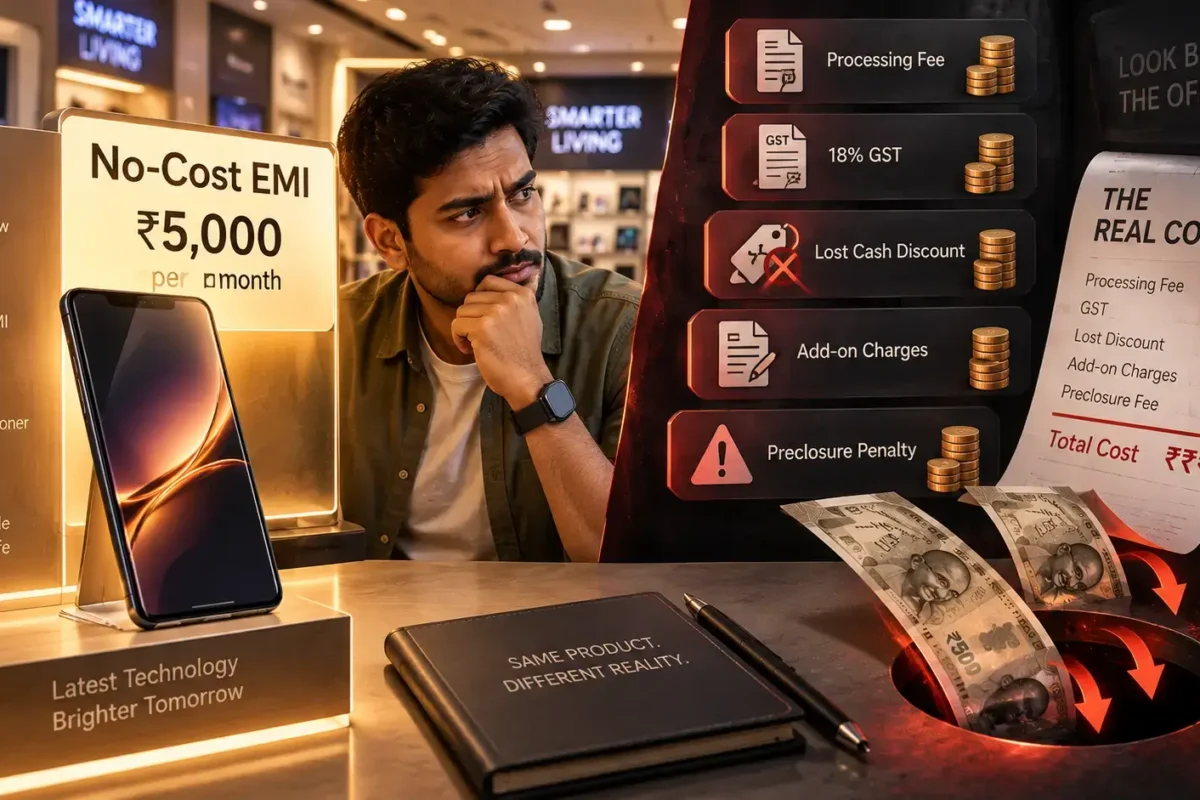
You walk into a retail electronics showroom or scroll through Amazon during a festive flash sale. A flagship phone priced at ₹60,000 catches your eye. Beside the staggering price tag, a comforting badge offers relief: “No-Cost EMI starting at just ₹5,000 per month.”
It feels like a victory against inflation. You split the total into twelve bite-sized chunks, clear your cart, and assume you paid zero interest. But financial institutions are not charities. The Reserve Bank of India banned completely zero-interest consumer financing years ago, issuing an explicit RBI circular stating that zero-percent loans are a mathematical illusion.
Yet, the marketing persisted by simply renaming the scheme. Beneath the hood of that zero-interest gimmick lurks a tangle of consumer durable loan hidden charges India shoppers regularly overlook. From upfront processing levies to unreturned GST and forfeited upfront discounts, the math is quietly rigged.
If you want to know what that split payment truly costs you, look past the banner. Learning to decipher consumer durable loan hidden charges India retail agreements contain is critical for avoiding debt traps. Here is the unvarnished breakdown of how financing companies charge you while pretending it is free.
Key Takeaways: The Real Cost of ‘Zero-Interest’ Financing
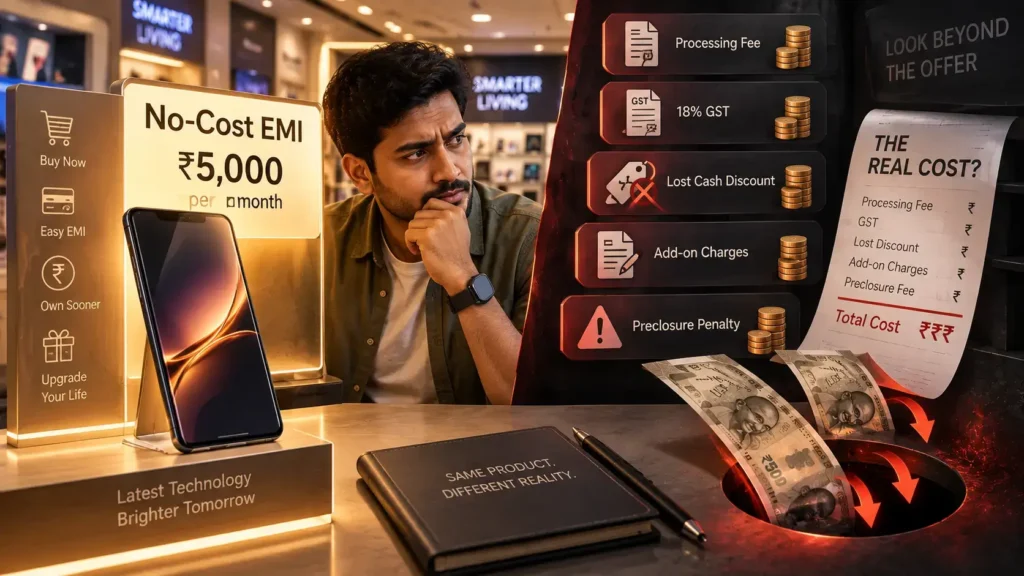
- No-cost loans do not legally exist: Under RBI rules, lenders cannot lend money at zero percent; the interest is either masked as a merchant discount or loaded onto the base retail price.
- Consumer durable loan hidden charges India buyers face: Retailers routinely hide file charges, documentation fees, and mandatory convenience fees running between ₹199 and ₹999 plus taxes.
- The permanent GST leak: Even if a brand provides an upfront interest discount, you still pay 18% GST on the monthly interest component billed by the lender.
- The lost cash rebate penalty: Opting for an EMI scheme almost always disqualifies you from instant upfront bank discounts that reduce the invoice total immediately.
- Multiple CIBIL hits: NBFC-backed consumer loans register as fresh active consumer credit lines on your bureau file, pinging your credit score.
- Preclosure traps: Deciding to clear your loan early often triggers penal foreclosure fees of 2% to 3% on the remaining balance.
The Mathematics Behind Consumer Durable Loan Hidden Charges India Shoppers Ignore
How do banks and NBFCs make money on a loan that advertises 0% interest? They use two standard operating mechanisms, and both take cash out of your wallet, creating the exact consumer durable loan hidden charges India consumers rarely calculate beforehand.
Mechanism 1: The Forfeited Upfront Discount
In the first variant, the manufacturer or online retailer provides a discount equal to the total interest the bank will charge over your tenure. If a laptop costs ₹80,000 and your bank charges 15% annual reducing interest (around ₹4,500 over nine months), the invoice price is lowered to ₹75,500. The bank then bills you ₹80,000 across nine months, pocketing that ₹4,500 as interest.
While that seems harmless, consider the cash alternative. If you paid upfront using UPI or an outright card swipe, the merchant would frequently offer you that ₹4,500 discount straight off the retail price. By choosing the EMI route, you forfeit a direct price markdown in exchange for split payments, representing one of the most subtle consumer durable loan hidden charges India consumers absorb.
Mechanism 2: The Artificially Inflated Retail Price
In the second variant, prevalent in offline multi-brand retail outlets, the dealer simply inflates the product price tag. A washing machine that sells for ₹24,000 cash is tagged at ₹28,000 on the showroom floor under an exclusive “zero-interest financing” tie-up. The interest is already baked into the sticker price. You never see the interest line item because you are paying a manufactured premium from day one, which stands as another major contributor to the consumer durable loan hidden charges India buyers encounter.
The Real Breakdown: 4 Sneaky Ways You Bleed Money on EMI
Beyond the fundamental design of the loan, several direct expenses quietly siphon money from your bank account every billing cycle. These are the specific consumer durable loan hidden charges India consumers discover only after reading their monthly loan account statements.
1. Non-Refundable Processing and Documentation Fees
Swipe your card or sign an agreement with an in-store NBFC representative, and a one-time fee is almost universally applied. Banks label this a “convenience fee” (typically ₹199 to ₹299 plus 18% GST). In-store consumer durable loan providers go even further, levying “documentation charges” or “file processing charges” ranging from ₹500 to ₹1,500.
When you finance a ₹15,000 tablet over 6 months, a ₹750 combined documentation and processing fee adds a 5% flat surcharge to your purchase instantly. Understanding these upfront file fees is essential to mapping consumer durable loan hidden charges India lenders layer onto small balances, turning your “free” financing into a shockingly expensive micro-loan.
2. The 18% GST Leak on Monthly Interest
This is the most common mathematical blind spot for Indian credit card holders. Even when an e-commerce platform gives you an instant interest discount at checkout, your bank still treats the loan as standard credit. That means the bank charges monthly interest on the reducing balance and collects 18% Goods and Services Tax (GST) on that interest.
The merchant gave you a discount on the interest amount, not on the government tax. That 18% GST is non-negotiable, non-refundable, and billed directly to your statement every month. On high-ticket durables like double-door refrigerators or OLED televisions, this GST leakage forms a recurring component of consumer durable loan hidden charges India shoppers overlook, quietly adding hundreds of rupees to your acquisition cost.
3. Unwanted Add-On Insurance and Mandate Penalties
Walk into any physical store to buy a consumer durable via point-of-sale financing, and the sales representative will slip supplementary add-ons into your paperwork. You will see charges for “Device Protection Plans,” “Extended Warranty Support,” or “Loan Shield Insurance.”
These add-ons cost anywhere from ₹499 to ₹2,500, rolled directly into the loan amount. If you question them, representatives often claim they are mandatory under company policy to approve the loan. They are not. They are commission-generating upsells that pad the lender’s profit margins, inflating the consumer durable loan hidden charges India customers must repay.
Furthermore, if an automated NACH debit or auto-pay mandate bounces due to a temporary salary delay, the penalties are brutal. The financing NBFC hits you with a mandate bounce fee (₹450 to ₹600), your own bank charges an ECS failure fee (₹250 to ₹500), and a late payment penalty is added on top. A single missed debit on a small ₹2,000 monthly installment can trigger ₹1,200 in administrative penalties.
4. Foreclosure and Prepayment Penalties
Suppose you receive a festive performance bonus at work and decide to wipe out your consumer loan early. Instead of thanking you, NBFCs slap you with preclosure fees. While the RBI prohibits foreclosure charges on floating-rate individual term loans, consumer durable loans are almost universally structured as fixed-rate credit facilities. This allows lenders to legally charge a 2% to 3% pre-closure penalty on your outstanding principal balance, plus GST, worsening the cumulative consumer durable loan hidden charges India borrowers pay.
Real-World Case Study: Vikram’s “Zero-Cost” Air Conditioner
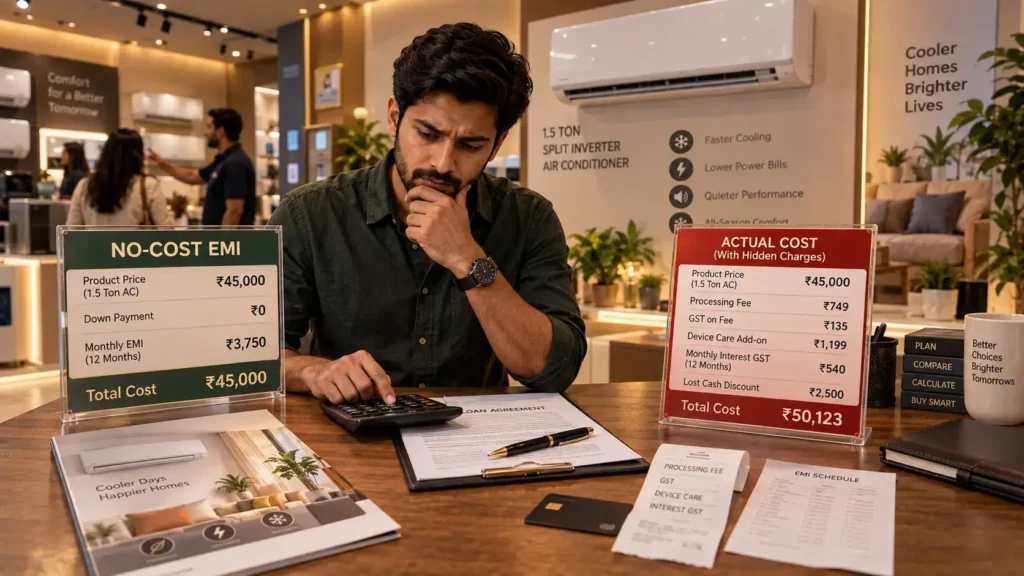
Consider Vikram, an IT systems engineer living in Pune. During peak summer, Vikram decided to buy a 1.5-ton split inverter air conditioner carrying an MRP of ₹42,000. He opted for an in-store 8-month “No-Cost EMI” through a prominent non-banking financial company.
Here is what the sales representative quoted Vikram versus the actual consumer durable loan hidden charges India finance agreements extracted from his account:
| Expense Component | What Vikram Expected | What Vikram Actually Paid |
|---|---|---|
| Air Conditioner Purchase Price | ₹42,000 | ₹42,000 |
| Upfront Processing Fee | ₹0 | ₹749 |
| 18% GST on Processing Fee | ₹0 | ₹135 |
| Mandatory Device Care Shield | ₹0 | ₹1,199 |
| 18% Monthly GST on Interest Component | ₹0 | ₹388 |
| Cash Discount Forfeited at Counter | ₹0 | ₹2,500 |
| Total Cost of Ownership | ₹42,000 | ₹46,971 |
Vikram ended up spending an extra ₹4,971—an effective 11.8% premium over the true cash price. His “free” EMI scheme was substantially more expensive than simply negotiating an upfront cash discount and using an existing emergency fund. The invisible leak came down entirely to consumer durable loan hidden charges India borrowers rarely read before signing.
How No-Cost EMIs Damage Your CIBIL Score and Borrowing Power
Beyond the direct financial hit, there is a hidden credit reporting cost. Every time you purchase a gadget through an in-store consumer durable loan, the NBFC runs an inquiry on your credit report and registers a brand-new loan account.
Buy three items across a year—a phone, a smart TV, and an air conditioner—and your credit file suddenly shows three distinct short-term personal credit lines. When you apply for a critical long-term facility like a home loan, mortgage underwriters examine your Debt-to-Income (DTI) ratio. Lenders dislike seeing a borrower carrying multiple fragmented consumer debt facilities, as it signals reliance on credit for routine lifestyle purchases. For a broader perspective on managing credit profiles, our guide on Personal Loan Traps to Avoid in India offers actionable insights into protecting your credit score from excessive retail inquiries.
Miss a single ECS mandate on a small consumer appliance loan due to a banking holiday, and the default reports straight to CIBIL, dragging down a prime credit score you spent years building.
Smart Alternatives: How to Avoid Consumer Durable Loan Hidden Charges India
You do not need to fall into the deferred-payment trap to afford modern electronics and appliances. Follow these rules to eliminate the risk of consumer durable loan hidden charges India retailers impose and protect your wallet:
1. Negotiate the Cash/UPI Counter Price First
Always ask the showroom manager for their absolute best price if you pay via direct UPI or bank transfer. Most retail chains have a built-in merchant markup to absorb loan subvention costs. When you offer immediate cash settlement, store managers can often slash 5% to 10% off the floor price on the spot.
2. Use a Sinking Fund Instead
Consumer electronics have predictable replacement cycles. Instead of taking an EMI after your old washing machine breaks down, automate a ₹3,000 recurring deposit or liquid fund allocation monthly. Buying assets with your own money guarantees zero processing fees, zero GST leaks, zero credit checks, and maximum bargaining leverage.
3. Examine the Key Fact Statement (KFS)
If you genuinely must take a consumer durable loan, demand the Key Fact Statement (KFS) before signing. RBI regulations mandate that lenders provide a clear, one-page document detailing the Annual Percentage Rate (APR), processing fees, bounce charges, and all incidental costs. By checking this document, you can uncover every element of consumer durable loan hidden charges India financiers embed before committing. If the salesperson hesitates to hand over the KFS, walk away.
FAQs
Is No-Cost EMI completely banned in India?
No, the marketing term is still used, but the RBI banned true zero-interest loans. Modern No-Cost EMIs work by converting a retailer’s cash discount into interest payments for the lending bank, leaving you responsible for administrative fees and monthly GST.
Do I pay GST on No-Cost EMI interest?
Yes. Even though the retailer discounts the interest equivalent from your purchase price, your bank is legally required to levy 18% GST on the monthly interest billed to your card.
Does taking a consumer durable loan hurt my CIBIL score?
It can. Each consumer loan creates a hard credit inquiry and opens a new short-term loan account on your bureau file, which can lower your average account age and penalize your score if a mandate fails.
Can I avoid processing fees on consumer durable loans?
Generally no, as most banks and NBFCs charge a non-negotiable convenience or file charge between ₹199 and ₹999. The only way to completely avoid them is paying in full via debit card, UPI, or cash.
Final Thoughts: Don’t Trade Freedom for Monthly Installments
Splitting large purchases into manageable monthly slices feels like smart financial planning. It feels responsible, frictionless, and modern. But financial institutions do not spend billions on promotional partnerships out of generosity.
The convenience of financing carries a documented price tag. Between unreturned GST levies, upfront documentation fees, and forfeited retail markdowns, consumer durable loan hidden charges India shoppers pay quietly inflate the price of every gadget they own.
Before you tap “Confirm EMI” or hand over your PAN card to an in-store executive, run the full math. Add up the processing fees, the taxes, and the lost cash discount. If the financing costs you more than your money would earn sitting safely in a bank account, skip the loan, save up for a few months, and buy it outright on your own terms.

This article is for educational purposes only and does not constitute financial advice. Figures, examples, and outcomes are illustrative and vary based on individual circumstances and lender policies. Always consult a certified financial advisor before making major financial decisions.
One Email a Week. Five Things Worth Knowing.
- One important financial change that actually affects you
- One practical money lesson
- One useful calculator
- One common mistake to avoid
- One guide worth reading