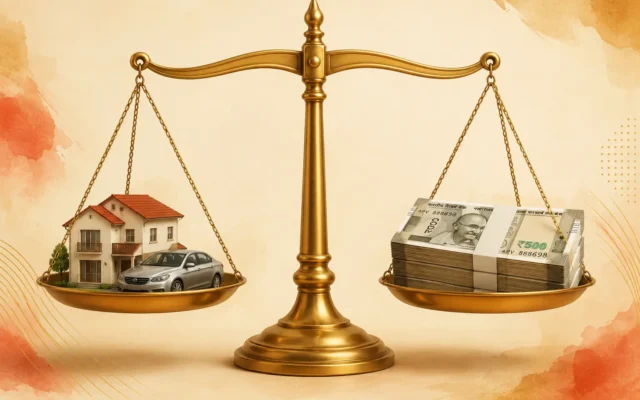


National Household Debt Statistics: Global Debt Trends
National Household Debt Statistics: A Deep Dive Into Global Debt Trends and What They Mean for Indian Families
Introduction
National Household Debt Statistics tell a story far bigger than numbers on a spreadsheet. National Household Debt Statistics reveal how families borrow, spend, survive economic shocks, and build wealth across different countries.
If you want the short answer first, here it is: household debt is rising worldwide, but not all debt is dangerous. The real issue is whether income grows faster than liabilities.
A family in Bengaluru with a ₹70 lakh home loan and rising salary may be financially healthier than a family in another country carrying high-interest credit card balances despite earning more money. That’s why understanding National Household Debt Statistics matters.
Across developed economies, household debt often exceeds annual income. In India, debt levels remain lower than many advanced economies, but consumer credit growth has accelerated rapidly over the last decade. This shift has major implications for middle-class households, financial institutions, policymakers, and investors.
For readers of InvestingLens, National Household Debt Statistics are not just macroeconomic indicators. They are early warning signals that can affect:
- Home loan affordability
- Credit card interest costs
- Personal loan approvals
- CIBIL scores
- Consumer spending
- Long-term wealth creation
External Resources
Internal Resources

Key Takeaways Box
✅ National Household Debt Statistics show debt is increasing globally.
✅ India’s household debt remains lower than many developed countries but is growing rapidly.
✅ Housing loans account for the largest share of household debt worldwide.
✅ Credit card debt creates the greatest risk due to extremely high interest rates.
✅ Debt becomes dangerous when income growth cannot keep pace with repayment obligations.
✅ Countries with high debt levels are more vulnerable during economic slowdowns.
✅ Indian families should monitor debt-to-income ratios instead of focusing only on EMI affordability.
What National Household Debt Statistics Actually Measure and Why Investors Should Care
Understanding National Household Debt Statistics starts with understanding what economists mean by “household debt.”
Most people assume debt means loans. Technically that’s correct, but National Household Debt Statistics include several categories:
- Home loans
- Personal loans
- Vehicle loans
- Education loans
- Credit card balances
- Consumer financing obligations
Every quarter, central banks and international organizations track these liabilities because they provide insights into future economic activity.
Think about it this way.
If millions of households suddenly reduce borrowing, spending usually falls shortly afterward.
If millions of households aggressively increase borrowing, spending tends to rise.
That’s why National Household Debt Statistics are often leading indicators for economic growth.
The Theory
Economists frequently compare household debt against GDP.
This metric shows whether borrowing is growing faster than the economy itself.
Countries with high household debt ratios often experience:
- Strong housing markets
- Higher consumer spending
- Greater economic sensitivity to interest rates
Countries with lower household debt ratios often have:
- More conservative borrowing cultures
- Lower financial risk
- Less exposure to housing bubbles
However, low debt is not automatically positive.
Debt often finances productive assets.
A family borrowing ₹80 lakh for a home that appreciates over twenty years may create substantial wealth.
A family borrowing ₹5 lakh on credit cards at 36% annual interest may destroy wealth.
The distinction matters enormously when analyzing National Household Debt Statistics.
The Indian Reality
Meet Rahul.
Rahul is a 35-year-old software engineer in Bengaluru earning ₹18 lakh annually.
In 2018, Rahul had:
| Item | Amount |
|---|---|
| Home Loan | ₹45 lakh |
| Car Loan | ₹6 lakh |
| Credit Card Debt | ₹0 |
| Total Debt | ₹51 lakh |
By 2026:
| Item | Amount |
| Home Loan | ₹39 lakh |
| Car Loan | ₹0 |
| Credit Card Debt | ₹20,000 |
| Total Debt | ₹39.2 lakh |
His debt actually fell despite rising asset ownership.
Now compare that with another household.
Ankit earns ₹15 lakh annually.
He carries:
| Item | Amount |
| Personal Loan | ₹8 lakh |
| Credit Card Debt | ₹4 lakh |
| Consumer Finance | ₹2 lakh |
| Total Debt | ₹14 lakh |
Despite having lower absolute debt, Ankit faces significantly greater financial stress because his borrowing costs are much higher.
This is exactly why National Household Debt Statistics require deeper interpretation than headline numbers.
IL Advisor Warning
Many Indians proudly say:
“I only pay the minimum due.”
That sentence has probably destroyed more wealth than stock market crashes.
A ₹50,000 credit card balance at roughly 36% annual interest can grow into a devastating long-term burden if repayment is delayed.
The danger isn’t borrowing.
The danger is expensive borrowing.
Global Comparison of Household Debt
The following illustration converts approximate household debt burdens into Indian Rupee equivalents for easier understanding.
| Country | Debt-to-GDP Trend | General Risk Level |
| Switzerland | Very High | Moderate |
| Australia | Very High | Moderate |
| Canada | High | Moderate |
| United States | High | Moderate |
| South Korea | High | Elevated |
| China | Rising | Elevated |
| India | Lower but Growing | Emerging Risk |
National Household Debt Statistics show that India still sits below many advanced economies, but growth rates deserve attention.
Hard Math
Suppose a household earns ₹12 lakh annually.
Financial planners often monitor debt-to-income ratios.
| Debt Level | Ratio |
| ₹6 lakh | 50% |
| ₹12 lakh | 100% |
| ₹24 lakh | 200% |
| ₹36 lakh | 300% |
The higher the ratio, the greater the vulnerability to:
- Job loss
- Medical emergencies
- Interest-rate increases
- Economic slowdowns
This relationship sits at the core of modern National Household Debt Statistics analysis.
Additional Reading
External Sources:
- Reserve Bank of India Financial Stability Reports
- Bank for International Settlements Household Credit Data
Internal Resources:

How National Household Debt Statistics Reveal Financial Risks Before They Become Crises
When economists worry about recessions, banking stress, or consumer spending slowdowns, they often look at National Household Debt Statistics before anything else.
Why?
Because households drive a massive portion of economic activity.
A government can spend more money.
Companies can invest more capital.
But if households stop spending because debt repayments consume too much income, economic growth can slow quickly.
This is why central banks worldwide closely monitor National Household Debt Statistics.
For Indian investors, understanding these numbers is becoming increasingly important because India’s household credit market has expanded dramatically over the last decade.
National Household Debt Statistics and the Global Debt Explosion
One of the biggest misconceptions about debt is that it suddenly becomes a problem.
It rarely does.
Most debt crises build quietly for years.
The pattern usually looks like this:
- Easy credit becomes available.
- Consumers borrow more.
- Asset prices rise.
- Confidence increases.
- Borrowing accelerates.
- Interest rates rise.
- Repayment stress appears.
- Defaults increase.
- Economic slowdown follows.
This cycle has repeated itself across countries and decades.
The United States experienced it before the 2008 financial crisis.
Several European countries experienced similar debt-driven stress after the Global Financial Crisis.
China’s rapid expansion in household borrowing has attracted increasing scrutiny from economists.
Even India is seeing signs that consumer borrowing is becoming a larger part of household financial behaviour.
That doesn’t mean a crisis is imminent.
It simply means National Household Debt Statistics deserve attention.
The Theory
Economists generally evaluate National Household Debt Statistics using four key metrics:
1. Debt-to-GDP Ratio
Measures total household debt relative to economic output.
Higher ratios suggest households rely heavily on borrowing.
2. Debt-to-Income Ratio
Measures how much households owe compared to annual income.
This often provides a clearer picture than debt alone.
3. Debt Service Ratio
Measures the percentage of income used for loan repayments.
This is one of the most important indicators.
4. Credit Growth Rate
Measures how quickly borrowing is expanding.
Rapid credit growth often deserves closer monitoring.
A country with moderate debt but very rapid credit growth may actually face greater risk than a country with higher but stable debt levels.
That’s one of the most important lessons hidden inside National Household Debt Statistics.
The Indian Reality: Priya’s EMI Trap
Priya works in Hyderabad.
Annual salary: ₹14 lakh.
Monthly in-hand income: approximately ₹90,000.
In 2021, her finances looked healthy.
| Category | Amount |
|---|---|
| Home Loan EMI | ₹24,000 |
| Car Loan EMI | ₹8,000 |
| Total EMI | ₹32,000 |
Debt consumed about 36% of monthly income.
Manageable.
Then things changed.
She upgraded her car.
She financed electronics.
She took a personal loan for home renovation.
Her financial picture became:
| Category | Amount |
| Home Loan EMI | ₹24,000 |
| Car Loan EMI | ₹14,000 |
| Personal Loan EMI | ₹11,000 |
| Consumer Finance EMI | ₹5,000 |
| Total EMI | ₹54,000 |
Monthly income remained ₹90,000.
Debt obligations now consumed 60% of take-home pay.
Nothing catastrophic happened.
No job loss.
No emergency.
Yet stress increased dramatically.
That’s how debt problems usually emerge.
Not through one huge mistake.
Through multiple small decisions.
Millions of households making similar decisions eventually influence National Household Debt Statistics.

IL Advisor: The EMI Illusion
Here’s a mistake I see repeatedly.
People ask:
“Can I afford the EMI?”
The better question is:
“Can I still build wealth after paying the EMI?”
Those are completely different questions.
A bank may approve a loan.
That doesn’t automatically mean the loan improves your financial future.
Consider two individuals earning ₹1 lakh monthly.
Household A
| Category | Amount |
| Total EMI | ₹25,000 |
| Savings | ₹25,000 |
| Investments | ₹20,000 |
| Lifestyle Spending | ₹30,000 |
Household B
| Category | Amount |
| Total EMI | ₹65,000 |
| Savings | ₹5,000 |
| Investments | ₹0 |
| Lifestyle Spending | ₹30,000 |
Both can technically pay EMIs.
Only one is building wealth.
This distinction rarely appears in headlines discussing National Household Debt Statistics, but it matters enormously.
Global Household Debt Comparison Through an Indian Lens
To understand the scale of borrowing globally, imagine average annual household income represented in Indian Rupees.
| Economy | General Household Debt Characteristics |
| United States | High mortgage and credit card usage |
| Canada | Significant housing debt exposure |
| Australia | Very high mortgage concentration |
| South Korea | Elevated household leverage |
| China | Rapid debt growth during urbanisation |
| India | Lower debt base but growing consumer credit |
The key takeaway from National Household Debt Statistics is not which country has the highest debt.
The key question is:
Can households comfortably service that debt?
Countries with stronger incomes, stronger employment markets, and longer mortgage maturities can often sustain higher debt levels.
Countries experiencing slower income growth may struggle with lower debt burdens.
Hard Math: What Rising Interest Rates Actually Do
Suppose a household has a ₹50 lakh floating-rate home loan.
Scenario A: 8% Interest
| Item | Value |
| Loan Amount | ₹50,00,000 |
| Tenure | 20 Years |
| EMI | Approx ₹41,800 |
Scenario B: 9% Interest
| Item | Value |
| Loan Amount | ₹50,00,000 |
| Tenure | 20 Years |
| EMI | Approx ₹45,000 |
Difference:
₹3,200 per month.
₹38,400 per year.
Over several years, that additional repayment can significantly reduce savings and investments.
When millions of households experience this simultaneously, National Household Debt Statistics begin influencing economic growth, consumer spending, and financial stability.
What Indian Families Should Watch Going Forward
Instead of obsessing over total debt, focus on these indicators:
â” Debt-to-income ratio
â” EMI-to-income ratio
â” Credit card balances
â” Emergency fund adequacy
â” Interest rate exposure
â” CIBIL score trends
The most useful lesson from National Household Debt Statistics is simple:
Debt itself isn’t the enemy.
Poorly managed debt is.
A home loan helping create long-term assets is different from rolling over high-interest credit card balances for years.
Understanding that difference is where financial resilience begins.
Further Reading
External Authority Sources
Internal InvestingLens Resources
The 9-Layer Transformation Story: How National Household Debt Statistics Became Personal for One Indian Family
Most people think National Household Debt Statistics are numbers that economists discuss on television.
Rajesh Sharma thought the same.
At age 34, Rajesh worked as a project manager in Pune earning ₹18 lakh annually. His wife Neha earned another ₹8 lakh as a school administrator. Combined income was ₹26 lakh per year.
They felt financially successful.
Yet within five years, they became a perfect example of why National Household Debt Statistics matter.
Layer 1: Status Quo
Life looked comfortable.
- ₹65 lakh home loan
- ₹7 lakh car loan
- Two credit cards
- International vacations
- EMI-funded electronics
Nothing seemed dangerous.
Their friends lived similarly.
The bank kept approving credit.
Everything felt normal.
Layer 2: Trigger
During the pandemic recovery years, property prices increased.
Friends discussed upgrading homes.
Social media amplified lifestyle pressure.
Rajesh started viewing debt differently.
Instead of seeing debt as a liability, he saw it as a shortcut to a better lifestyle.
This is often where trends inside National Household Debt Statistics begin.
Millions of households simultaneously become more comfortable borrowing.
Layer 3: Mistake
The biggest mistake wasn’t taking a home loan.
The mistake was layering debt.
First came a luxury SUV.
Then premium furniture.
Then a renovation loan.
Then vacation financing.
Individually each EMI looked manageable.
Together they became dangerous.
Monthly commitments jumped from ₹48,000 to ₹1.02 lakh.
Layer 4: Wake-Up Call
The wake-up call arrived unexpectedly.
Neha’s school reduced staff bonuses.
Rajesh’s company delayed promotions.
Income growth stalled.
Expenses did not.
For the first time, they started using credit cards to bridge monthly cash flow gaps.
That is one of the earliest warning signs hidden inside National Household Debt Statistics.
When debt begins funding consumption instead of assets, vulnerability rises.
Layer 5: IL Advisor
Here’s the uncomfortable truth.
Most debt problems are not caused by low income.
They’re caused by lifestyle inflation.
Rajesh wasn’t poor.
His household earned more than many Indian families.
Yet debt absorbed so much cash flow that wealth creation stopped.
A person earning ₹25 lakh but saving nothing is often financially weaker than someone earning ₹10 lakh and investing consistently.
That’s the hard lesson.
Layer 6: Calculation
Let’s compare.
| Category | Before | After |
|---|---|---|
| Combined Income | ₹26 lakh | ₹26 lakh |
| Total EMI | ₹48,000 | ₹1,02,000 |
| Annual Investments | ₹4.8 lakh | ₹60,000 |
| Emergency Fund | ₹5 lakh | ₹1.5 lakh |
| Credit Card Balance | ₹0 | ₹2.8 lakh |
Investment growth suffered dramatically.
Assuming 12% annual returns:
| Annual Investment | 20-Year Value |
| ₹4.8 lakh | Approx ₹3.8 crore |
| ₹60,000 | Approx ₹47 lakh |
The difference exceeded ₹3 crore.
That wealth destruction happened without a market crash.
It happened because debt crowded out investing.
Layer 7: Pivot
Rajesh and Neha made difficult decisions.
They sold the SUV.
Cancelled expensive memberships.
Used bonuses to repay high-interest debt.
Focused on rebuilding cash reserves.
Their goal changed from appearing wealthy to becoming wealthy.
Layer 8: Result
Within three years:
- Credit card debt eliminated
- Personal loans closed
- Emergency fund restored
- SIPs increased
- Financial stress reduced
The family still had debt.
But now the debt was primarily asset-backed.
Layer 9: Lesson
The lesson isn’t “avoid all debt.”
The lesson is understanding the difference between productive debt and destructive debt.
That’s the real value of National Household Debt Statistics.
They help us understand how borrowing affects long-term financial health.
National Household Debt Statistics and the Next Decade of Global Financial Risk
The future of National Household Debt Statistics will likely be shaped by three major forces:
- Higher interest rates
- Aging populations
- Slower economic growth
These forces are already influencing household finances worldwide.
The Theory
For nearly two decades after the Global Financial Crisis, many countries experienced historically low interest rates.
Cheap borrowing encouraged:
- Housing purchases
- Consumer spending
- Asset price appreciation
As rates rise, repayment costs increase.
Households carrying excessive leverage face greater pressure.
This is why analysts carefully monitor National Household Debt Statistics during monetary tightening cycles.
A debt level that feels manageable at 5% interest may feel very different at 8%.
The Indian Reality: A Tale of Two Households
Household One: Meera and Arjun
Combined income: ₹22 lakh.
Debt profile:
| Category | Amount |
| Home Loan | ₹45 lakh |
| Credit Card Debt | ₹0 |
| Emergency Fund | ₹10 lakh |
| SIP Investment | ₹25,000/month |
Interest-rate increases affect them.
But they remain financially resilient.

Household Two: Karan and Pooja
Combined income: ₹22 lakh.
Debt profile:
| Category | Amount |
| Home Loan | ₹50 lakh |
| Personal Loan | ₹10 lakh |
| Credit Card Debt | ₹4 lakh |
| Emergency Fund | ₹50,000 |
| SIP Investment | ₹0 |
A similar income produces a very different outcome.
This distinction is central to interpreting National Household Debt Statistics.
The same amount of income does not guarantee the same financial resilience.
IL Advisor: Stop Celebrating Loan Approvals
One of the most dangerous financial myths is:
“The bank approved it, so I can afford it.”
Banks assess repayment probability.
They do not assess whether the loan helps you build wealth.
Those are different objectives.
Many households confuse access to credit with financial strength.
The result often appears years later.
Hard Math: Debt Service Stress
Assume monthly take-home income of ₹1 lakh.
| EMI Burden | Risk Level |
| ₹20,000 | Low |
| ₹35,000 | Moderate |
| ₹50,000 | Elevated |
| ₹65,000+ | High |
As EMI burdens rise:
- Savings decline
- Investments decline
- Emergency preparedness declines
Eventually, even small disruptions become serious problems.
This pattern repeatedly appears across countries whenever National Household Debt Statistics deteriorate.
What Investors Should Monitor
Over the next decade, watch:
Household Credit Growth
Rapid expansion often precedes future stress.
Housing Market Leverage
Mortgage growth drives many debt cycles.
Credit Card Balances
Often the most expensive form of household debt.
Debt Service Ratios
More important than headline debt numbers.
Wage Growth
The best antidote to rising debt burdens.
Recommended Resources
External Sources
Internal Resources
The biggest lesson from National Household Debt Statistics is surprisingly simple:
Debt isn’t automatically dangerous.
Debt becomes dangerous when it grows faster than income, savings, and financial discipline.
How India Compares in National Household Debt Statistics: The Opportunity and the Warning
When people first examine National Household Debt Statistics, they often focus on countries with the highest debt levels.
That is usually the wrong approach.
The better question is:
Which countries are seeing debt grow faster than household incomes?
That question matters because debt becomes a problem when repayment capacity cannot keep pace.
India currently occupies a unique position in global National Household Debt Statistics.
Compared to many advanced economies, Indian households still carry relatively lower debt burdens.
However, India is also one of the fastest-growing consumer credit markets in the world.
That’s both an opportunity and a warning.
For investors, policymakers, and ordinary families, understanding this trend is becoming increasingly important.
National Household Debt Statistics and India’s Next Financial Transformation
India’s economy is changing rapidly.
Twenty years ago, many households avoided formal borrowing entirely.
Today, access to credit is easier than ever.
Consumers can obtain:
- Home loans online
- Instant personal loans
- Buy Now Pay Later financing
- Credit cards through mobile apps
- Vehicle financing within hours
This transformation is reshaping National Household Debt Statistics.
Credit access supports economic growth.
Families can purchase homes earlier.
Small business owners can expand operations.
Students can finance education.
However, easy credit also creates new risks.
History shows that every major debt cycle begins with a period when borrowing feels harmless.
The United States experienced this before 2008.
Several European economies experienced it after prolonged housing booms.
China experienced rapid household leverage growth during urbanisation.
India must learn from these experiences.
The goal is not to avoid debt.
The goal is to use debt intelligently.
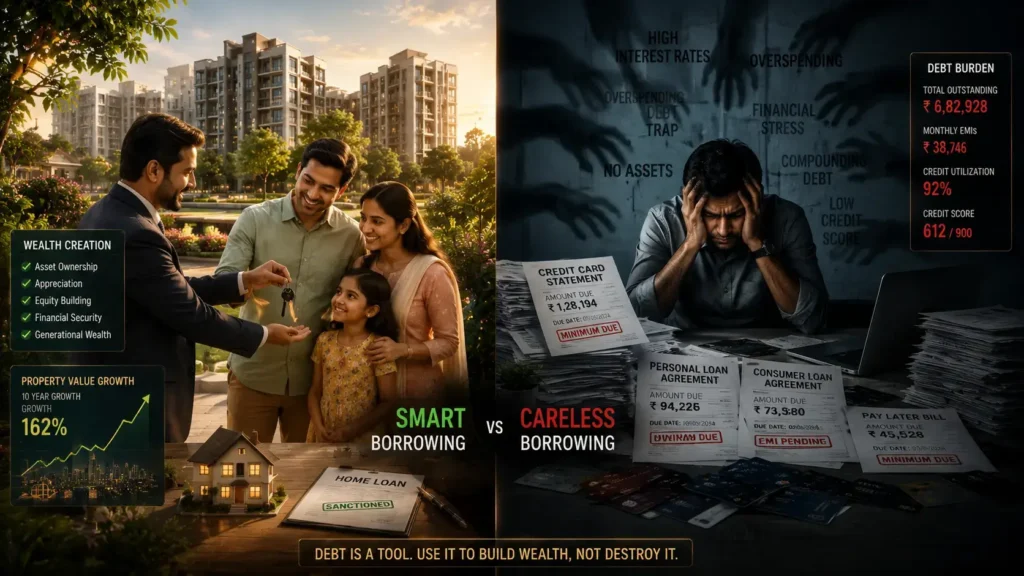
The Theory
Economists often divide debt into two broad categories:
Productive Debt
Debt used to acquire assets or increase future earning power.
Examples:
- Home loans
- Education loans
- Business loans
Consumptive Debt
Debt used primarily for spending.
Examples:
- Credit card balances
- Vacation loans
- Lifestyle financing
- Consumer durable financing
The healthiest National Household Debt Statistics usually contain a higher proportion of productive debt.
The most vulnerable debt profiles often contain large amounts of high-interest consumer debt.
This distinction explains why two countries can have similar debt levels but dramatically different financial risks.

This article is for educational purposes only and does not constitute financial advice. Figures, examples, and outcomes are illustrative and vary based on individual circumstances and lender policies. Always consult a certified financial advisor before making major financial decisions.
One Email a Week. Five Things Worth Knowing.
- One important financial change that actually affects you
- One practical money lesson
- One useful calculator
- One common mistake to avoid
- One guide worth reading