

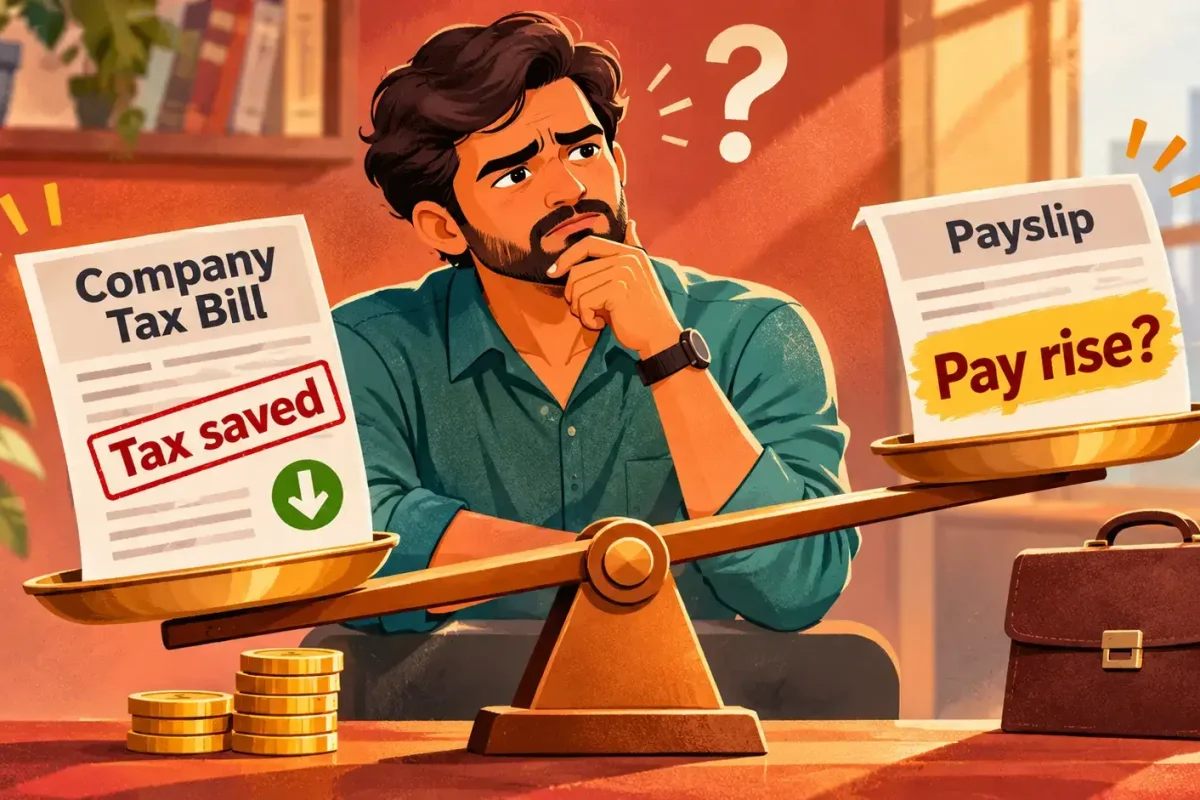
Are Salary Hikes Being Left Behind While Companies Get Tax Cuts?
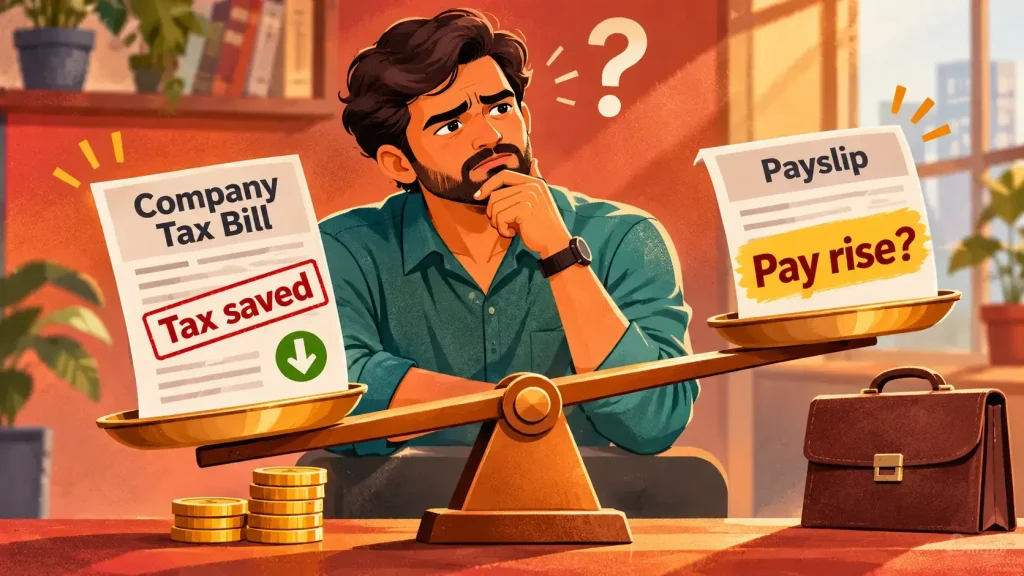
When people discuss salary hikes and corporate tax cuts India, they often expect tax relief for companies to mean better pay, more jobs or lower prices. It doesn’t happen automatically. A tax cut changes a company’s costs; it doesn’t require the company to share the benefit with employees.
So the complaint about salary hikes and corporate tax cuts in India has a real point. But it needs careful framing. Government policy can shape the conditions for wages and employment. Your employer still decides how much available money goes to payroll, expansion, debt repayment or shareholder returns.
Is the government favouring companies over professional employees? The answer depends on what the policy is meant to do, who benefits in practice and whether workers see any knock-on gains.
This guide separates the argument from the evidence and gives you a practical way to assess what it means for your pay. Judge the debate over salary hikes and corporate tax cuts India by looking at outcomes—not by assuming a direct link.
| Scenario | Inflation | Real gain |
|---|
Key Takeaways
- A corporate tax cut does not automatically lead to a salary hike, bonus or lower prices.
- Supporters argue that lower business costs can encourage investment, hiring and growth; those outcomes depend on company decisions and economic conditions.
- Employees may feel squeezed when their pay rises more slowly than household costs, even if headline economic indicators look strong.
- “Professional employees” are not one uniform group: pay outcomes vary by industry, role, seniority, location and bargaining power.
- To assess your own raise, compare take-home pay and recurring expenses rather than relying on the percentage alone.
- Government policy, employer choices and market conditions all shape wages; blaming only one of them can hide the real cause.
Salary hikes and corporate tax cuts India: what is the actual trade-off?
Tax relief for a company is not a pay-rise promise
Corporate tax is paid by companies on taxable profits under applicable rules. When the government reduces a company’s tax burden, the immediate effect is on the company’s finances—not your payslip.
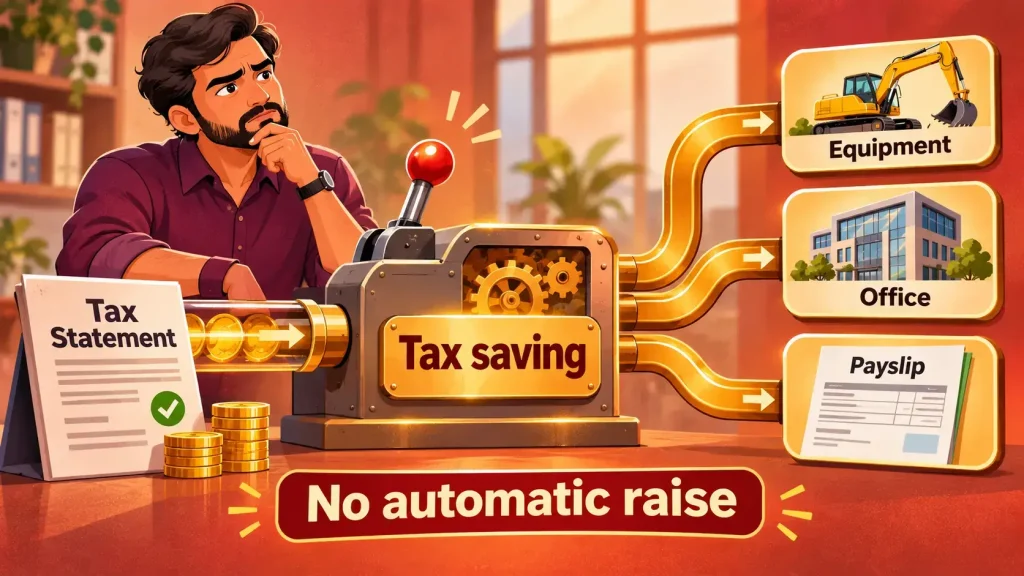
No automatic mechanism turns a tax saving into a matching salary increase. That distinction is central to the debate about salary hikes and corporate tax cuts India.
A business may use extra cash to invest in equipment, open a new office, repay borrowing, build reserves or distribute returns to owners. It may also use some of it to recruit or improve compensation.
Which route it takes depends on demand, competition, its balance sheet and management priorities.
That distinction matters. A policy may aim to encourage business activity without guaranteeing workers an equal or immediate share. Calling a tax cut a direct pay benefit overstates the case.
Why governments argue that companies need room to grow
The case for lower business taxes is that companies with more money available may invest, expand production and hire. If that expansion creates demand for skilled workers, competition for talent could put upward pressure on pay over time.
That chain of effects is possible, not guaranteed. It’s why claims about salary hikes and corporate tax cuts India need to be tested against actual hiring and pay outcomes.
The chain can break at several points. A company may face weak demand and hold back investment. New equipment might raise output without adding many jobs. Or a firm may expand but hire for roles that don’t match the skills or locations of existing employees.
The time lag can be long. A worker facing rent due on the 5th may see no relief from an investment plan announced this year.
Why the “favouritism” charge resonates
When your salary feels stuck while companies receive visible policy support, the contrast is hard to ignore. Employees usually can’t negotiate their personal tax burden in the same way the government changes a corporate tax framework.
Even when employers report growth, your raise can remain modest if the business faces little pressure to retain staff.
Still, that comparison alone doesn’t prove the government has deliberately neglected professional employees. A fair assessment looks at wages, hiring, prices, productivity and investment over a useful period—and asks whether the gains reached ordinary workers.
A headline tax announcement can’t answer that by itself, including in arguments about salary hikes and corporate tax cuts India.
What a stagnant raise looks like in a household budget
Rojina’s raise looks different after monthly costs
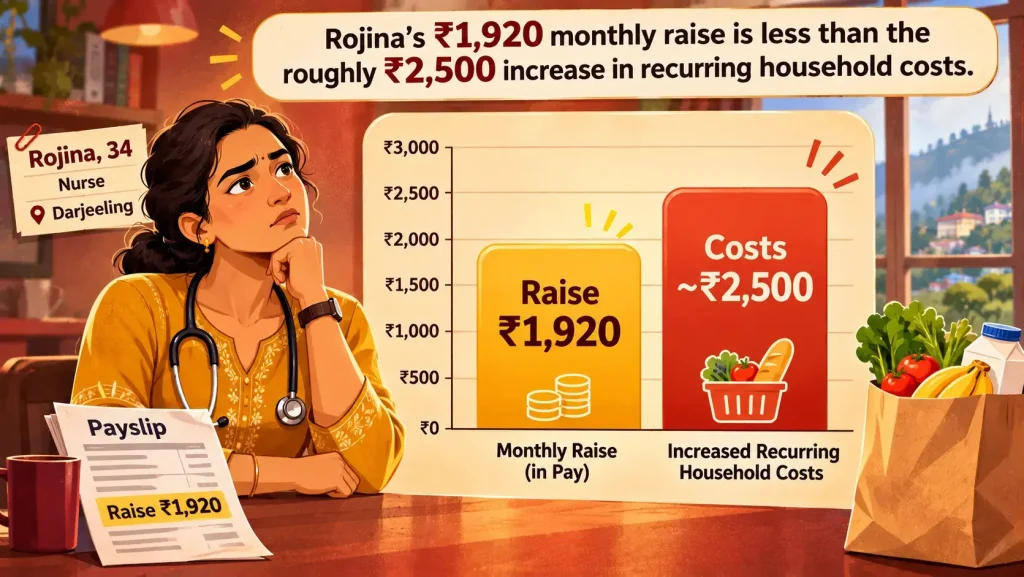
Rojina, a 34-year-old nurse in Darjeeling, earns ₹48,000 a month after deductions. Her take-home pay rises by 4%, or about ₹1,920 monthly.
If her recurring household costs have risen by roughly ₹2,500, the raise hasn’t given her more breathing room. It hasn’t covered the additional outgo.
That doesn’t prove a corporate tax cut caused her pay outcome. Her employer’s finances, staffing needs, local labour market and the timing of her review may all matter.
But it explains why a nominal raise can feel like no raise at all. Salary hikes and corporate tax cuts India have no simple cause-and-effect relationship in an individual household budget.
| Monthly item | Before | After the change | Difference |
|---|---|---|---|
| Take-home pay | ₹48,000 | ₹49,920 | +₹1,920 |
| Recurring household costs | ₹35,000 | ₹37,500 | +₹2,500 |
| Amount left after those costs | ₹13,000 | ₹12,420 | -₹580 |
The table leaves out irregular costs such as a medical bill, school expenses or travel to visit family. That’s exactly why salary comparisons based only on the raise percentage can mislead.
Tabish’s employer may grow without raising every salary
Tabish, a 29-year-old software support specialist in Hyderabad, earns ₹72,000 a month. His employer invests in new systems and expands a team, but his own annual increment is limited.
That can happen if the new roles differ from his, if the company is containing payroll costs, or if his job market is less competitive than the roles being recruited.
Could business growth eventually improve his opportunities? Possibly. But an expanding company doesn’t prove that every existing employee will get a larger increment.
The practical question is whether growth is giving people with his skills more bargaining power, better roles or improved compensation. That’s the test behind the discussion of salary hikes and corporate tax cuts India.
What the policy argument gets right—and what it misses
The strongest case for concern
Public policy shapes the economic environment, and tax choices don’t affect everyone equally. If relief is concentrated on businesses while workers face weak wage growth and rising everyday costs, people can reasonably ask whether the benefits are being shared.
That’s a question about distribution—not just whether a policy helped company accounts.
Kiranjot, a 41-year-old logistics supervisor in Patiala, earns ₹61,000 a month and supports a household with school and transport expenses. A small raise may disappear quickly into recurring costs.
If the company reports stronger profits but gives employees little visibility into pay decisions, frustration is understandable. The missing piece is evidence about the company’s results, wage trends and the wider labour market—not an assumption that tax policy alone set her increment.
The same evidence-based approach matters when assessing salary hikes and corporate tax cuts India.

The limits of the claim
It’s too simple to say every corporate tax cut is money taken directly from workers. Government revenue, public spending, business investment and employment interact. A tax change doesn’t map one-for-one onto any individual’s salary.
Lower tax revenue can also affect the government’s fiscal room. The eventual consequences depend on the full budget and other revenue sources.
It’s just as simplistic to claim company tax relief will reliably “trickle down” to employees. Firms may invest, but they may choose other uses for the funds.
Workers need actual wage, hiring and price data to know what happened—not a promise about what should happen. The Reserve Bank of India (RBI) publishes inflation information that can help put changes in household costs into context.
How to judge the effect without confusing correlation with cause
Look at several indicators together: wage changes in the relevant industry, hiring levels, inflation in household essentials, company performance and changes in productivity.
A national average can hide very different experiences for a nurse in Darjeeling, a support specialist in Hyderabad and a logistics supervisor in Patiala. For a related personal-finance perspective, see InvestingLens’ “How to Calculate Your Real Salary After Inflation.”
For your own pay, compare the increase in take-home income with the increase in recurring costs. A raise from ₹50,000 to ₹52,000 is 4%. But if rent, school fees and commuting costs rise by ₹2,500 combined, your monthly margin has narrowed.
Try it yourself: write down last year’s take-home pay, this year’s take-home pay and the costs that repeat every month. The gap tells you more than the headline increment.
That calculation can clarify your experience without treating salary hikes and corporate tax cuts India as a guaranteed direct link.
Is this a fair policy trade-off for employees?
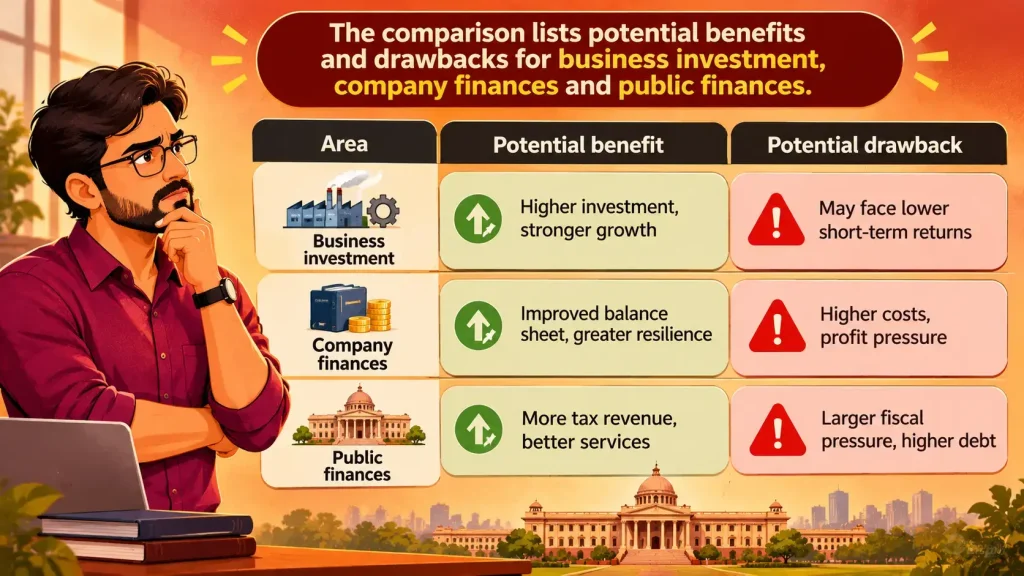
Potential benefits and drawbacks, side by side
| What to assess | Possible benefit | Possible drawback |
|---|---|---|
| Business investment | More capacity or expansion may support future hiring. | Investment may not create many jobs or may take years to affect wages. |
| Company finances | Lower tax costs may help some firms manage pressure or fund growth. | Employees are not entitled to an automatic share of the savings. |
| Public finances | A stronger business base may support economic activity over time. | Lower revenue can narrow fiscal choices if other sources do not offset it. |
| Employee pay | Competition for skills can strengthen some workers’ negotiating position. | Workers in slower-growing roles or sectors may see little change. |
Who may see the upside—and who may not
Workers in a growing sector with scarce skills may benefit if employers compete for them. Employees at firms facing weak demand, operating constraints or a large available workforce may see little connection between tax policy and their own compensation.
Public-sector employees also have different pay-setting arrangements from private-sector staff. Treating all professionals as one group blurs the analysis.
Is a company’s tax saving evidence that your pay is being held down? No. It’s a reason to ask how the business allocates resources, but it can’t establish the cause of an individual pay decision on its own.
That caution matters when discussing salary hikes and corporate tax cuts India.
Questions worth asking before drawing a conclusion
- Did the company’s revenue, profits or investment actually change, or is the argument based only on a tax announcement?
- How did salaries for comparable roles and experience levels move in the same industry?
- Did hiring increase, and were those new jobs relevant to existing employees’ skills?
- Did your own take-home pay outpace the recurring costs you actually face?
- Is the claimed policy benefit based on measured outcomes or an expectation about future growth?
These questions help whether you’re assessing a national debate or trying to interpret your own increment. For a personal pay review, look at your role, skills, performance, local market and take-home purchasing power—not the tax rate alone.
That’s a more useful way to evaluate salary hikes and corporate tax cuts India than relying on slogans.
FAQs
Do corporate tax cuts automatically increase employee salaries?
No. A tax cut changes a company’s tax burden, but there is no automatic rule requiring the company to pass the saving to employees as salary.
Can corporate tax cuts create more jobs in India?
They may support investment or expansion in some circumstances, which can create jobs. The outcome depends on demand, company decisions, the kind of investment and broader economic conditions.
Why can my salary rise while my household feels poorer?
Your take-home pay may rise more slowly than recurring costs such as rent, food, transport or school fees. Comparing the actual monthly increase in income with those costs shows whether your available margin grew or shrank.
Does slow salary growth prove the government favours companies?
Not by itself. It raises a legitimate question about who benefits from policy, but judging the claim requires evidence on wages, hiring, prices, investment and public finances over time.
Final Thoughts
The blunt truth: a company’s tax relief is not your salary increment. It may help create conditions that support business growth, but workers don’t benefit automatically, equally or on the same timeline.
That gap between policy intent and household experience deserves scrutiny. For salary hikes and corporate tax cuts India, distinguish a possible economy-wide effect from an assured change in any one employee’s pay.
Before treating your annual raise as a win or a failure, calculate the change in take-home pay and compare it with the recurring costs that changed during the same period. For the wider policy debate, look for wage and employment evidence alongside company tax figures. The examples above are illustrations, not accounts of actual individuals.
The examples above are simplified, and their figures are assumptions used to show how the numbers work.

Rules, rates, and thresholds mentioned here can change. This article reflects information available as of the last review date above — always verify current requirements with the official source (RBI, SEBI, IRDAI, or the relevant authority) before acting.
One Email a Week. Five Things Worth Knowing.
- One important financial change that actually affects you
- One practical money lesson
- One useful calculator
- One common mistake to avoid
- One guide worth reading