

El Niño and the Financial Impact on Indian Middle-Class Families: 7 Proven Budget Checks
A forecast about El Niño can sound far removed from your bank balance. Then tomato prices jump, the fan runs all night, a water tanker arrives, or a family business has fewer customers. The weather story becomes a money story—often before anyone has named it.
The El Niño impact on Indian middle class families is not a single predictable bill. It depends on where you live, what you eat, how your home handles heat, and whether your household income depends on agriculture, tourism, transport or outdoor work. A national forecast cannot tell you exactly what your monthly expenses will be.
This guide breaks down the channels that can affect a household, shows how to stress-test a budget with realistic numbers, and explains what to check before a temporary squeeze turns into expensive borrowing.

Key Takeaways
- El Niño does not automatically mean a drought or a specific food-price increase; local rainfall, crop conditions, policy and supply chains matter.
- Household pressure often arrives through several small changes at once: food, electricity, water, commuting and reduced income.
- Use a separate weather-pressure line in your budget instead of treating every price change as a permanent new normal.
- Compare bills and quantities, not just headline prices. A higher bill may reflect increased usage, a tariff change or both.
- Build a short cash-flow scenario around your own location and income rather than relying on a national average.
- Protect essential payments from short-term shocks where possible; revolving credit and app-based borrowing can make a temporary squeeze costlier.
Why El Niño can show up in a household budget
El Niño is a climate pattern involving warmer-than-average sea-surface temperatures in parts of the tropical Pacific. It can influence weather patterns, including India’s monsoon, but it does not dictate the exact rainfall in every district. Indian Ocean conditions, regional weather systems, reservoir levels and government measures also shape what happens on the ground.
That distinction matters for your money. A weak monsoon in one area can affect a crop or local water supply while another region experiences a different pattern. Prices may respond to a short supply disruption, but imports, storage, transport costs and policy decisions can soften or intensify the effect. The El Niño impact on Indian middle class families is therefore uneven, not a universal surcharge on every household.

From a climate signal to a price tag
The route is usually indirect. Weather can influence sowing, crop yields, livestock feed, water availability and demand for cooling. These changes can then affect wholesale supply, local market prices, electricity consumption and work conditions. A household sees the final bill, not the chain that produced it.
Take Ruchika, a nurse in Jaipur, whose household spends around ₹9,000 a month on groceries. If vegetables and cooking ingredients become more expensive, she may notice the shift across several purchases rather than in one dramatic bill. The useful question is not “Did El Niño cause this exact price?” It is “What changed in our monthly spending, and is it temporary or recurring?”
Forecasts are signals, not household price predictions
Seasonal forecasts provide probabilities and broad patterns. They are not a promise that your city will get a specific number of rainy days or that a particular food will rise by a set percentage. Avoid turning a climate headline into a precise personal forecast.
For the El Niño impact on Indian middle class families, local evidence is more useful than alarmist predictions: actual market prices, your electricity bill, municipal water notices, and updates from official weather and agriculture sources. A forecast can prompt a budget check. It cannot replace one.
Five household spending channels worth watching
A climate-related squeeze rarely arrives as a neat line item marked “El Niño.” It can spread across a few ordinary categories. Tracking those categories separately for two or three billing cycles helps you identify what is genuinely changing.

Groceries and food choices
Food prices depend on season, supply, transport, storage, arrivals at local markets and policy—not weather alone. Even within the same city, the price difference between a neighbourhood vendor and a supermarket can be meaningful. Comparing the same basket matters more than remembering what one item cost last month.
Vanlalruata, who works in a school office in Lunglei, has a monthly household food budget of about ₹8,500. If fresh produce gets dearer, his family could keep the total stable only by changing quantities or choosing different seasonal items. That is a trade-off, not proof that the family has solved the problem. Nutrition, convenience and local availability all matter.
Track a repeat basket of roughly 10 to 15 items. Record the quantity, price and shop. If the total rises, you can see whether the cause is higher prices, a switch to more expensive products, or buying more because of guests or a change in routine.
Electricity, cooling and water
Hotter conditions can increase fan, cooler or air-conditioner use. But a higher electricity bill can also reflect a tariff revision, billing-cycle length, an appliance fault or a changed household schedule. Compare units consumed and the number of billed days, not only the rupee total.
Water stress may bring a different cost: tanker charges, extra storage, bottled water or repairs to pumps. These expenses are highly local. A household in an apartment with reliable municipal supply faces a different risk from a household in an area where supply interruptions are common.
Transport and daily work
Heat, heavy rain or local disruptions can change commute time and cost. A cab instead of a bus, extra fuel for a detour or a day of lost wages may look small once. Repeated across a month, it can crowd out other payments.
For households with outdoor work, weather may affect shifts, deliveries, construction schedules or customer footfall. The budget risk is then not just higher spending. It may be lower or less predictable income.
Healthcare and home maintenance
Heat-related discomfort, poor sleep or disrupted routines can lead to extra spending on medicines, clinic visits or repairs. These effects are not the same for every person, and a weather event should not be used to diagnose symptoms. Keep medical costs in the picture without assuming they will occur.
Leaks, dampness, electrical faults and cooling-appliance servicing can also create lumpy costs. A household that waits until peak season to service an appliance may face fewer repair options and greater inconvenience. That is a maintenance-planning issue, not a reason to buy new equipment in a rush.
School, care and family support
When heat or local weather interrupts routines, parents may pay for alternate transport, childcare or meals outside the home. Families may also support relatives facing a poor harvest, disrupted work or water shortages. Those transfers deserve a place in the household cash-flow picture; they are not invisible spending.
Stress-test the numbers instead of guessing
There is no single reliable “El Niño allowance” that fits every Indian household. Start from your own recent spending, then test a few changes separately. Keep the scenario modest and transparent: it is a planning exercise, not a prediction that every cost will rise together.

Build a baseline from actual transactions
Use bank statements, UPI history, electricity bills and grocery receipts from the last three months. Separate fixed commitments from flexible spending, and avoid counting a one-off purchase as a normal monthly cost. If a category varies seasonally, compare with the same season from last year when that information is available.
Sangeetha, a textile shop supervisor in Salem, brings home about ₹52,000 a month. Her household baseline is ₹10,000 for groceries, ₹2,800 for electricity and water, ₹4,000 for commuting, and ₹7,500 for school and family care. These figures are a starting point, not a claim about what her expenses will do.
Use a scenario table with separate assumptions
Try it yourself: create a “pressure month” by adding only costs you can explain. For example, test a 10% grocery increase, an extra ₹800 for electricity and water, and ₹600 in transport changes. The percentages and rupee amounts below are illustrative inputs for a calculation—not forecasts or recommended buffers.
| Monthly category | Baseline | Illustrative pressure | Scenario total |
|---|---|---|---|
| Groceries | ₹10,000 | 10% increase: ₹1,000 | ₹11,000 |
| Electricity and water | ₹2,800 | Additional ₹800 | ₹3,600 |
| Commuting | ₹4,000 | Additional ₹600 | ₹4,600 |
| Combined total | ₹16,800 | Additional ₹2,400 | ₹19,200 |
In this example, the three categories add ₹2,400 to the month. The arithmetic is simple; the judgement is not. Perhaps the grocery increase lasts one month, while a water expense continues for a season. Mark each assumption as temporary, uncertain or recurring. That gives you a more useful estimate than treating every headline as a permanent cost.
Check the cash-flow gap, not just the total
Compare the pressure-month total with money available after essential commitments. A household can be within its annual budget and still face a tight week because a school fee, rent and utility bill fall before payday. Timing matters.
Write down due dates for rent, loan payments, school costs, insurance premiums and utility bills. Then check whether the scenario leaves a shortfall before the next salary or business receipt. This is where a seemingly manageable ₹2,400 increase can trigger a credit-card balance or a missed payment if cash is already committed.
How to adjust without creating a bigger problem
When costs rise, the first reaction is often to cut whatever looks easiest. That can backfire. Skipping necessary medicine, delaying a required bill or replacing a useful commute with an unsafe option may create a more expensive problem. A careful response starts by separating essential costs, adjustable costs and decisions that need more information.

Look for changes that preserve the household routine
Review food waste, delivery frequency, duplicate subscriptions and peak-hour appliance use. A ₹20 chai or a Swiggy order is not automatically the problem; the pattern and total matter. One household may find ₹1,200 in low-value spending, while another has no meaningful discretionary margin at all.
Ruchika could compare her grocery receipts and find that a few items are being bought twice because of separate market trips. That is a practical efficiency, not a moral lesson about spending. Another family may already shop carefully and have little room to cut without affecting nutrition or convenience.
Separate a temporary shock from a lasting change
Use a simple review date. If the higher bill or price persists for several cycles, investigate the underlying cause: tariff, usage, supply or a permanent change in household needs. If it is clearly a one-off repair or a short disruption, spreading it mentally across a full year can distort the budget.
The El Niño impact on Indian middle class families can also be indirect and delayed. A food price may stay elevated after a weather event has passed, while an electricity spike may disappear when temperatures ease. Do not assume all climate-linked costs start and end at the same time.
Be cautious with borrowing as a bridge
A credit card or small loan may cover a timing gap, but the cost depends on the product’s interest, fees, repayment schedule and what happens if payment is late. Paying only a card’s minimum due can leave the remaining balance accruing costly interest. Short-term borrowing is not automatically wrong, but treating it as extra income is a dangerous accounting trick.
Before accepting a new loan, compare the total repayment amount and the effect on existing monthly obligations. Check the lender’s regulated status and read the agreement, especially for a digital loan. If a repayment problem is already developing, official lender grievance channels and RBI information are more useful than an unsolicited “instant relief” offer.
Income risk deserves as much attention as higher bills
Household budgets are often modelled as if salary and business income never change. Weather-related disruption can challenge that assumption, particularly for casual work, agriculture-linked businesses, tourism, transport and outdoor services. Even a salaried employee may face altered shifts or higher commuting costs.
Map which income streams are weather-sensitive
List income by source, not only as one monthly total. Note which part is fixed, variable or seasonal. A household with one stable salary and one commission-based income has a different exposure from a family where several earners depend on local footfall.
Vanlalruata’s household may have predictable salary income, but if a relative who contributes to family expenses earns from seasonal work, the wider family cash flow can still be affected. The point is not to assume a loss. It is to know which contribution might arrive late and what payments depend on it.
Prepare for timing gaps and uneven receipts
For a small business or self-employed worker, track receivables, supplier payments and household withdrawals separately. A month with lower sales can create a cash shortage even if the business remains viable over the year. Mixing all money in one account makes the gap harder to see.
Try it yourself: note the date income normally arrives, the date major bills fall due, and the smallest balance your account reaches during a typical month. Then repeat the exercise with one delayed payment or a lower variable-income month. That low point—not your average balance—shows how much timing pressure the household can absorb.
Use local evidence and avoid climate headline traps
Climate coverage can swing from “no concern” to “everything will become expensive” within days. Neither is a household budgeting method. El Niño is one influence among several, and a forecast headline cannot tell you the price of your local vegetable basket or the number of units your home will consume.
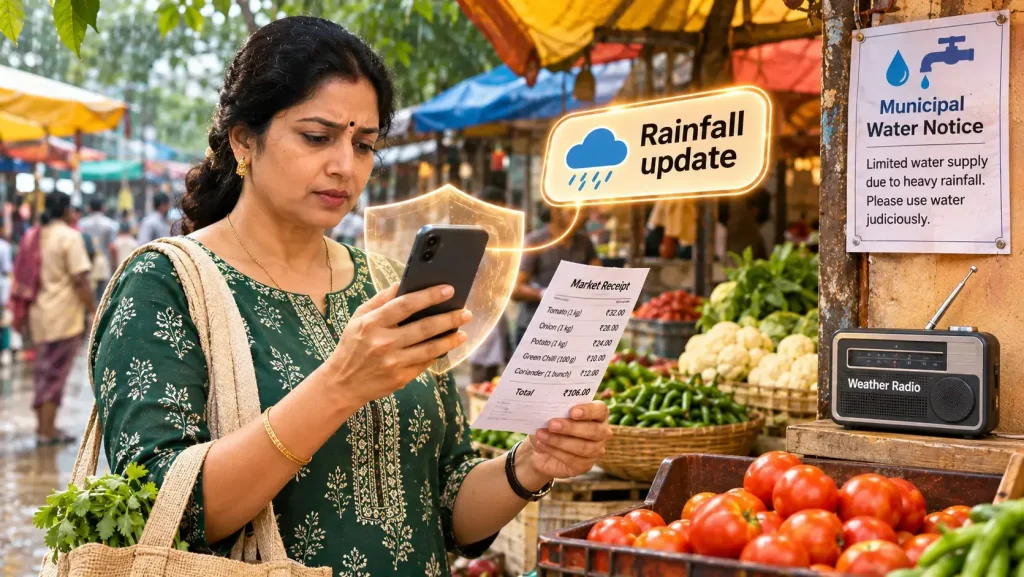
Check what is happening near you
Use local market receipts, your electricity distributor’s bill, municipal water notices and official weather updates. For rainfall and forecast information, check the India Meteorological Department. For broader policy and economic context, RBI publications can help explain inflation and household conditions, but they will not replace your own expense records.
Look for repeat evidence rather than reacting to one expensive shopping trip. A local price can jump because of a transport disruption or a festival demand spike. One month’s bill may contain a longer billing period. The El Niño impact on Indian middle class families becomes easier to assess when those explanations are kept separate.
Watch for exploitative claims and rushed purchases
Extreme weather headlines can be used to sell overpriced appliances, dubious water devices or high-return investment schemes supposedly linked to the crisis. Ask what the product does, what it costs to operate and whether the seller’s claims can be verified. A genuine household need does not make every urgent sales pitch trustworthy.
Do not make an investment decision based on a weather prediction or a claim that a specific crop, commodity or company is certain to benefit. Market prices and business outcomes have many moving parts. For product-specific or investment questions, verify information with the relevant official source and consider a SEBI-registered adviser for personal advice.
Build a household response that can be reviewed
A useful plan is a small set of checks you can revisit—not a complicated spreadsheet that becomes outdated after one week. The El Niño impact on Indian middle class families may vary by city, income and season, so your plan should be adjustable rather than built around a single dramatic forecast.

Set a short review rhythm
For the next two or three months, record groceries, utilities, water, transport and weather-related repairs. Review the total once a month. If one category has risen, ask whether the cause is price, quantity, timing, tariff or a one-off event before changing another part of the budget.
Budgeting and Money Management is the site hub for practical cash-flow and spending topics. The existing article “El Niño and Your Monthly Budget: 7 Real Money Pressures to Watch” also covers household pressures related to this climate pattern. Use those resources as context, then ground decisions in your own statements and bills.
Make the plan resilient, not rigid
A household plan can include a buffer for irregular costs, but the amount depends on income stability, existing savings, dependants and fixed obligations. There is no universal number that makes every family prepared. Keep a clear distinction between cash set aside for near-term needs and money committed to longer-term goals.
For Sangeetha’s household, the scenario table might lead to a conversation about bill timing, the school calendar and whether the appliance service is due—not an automatic cancellation of every optional expense. The practical win is seeing the pressure before the card bill arrives. Even a modest amount of clarity can reduce panic.
Know when the issue is bigger than budgeting
If repeated income disruption or rising essential costs make payments unmanageable, a budget alone may not solve it. Contact the relevant lender or service provider through verified channels, ask about available processes and keep records of communication. For persistent debt stress, qualified credit counselling or a registered professional can help assess the options without promising a quick fix.
For household-level climate planning, local government and utility guidance may matter as much as finance information. Check official heat, water and weather alerts. A money plan cannot prevent a weather event, but it can make the financial effects more visible and reduce the chance of a rushed, expensive response.
FAQs
Does El Niño always cause food prices to rise in India?
No. El Niño can influence weather, but food prices also depend on local rainfall, crop supply, storage, transport, imports and policy decisions. A specific price increase cannot be attributed to El Niño without looking at those factors.
Which household expenses are most affected by El Niño?
Food, electricity, water, transport, healthcare and income can all be exposed, but the effect varies by location and household circumstances. Track actual bills and spending rather than assuming every category will rise.
How can I estimate the El Niño impact on Indian middle class families in my budget?
Start with recent grocery, utility and transport costs, then test modest, clearly labelled changes one category at a time. Treat the result as a planning scenario, not a forecast, and compare it with your available cash flow and bill dates.
Should I borrow money to manage weather-related expenses?
Borrowing has costs and repayment obligations, so compare the total amount payable, fees and effect on existing commitments before making a decision. If the problem is personal or persistent, consult the lender’s official channels or a qualified professional rather than relying on unsolicited offers.
Final Thoughts
El Niño does not send a bill with its name on it. The financial effects arrive through ordinary prices, usage, disrupted routines and income uncertainty—and they are different from one household to another. That is why a national forecast is a prompt to pay attention, not a substitute for your own numbers.
Start with three recent grocery records, two utility bills and your next month of due dates. Run a modest pressure scenario, check local official updates and revisit the figures when real costs arrive. For advice tailored to your situation, use verified official information or speak with a qualified professional.
The examples above are simplified, and their figures are assumptions used to show how the numbers work.
Build a Safety Net, Step by Step
See a short list of guides and calculators for budgeting, emergency savings and protecting yourself from big expenses, in a sensible order, with no sign-up. It is for learning, not personal advice.

This article is for educational purposes only and does not constitute financial advice. Figures, examples, and outcomes are illustrative and vary based on individual circumstances and lender policies. Always consult a certified financial advisor before making major financial decisions.
One Email a Week. Five Things Worth Knowing.
- One important financial change that actually affects you
- One practical money lesson
- One useful calculator
- One common mistake to avoid
- One guide worth reading