
7 Proven Truths About FD-Backed Credit Cards in India: Who Should Actually Get One?
FD backed credit card India eligibility and benefits
You have a fixed deposit. You have zero credit history. You want a credit card. Banks know this gap exists, and they’ve built a product specifically to exploit it — politely called an FD-backed credit card.
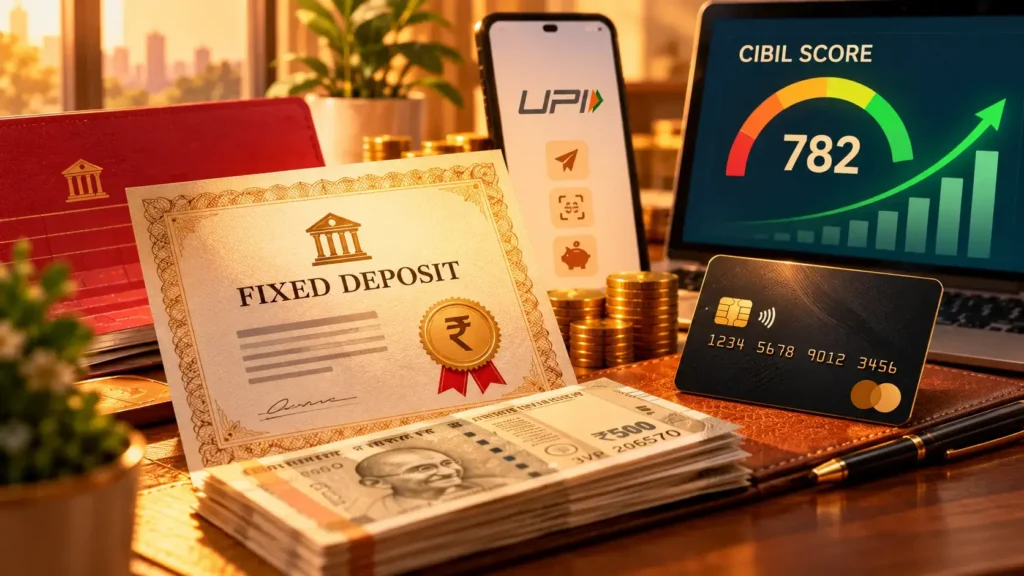
In simple terms, you park money in a fixed deposit with a bank, and that FD becomes collateral for a credit card. The bank doesn’t need to trust your CIBIL score because your own money backs the card. If you default, they liquidate the FD. It’s the financial equivalent of lending your friend ₹50,000 and keeping their watch as security.
The FD backed credit card India eligibility and benefits have made this product one of the most searched credit card topics in India, especially among first-time borrowers, young professionals, and retirees. But here’s the thing — it’s not automatically the best move for everyone. And the banks aren’t going to tell you that.
Let’s break down exactly what you’re signing up for, who actually benefits, and where this product quietly fails you.
Key Takeaways
- An FD-backed credit card requires you to lock in a fixed deposit — usually ₹10,000 to ₹25,000 minimum — as collateral for your credit limit.
- Your FD backed credit card India eligibility and benefits include instant approval even with no CIBIL score, making it ideal for credit newcomers.
- Credit limits typically range from 75% to 100% of your FD value, depending on the bank.
- You still earn interest on the FD while using the card — so your money isn’t completely frozen out.
- Missing payments can cost you the FD itself, and damage your CIBIL score.
- Not all FD-backed cards offer reward points, lounge access, or the perks of regular premium cards.
- This product works best for building credit history, not for earning rewards or cashbacks.
How FD-Backed Credit Cards Actually Work
How Does It Work?
You open a fixed deposit — say ₹50,000 with SBI or HDFC. The bank then issues a credit card against it, typically setting your limit at 80% to 90% of that FD amount. So on a ₹50,000 FD, you’d get a card with a ₹40,000 to ₹45,000 limit. The FD stays locked for the card’s lifetime, but you keep earning the FD interest rate — currently around 6.5% to 7% annually at most public sector banks.
Ravi, a 24-year-old software trainee in Hyderabad earning ₹18,000 a month, opened a ₹20,000 FD at his bank and got a ₹18,000 credit limit within three days. No income proof, no CIBIL check, no guarantor. That’s the pitch, and it works exactly like that.
Who Can Apply for an FD-Backed Credit Card?
The FD backed credit card India eligibility and benefits are deliberately broad because the banks want volume. You generally need to be:
- An Indian resident aged 18 or above.
- Holder of an FD with the issuing bank (minimum amounts vary — ₹10,000 at SBI, ₹20,000 at HDFC Bank, ₹15,000 at Axis Bank).
- Not necessarily employed — students, homemakers, and retirees with an FD can apply.
- A valid PAN card holder, as per RBI KYC norms.
The beauty of this structure is that the bank takes almost zero risk. That’s why approval rates for FD-backed cards hover near 95% — it’s practically guaranteed. But guaranteed approval doesn’t mean guaranteed value.
FD-Backed Credit Card India Eligibility and Benefits
Eligibility Criteria You Need to Know
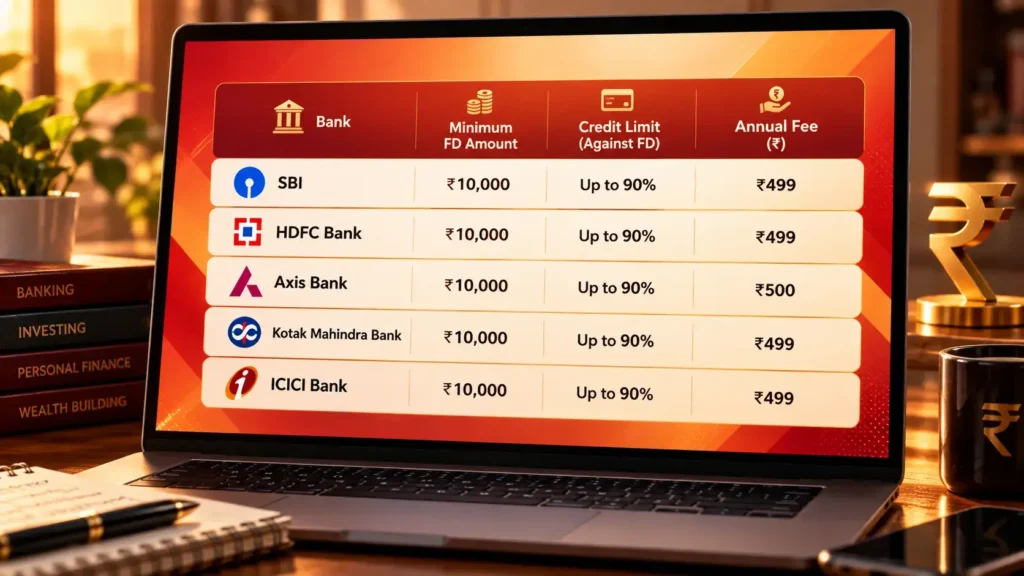
When you look at the FD backed credit card India eligibility and benefits across major banks, the pattern is strikingly similar. The table below gives you a quick comparison of what different banks demand.
| Bank | Minimum FD Amount | Credit Limit (% of FD) | Annual Fee |
|---|---|---|---|
| SBI (SBI Cashback / Unnati) | ₹10,000 | 85% – 100% | Nil (for select cards) |
| HDFC Bank (Insta Easy) | ₹20,000 | 80% – 90% | ₹500 – ₹1,000 |
| Axis Bank (Axis ASAP) | ₹15,000 | 80% – 85% | ₹500 |
| Kotak Mahindra (K8 Smart) | ₹10,000 | 85% – 90% | ₹500 |
| ICICI Bank (Coral / Instant) | ₹20,000 | 80% – 85% | ₹500 |
Notice that the minimum FD amounts range from ₹10,000 to ₹20,000. At ₹10,000, you’re getting a card with roughly ₹8,500 to ₹10,000 limit. That’s not going to fund a vacation — it’s meant to help you build a credit footprint. The FD backed credit card India eligibility and benefits are real, but the scale is modest.
Key Benefits That Make These Cards Attractive
The benefits are real, but they’re narrow. Here’s what you actually get:
- No CIBIL score required: This is the headline benefit. If you’ve never borrowed money, you have no score. An FD-backed card skips that check entirely.
- Interest on your FD: Unlike a regular deposit that sits idle, your FD keeps earning 6.5%–7.5% annually while you use the card.
- Quick approval: Since the FD is collateral, processing takes 2–5 days versus weeks for a standard card.
- Rewards and cashback: Some banks like SBI offer cashback on select categories — but the rates are lower than premium cards.
- Credit score building: Timely payments get reported to CIBIL, slowly building your score from zero to 700+ over 12–18 months.
For someone like Priya, a 30-year-old homemaker in Pune with no income proof and no credit history, an FD-backed card was her only realistic path to a credit card. She put ₹30,000 in an FD at her local bank, got a card within four days, and within eight months of disciplined usage, her CIBIL score crossed 720. That’s a genuine success story — but it required patience and consistency.
Who Should Actually Get an FD-Backed Credit Card?
First-Time Credit Users Building Their Score
If you’re 18 to 30 years old, just started earning, and have never taken a loan, your CIBIL file is probably empty. Banks see an empty file as risky — not because you’re risky, but because they can’t measure you. An FD-backed card solves this problem directly.
The FD backed credit card India eligibility and benefits for this group are unmatched. You get a card, you build a score, and you don’t need a salary slip or Form 16. After 12–18 months of on-time payments, you can graduate to a regular card with better rewards and higher limits.
Retirees and Those Without Regular Income
Retired individuals often struggle to get credit cards because banks want salary slips and ITR filings. If you’ve got a ₹2 lakh FD sitting in your savings account, why not convert it into a credit card? The FD backed credit card India eligibility and benefits include relaxed income verification, making this a practical option for retirees who want the convenience of card payments without the paperwork.
Students and Young Professionals
College students above 18 can apply if they (or their parents) open an FD in their name. The credit limit is modest, but it teaches financial discipline early. The key benefit here is behavioral — learning to manage a credit line before real financial responsibilities hit.
Downsides and Risks You Must Consider
Your FD Is Locked Up — Literally
Here’s the trade-off nobody highlights enough: your money is locked until you close the card. If you need that ₹20,000 for an emergency, you’re out of luck unless you close the card first — and closing the card means losing the credit line and potentially resetting your CIBIL-building progress.
The FD backed credit card India eligibility and benefits don’t include liquidity. Your FD earns interest, yes, but you can’t break it without consequences. If you default on your card bill, the bank will recover dues directly from the FD — and you’ll be left with whatever remains.
Limited Perks Compared to Regular Cards
An FD-backed card is a basic product. You won’t get lounge access, premium reward multipliers, travel insurance, or concierge services. The cashback rates are typically 0.5% to 1%, versus 2% to 5% on regular cards like the HDFC Millennia or SBI Cashback. If you’re a heavy spender looking for rewards, an FD-backed card will frustrate you.
Defaulting Hurts More Than You Think
Missing a payment on a regular card tanks your CIBIL score. Missing a payment on an FD-backed card does the same — and costs you your FD. The bank will first send reminders, then deduct from the FD, and if the FD doesn’t cover the full outstanding, they can still pursue recovery. Your credit score takes the hit either way.
FAQs
Can I get a credit card against my fixed deposit?
Yes. Most major Indian banks — SBI, HDFC, Axis, ICICI, and Kotak — offer credit cards against FDs. You simply need an FD with the issuing bank meeting their minimum amount requirement, typically ₹10,000 to ₹20,000.
Does FD-backed credit card affect CIBIL score?
Yes, it does — both ways. Timely payments build your CIBIL score over time, while missed payments damage it just like any other card. The bank reports your activity to CIBIL monthly, so discipline matters.
What is the minimum FD amount required for an FD-backed credit card?
It varies by bank. SBI and Kotak require ₹10,000 minimum, while HDFC and ICICI typically ask for ₹20,000. Axis Bank sits in the middle at ₹15,000. Always confirm current requirements directly with the bank before applying.
Can I close my FD while the credit card is active?
No. The FD serves as collateral for the card. You must either close the card first or transfer the FD to a different product that the bank accepts as collateral. Breaking the FD while the card is active will trigger card suspension.
Is an FD-backed credit card worth it for building credit?
For someone with no credit history, absolutely. It’s one of the few guaranteed-approval products that reports to CIBIL. The FD backed credit card India eligibility and benefits make it the most accessible entry point into the credit system — but only if you use it responsibly and pay on time every month.
Final Thoughts
An FD-backed credit card isn’t a premium product, and it’s not meant to be. It’s a gateway — a bridge between having no credit and having a score that opens doors to better cards, lower interest rates on loans, and financial flexibility. The FD backed credit card India eligibility and benefits are straightforward: you lock money, you get a card, you build a score. That’s it.
For a deeper dive into building credit from scratch, see our InvestingLens article: How to Build Your CIBIL Score from Zero in India. But the real question isn’t whether you can get one. It’s whether you should. If you already have a CIBIL score above 700 and a steady income, a regular card will give you better rewards, higher limits, and more perks without locking up your savings. If you’re starting from zero, or if you’re a retiree without income proof, an FD-backed card is genuinely one of the best tools available to you.
Before you apply, check whether your existing bank offers this product — it saves paperwork and processing time. And once you have the card, treat it like a test of discipline, not a free spending limit. Pay in full every month, never exceed 30% utilization, and within a year, you’ll likely have the CIBIL score to graduate to something better. That’s the real endgame here — and it works.

This article is for educational purposes only and does not constitute financial advice. Figures, examples, and outcomes are illustrative and vary based on individual circumstances and lender policies. Always consult a certified financial advisor before making major financial decisions.
One Email a Week. Five Things Worth Knowing.
- One important financial change that actually affects you
- One practical money lesson
- One useful calculator
- One common mistake to avoid
- One guide worth reading