


Festive EMIs and Consumer Debt Traps: 7 Proven Checks Before You Borrow
The festive sale says “easy EMI.” Your bank app says the first instalment is manageable. Then the credit-card bill, rent, school fees and a family trip land in the same month. That is how a festive season debt trap India can begin: not with one outrageous purchase, but with several small monthly commitments that crowd out everything else.
Borrowing for a phone, fridge or family celebration is not automatically reckless. The trouble starts when the price is judged by the EMI alone, while fees, interest, existing dues and future expenses stay outside the calculation.
This guide shows you how to price festive borrowing honestly, stress-test your monthly budget and spot the point where a discount stops being a saving.

Key Takeaways
- A low EMI does not tell you the total amount payable or whether the purchase fits your budget.
- “No-cost EMI” offers can still involve processing fees, taxes on charges, lost discounts or other conditions; check the current terms.
- Add all existing EMIs and card dues before considering another festive purchase.
- Keep a clear monthly buffer for essentials and irregular costs instead of spending every rupee left after bills.
- Paying only the credit-card minimum due can keep interest accumulating on the unpaid balance.
- Compare the cash price, total instalment cost, fees and repayment dates in writing before accepting finance.
Why the festive season debt trap India can quietly take hold
The EMI makes a large price feel small
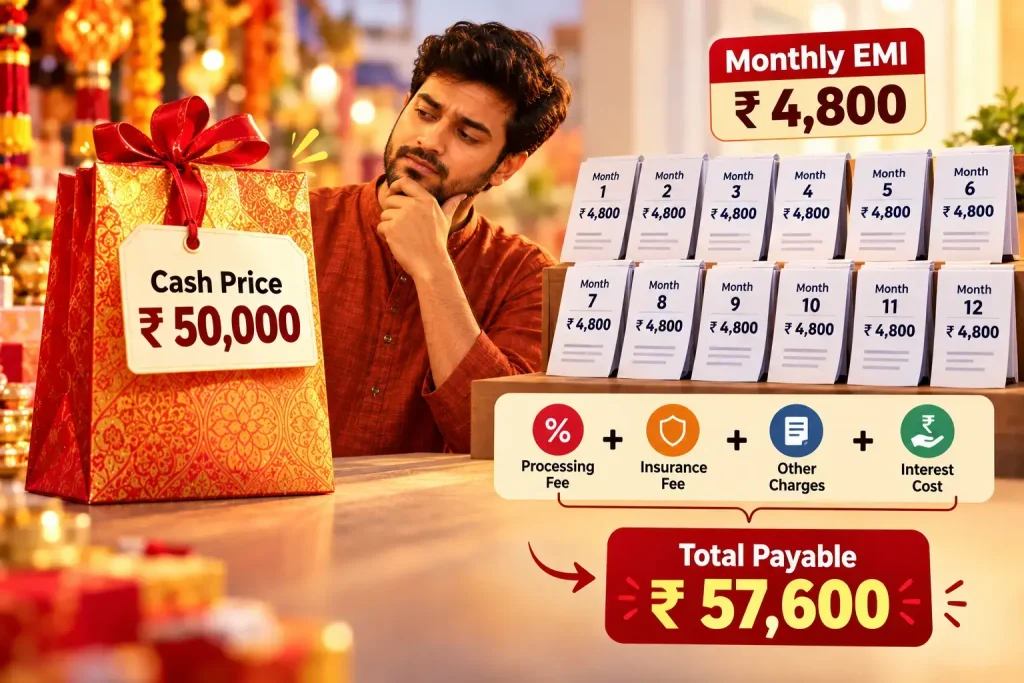
Retailers and lenders advertise the monthly amount because it is easier to fit into a conversation than the full cost. But ₹4,500 a month for 12 months is ₹54,000 before any additional fee. A customer focused only on “under ₹5,000” may miss that total—and the fact that this payment will still be due after the decorations come down. This is one way a festive season debt trap India can start, even when each purchase seems modest.
Take Chanda, a school administrator in Udaipur. She is comparing a ₹48,000 appliance with a festive offer of ₹4,300 a month. The instalments total ₹51,600, before possible fees. That does not automatically make the offer bad; it means the right comparison is against the cash price and full repayment amount, not against the monthly headline.
Several small commitments stack up
A phone EMI, a furniture instalment and a credit-card purchase can each look manageable on its own. Together, they reduce the money available for groceries, transport, medical costs and savings. This is the practical shape of a festive season debt trap India: next month’s salary arrives already partly spoken for.
For example, if a household has ₹8,000 of existing monthly EMIs and adds two new instalments of ₹3,000 and ₹2,500, the total becomes ₹13,500. The extra ₹5,500 is not a one-time festive expense. It repeats until those obligations end, and missed payments may also affect credit history. Tracking the combined amount helps households avoid a festive season debt trap India before the obligations build up.
“No-cost” is a claim to verify, not a magic phrase
Check whether the seller’s cash discount is unavailable on EMI, whether a processing charge applies, and whether taxes are added to applicable fees or interest. Read the lender’s repayment schedule and the offer conditions, not just the banner on the shop counter. Terms differ between banks, card issuers, NBFCs and individual promotions.
The Reserve Bank of India (RBI) publishes rules and consumer information relevant to lending. For a specific offer, however, the lender’s current key facts, agreement and statement show the charges attached to that transaction. A word like “no-cost” does not erase the need to read them, especially when assessing a possible festive season debt trap India.
Calculate the real cost before you say yes
Compare the cash price with every instalment
Put the options side by side. Include the upfront amount, total instalments, processing charges and any discount you would lose by choosing finance. If a salesperson cannot provide the total payable clearly, pause. You should not have to reverse-engineer a loan from a monthly figure.
| Cost item | Cash purchase | EMI offer |
|---|---|---|
| Advertised price | ₹40,000 | ₹40,000 |
| Upfront payment | ₹40,000 | ₹0 in this illustration |
| Instalments | ₹0 | ₹3,500 × 12 = ₹42,000 |
| Processing charge | ₹0 | Check the current offer |
| Discount or cashback lost | Check the cash offer | Check the EMI conditions |
This example is deliberately simple. Actual terms vary, and applicable taxes or charges can change the final amount. The festive season debt trap India becomes easier to avoid when you put those less-visible costs in the same calculation as the advertised EMI.
Check the calendar, not just the monthly total
Note the first payment date, statement date, salary date and any seasonal expenses due in the same period. A ₹3,500 instalment may fit in an average month but create a squeeze if it falls alongside annual insurance, school fees or travel. Timing is part of affordability, and checking dates can help prevent a festive season debt trap India from growing through missed payments.
Try it yourself: open your bank statement and card app. List every EMI and recurring payment due over the next three months, then add the proposed instalment. If the result leaves no breathing room for ordinary surprises, the offer is not affordable on those terms—even if the lender approves it.
Protect a buffer for real life
Sentimongla, a nurse in Dimapur, brings home about ₹42,000 a month. Her rent, groceries, transport and existing commitments take roughly ₹31,000, while a family event is expected to cost another ₹4,000. A new ₹5,000 EMI would leave little room for a medicine bill or a delayed reimbursement. Her decision point is not whether the bank app accepts the application; it is whether the remaining cash can absorb an ordinary setback.
There is no universal percentage that makes an EMI safe for every household. Income stability, dependants, existing debt and necessary expenses matter. A budget that allocates every remaining rupee to instalments is fragile. Leaving a buffer is a practical safeguard against a festive season debt trap India when an unexpected expense arrives.
Use a simple pre-purchase check to avoid overborrowing
Write down what you already owe
Gather your loan schedules, card statements and any active BNPL or shop-finance plans. Record the monthly payment, remaining term and due date for each. Small app-based payments count too; they do not become harmless because they are collected automatically. Making all these commitments visible is an important step in avoiding a festive season debt trap India.
For a wider view of household spending, How to Budget on a Rs. 30,000 Monthly Salary in India explains a budgeting framework. The point here is not to force every household into a fixed formula. It is to make existing commitments visible before adding another one.
Separate a need from a deadline invented by a sale
Ask whether the item is needed now, whether an existing product can last, and whether the sale price is genuinely lower than recent prices. “Offer ends tonight” is a marketing deadline, not proof that the purchase makes financial sense. Swiggy offers, flash sales and store banners can all trigger the same habit: treating a short window as permission to skip the arithmetic.
Kishorchand, a small-business bookkeeper in Bishnupur, is considering a ₹28,000 phone because his current one is unreliable. He writes down the repair estimate, cash price and EMI total, then checks whether work calls and payment records depend on the device. That comparison gives him useful information; the sale countdown does not.
Know what happens if a payment is missed
Late fees, interest and collection activity depend on the product and its terms. A missed card payment can also have credit-report consequences. Check the lender’s policy and keep payment dates visible rather than assuming an automatic debit will always work. Maintain enough balance in the linked account on the due date.
Paying only the minimum due on a credit card is not the same as clearing the bill. The unpaid balance may continue to attract interest under the card’s terms. Read Credit Card Minimum Due Payment Trap India: 5 Proven Warning Signs of This Costly Habit for more on why that minimum can be misleading.
When borrowing may be manageable—and when to pause
Signs the instalment could fit the household budget
An instalment is easier to evaluate when the total cost is disclosed, the repayment period is clear, and the payment fits alongside essentials, existing obligations and a reasonable buffer. You also know what expense the borrowing replaces or enables, rather than adding several purchases simply because each has a separate offer.
This still does not make borrowing risk-free. Income can change, products can break, and household costs can rise. A lender’s approval checks its own criteria; it does not certify that the repayment feels comfortable for your family. That distinction matters when deciding whether a purchase could contribute to a festive season debt trap India.
Warning signs that deserve a pause
- You need to use another credit card or loan to make the EMI payment.
- You are counting on a bonus, uncertain commission or future salary increase to cover fixed instalments.
- The seller will not show the total payable or explain the fees in writing.
- Your existing card balance is already rolling over from month to month.
- Several purchases are being justified as “only ₹2,000 a month” without adding them together.
If debt payments are already difficult to manage, compare the actual terms and consequences before taking another loan to cover them. A new facility may change the payment schedule without reducing what you owe. Personal Loan Interest Rates: 9 Expert Tips for 2026 discusses loan-cost checks, while the RBI’s consumer resources can help you understand regulated lending and grievance routes.
FAQs
How do I avoid a festive season debt trap in India?
Add all current EMIs and card dues, compare the full repayment cost with the cash price, and test the new payment against your real monthly budget. Do not treat lender approval as proof that the instalment is comfortable. These steps can help you avoid a festive season debt trap India by checking affordability before committing.
Is a no-cost EMI really free?
Not always in the everyday sense of the word. Check the current offer for processing fees, lost cash discounts, taxes on applicable charges and the total payable across all instalments.
Can I use my credit card for festive purchases?
You can use a card under its terms, but a purchase becomes costly if you cannot clear the bill and carry the balance. Review the card’s interest, fees and due date before relying on it for a large expense.
Does a new EMI affect my CIBIL score?
A loan or card account may be reported to credit bureaus, and repayment history is one factor in credit assessment. Check your lender’s reporting practices and review your credit report for accuracy; do not assume one EMI has an identical effect for every profile.
Final Thoughts
Festive spending is meant to bring people together, not leave January’s salary committed before it arrives. The useful question is not simply “Can I pay this EMI?” It is “Can I keep paying it while handling the rest of my life, without shifting the shortfall to another lender?”
Before accepting an offer, save the price and repayment terms, calculate the total, and compare it with your next few months of expenses. If debt is already causing strain, check official RBI information or speak with a qualified financial professional about your specific situation. The examples in this article are illustrations, not testimonials or recommendations.
The examples above are simplified, and their figures are assumptions used to show how the numbers work.
Not Sure What to Do Next?
Every situation is different. Get a short list of guides and calculators for debt, in a sensible order, with no sign-up. It is for learning, not personal advice.

This article is for educational purposes only and does not constitute financial advice. Figures, examples, and outcomes are illustrative and vary based on individual circumstances and lender policies. Always consult a certified financial advisor before making major financial decisions.
One Email a Week. Five Things Worth Knowing.
- One important financial change that actually affects you
- One practical money lesson
- One useful calculator
- One common mistake to avoid
- One guide worth reading