
Credit Card Minimum Due Payment Trap India: 5 Proven Warning Signs of This Costly Habit
You open your monthly credit card statement, and there it is. A hefty total outstanding balance of ₹30,000. Your heart sinks a little. But right next to it, like a friendly lifebuoy, is a much smaller number: “Minimum Amount Due: ₹1,500.” You breathe a sigh of relief, tap your banking app, pay the ₹1,500, and go back to ordering your weekend Swiggy treat. You think you have played the system. You think you are safe.
You are not. The reality is brutal. By paying just that tiny sliver, you have walked straight into a financial quicksand designed to keep you paying for years. It is a classic trap that thousands of urban Indians fall into every single month, mistaking a temporary safety valve for a smart financial strategy.
This comprehensive guide will unpack the mechanics of the credit card minimum due payment trap India, break down the actual math of how interest compounds against you, and show you exactly how to break free before your credit profile is ruined.
Key Takeaways
- The Illusion of Safety: Paying the minimum due only protects you from late fee penalties; it does not stop interest from accruing.
- The Interest Avalanche: Unpaid balances attract interest rates ranging from 36% to 48% per annum, making it one of the most expensive forms of debt in India.
- No More Grace Period: The moment you carry a balance forward, you lose the interest-free grace period on every single new purchase you make.
- CIBIL Damage: Consistently carrying a high balance spikes your credit utilization ratio, which can drag down your CIBIL score over time.
- The Escape Route: Reclaiming your interest-free period requires paying your total outstanding in full for several consecutive billing cycles.
What is the Credit Card Minimum Due Payment Trap India?
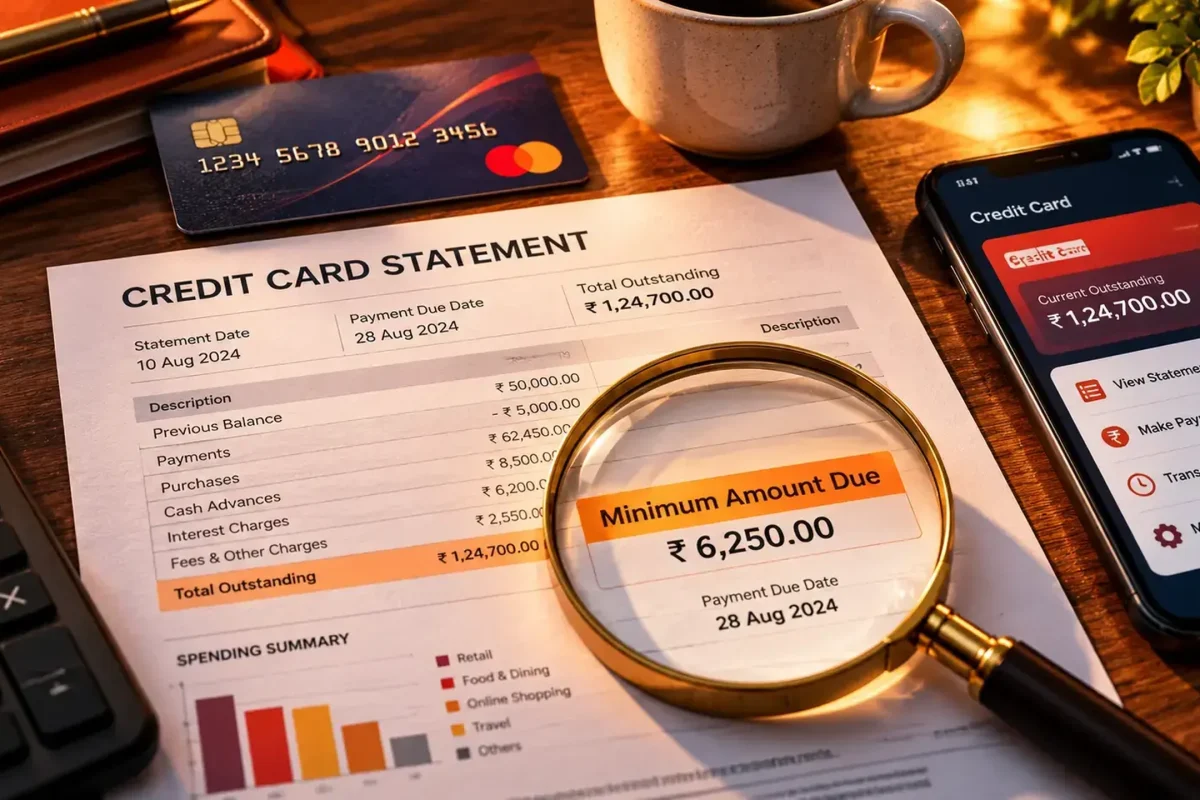
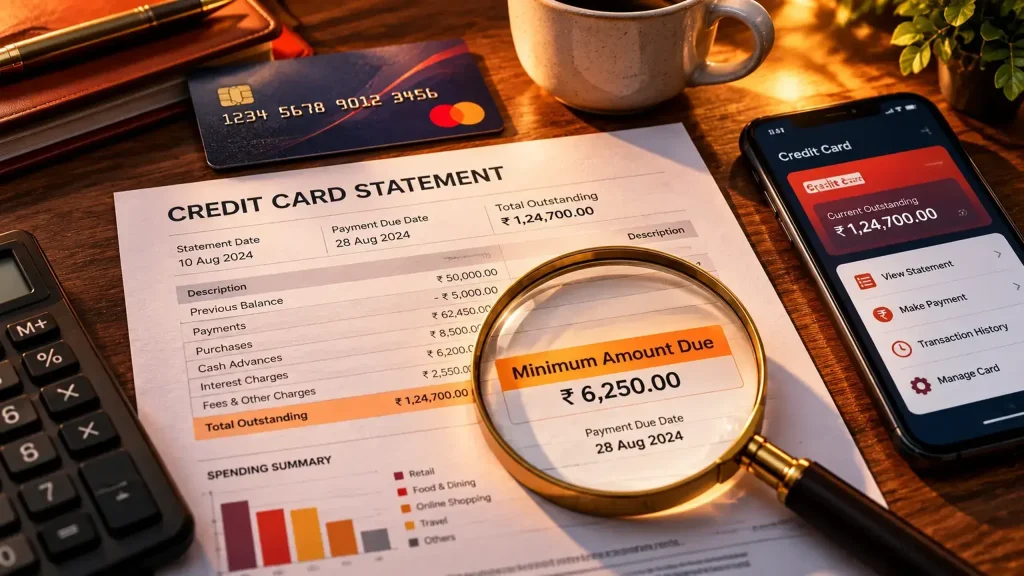
To understand why this is a trap, we must first look at what the minimum amount due actually represents. According to guidelines and standard banking practices, the minimum amount due is the absolute smallest payment your card issuer requires to keep your account active and prevent you from being marked as a defaulter.
Typically, this amount ranges from 5% to 10% of your total outstanding balance. This figure includes any accrued interest, service fees, taxes, and any EMI installments you might have running on the card. While paying this amount keeps the recovery agents from calling and stops the bank from levying a flat late payment fee, it does absolutely nothing to stop the interest clock.
How Banks Calculate Your Minimum Due
Let us look at a concrete hypothetical illustration. Take Amit, a software engineer in Bengaluru who holds an HDFC Bank Millennia Credit Card. Amit went a bit overboard during a festive sale and racked up a total outstanding balance of ₹30,000.
If his card issuer sets the minimum payment at 5%, Amit’s statement will show:
| Billing Component | Amount (₹) |
|---|---|
| Total Outstanding Balance | ₹30,000 |
| Minimum Due Percentage | 5% |
| Minimum Amount Due | ₹1,500 |
| Carried Forward Balance | ₹28,500 |
Amit pays the ₹1,500 on time. He feels satisfied. But what he does not realize is that the remaining ₹28,500 is now subject to compounding interest that starts accumulating immediately.
The True Cost of the Credit Card Minimum Due Payment Trap India
The primary reason the credit card minimum due payment trap India is so lethal to your wallet is the sheer size of the interest rates. Unlike a home loan or a personal loan, which might charge 9% to 15% annually, credit cards in India regularly charge monthly interest rates of 3% to 4%. On a simple annualized basis, this translates to an astronomical 36% to 48% per year.

The Double Whammy: Loss of the Interest-Free Period
Many cardholders believe that if they pay the minimum, their new purchases are still protected by the usual 45-to-50-day interest-free grace period. This is a massive misconception.
The moment you carry even one rupee of unpaid balance into the next billing cycle, your interest-free grace period is completely revoked. Every new transaction you make—whether it is a ₹200 auto ride or a ₹10,000 gadget purchase—starts incurring interest from the very day of the transaction. You are essentially borrowing at 40%+ interest from second one.
How the Math Compounds Against You
Let us look at how long it would take to clear that ₹30,000 balance if Amit continues to pay only the minimum due every month, assuming no new purchases are made. With an annualized interest rate of 42% (3.5% per month), paying just the 5% minimum means Amit will spend years paying off the debt, and the total interest paid will eventually dwarf the original ₹30,000 he spent. This is how a simple purchase turns into a multi-year financial sentence.
How This Habit Silently Damages Your CIBIL Score
Many people believe that as long as they pay the minimum due on time, their credit health remains pristine. While it is true that you will avoid the dreaded “late payment” flag on your credit report, the credit card minimum due payment trap India damages your credit profile in a much more subtle way.
The Credit Utilization Ratio Spike
Your credit utilization ratio (CUR) is the percentage of your total available credit limit that you are actively using. Credit bureaus like CRIF High Mark and CIBIL look at this ratio closely. If your total limit across cards is ₹1,00,000 and you consistently carry a balance of ₹70,000 because you only pay the minimum due, your CUR is 70%.
A CUR above 30% signals to lenders that you are credit-hungry and potentially struggling to manage your monthly cash flows. Over time, this high utilization drags down your credit score, making it significantly harder to secure favorable terms when you apply for critical loans, such as a home loan or a personal loan.
The Risk of a Debt Spiral
When you make paying the minimum due a habit, your outstanding balance grows larger each month due to compounding interest. Eventually, the balance reaches a point where you can no longer manage even the minimum payment. This is the point where many borrowers are forced to take out expensive personal loans or seek a credit card settlement, both of which can severely damage your credit history for years.
How to Escape the Minimum Due Trap
If you are already caught in this cycle, do not panic. It is entirely possible to break free, but it requires a disciplined approach and a clear understanding of how credit card issuers operate.
Step 1: Stop Using the Card Immediately
Since you have lost your interest-free grace period, any new purchase you make on this card will immediately start accumulating interest at 36% to 48% per year. Put the card away in a drawer, remove it from your Swiggy, Zomato, and Amazon accounts, and switch entirely to UPI or debit cards for your daily expenses.
Step 2: Pay More Than the Minimum
Even if you cannot pay the entire outstanding balance, pay as much as you possibly can. If your total due is ₹30,000 and the minimum is ₹1,500, try to pay ₹10,000 or ₹15,000. Every extra rupee you pay directly reduces the principal balance that attracts that heavy monthly interest.
Step 3: Reclaim Your Interest-Free Grace Period
To get your interest-free period back, you must pay the total outstanding balance in full. Once you have cleared the entire balance, most Indian card issuers will reactivate your interest-free grace period after you maintain a zero or fully paid balance for a few consecutive billing cycles.
If you are struggling with high-interest debt across multiple cards, you might want to read about structured repayment strategies like the debt snowball or look into a low-interest personal loan to consolidate your credit card debt at a lower rate. For more details on managing credit health, you can read our guide on Personal Loan Interest Rates: 9 Expert Tips for 2026.
Comparing Popular Indian Credit Cards and Their Annual Fees
When managing credit card debt, it is also important to keep track of the recurring costs of your cards. High annual fees can add to your outstanding balance if they are not waived through retail spend thresholds. Here is a quick look at the fees for some popular credit cards in India:
| Credit Card Issuer & Variant | Joining Fee (₹) | Annual Fee (₹) | Waiver Conditions |
|---|---|---|---|
| Kotak Mahindra Bank — Kotak 811 Credit Card | ₹500 | ₹500 + GST | Waived on ₹50,000 retail spend |
| Axis Bank — Flipkart Axis Bank Credit Card | NIL (Limited Offer) | ₹500 + GST | From 2nd year onwards |
| ICICI Bank — Coral Credit Card | NIL / Var. | ₹500 + GST | Subject to bank terms |
| HDFC Bank — Millennia Credit Card | Var. | ₹1000 + GST | Subject to bank terms |
| SBI Card — SimplyCLICK | ₹499 | ₹499 + GST | Subject to bank terms |
Always check the official website of the respective bank to verify the latest fees, interest rates, and waiver terms before applying or renewing your card.
FAQs
Does paying the minimum due affect my CIBIL score?
Paying only the minimum due on time prevents you from being marked as a late payer, but carrying a large unpaid balance month after month increases your credit utilization ratio. This high utilization can negatively impact your CIBIL score over time.
How can I get my interest-free grace period back?
You can get your interest-free grace period back by paying your total outstanding balance in full for several consecutive billing cycles. Once the card issuer sees that you are no longer carrying a balance, they will reactivate the grace period.
Can I convert my credit card outstanding into EMIs?
Yes, most Indian banks allow you to convert large outstanding balances into monthly EMIs at an interest rate that is usually much lower than the standard 36% to 48% credit card interest rate. However, you should check the processing fees and exact interest rates with your bank first.
Final Thoughts
The minimum amount due on your credit card statement is not a discount, nor is it a helpful tool to manage your monthly budget. It is a safety net meant for emergencies only—to prevent you from defaulting when cash flow is temporarily tight. Treating it as a regular payment strategy is a guaranteed path into a high-interest debt spiral.
If you find yourself regularly relying on the minimum due option, it is time to reassess your spending habits and look closely at your monthly budget. For a structured way to manage your income and expenses, consider reading our guide on The 50/30/20 Rule in India: How to Budget Your Salary.
Remember, this guide is for educational purposes only. If you are struggling with severe debt or need personalized financial advice, please consult a qualified financial professional or a SEBI-registered investment adviser to help you map out a recovery plan.

This article is for educational purposes only and does not constitute financial advice. Figures, examples, and outcomes are illustrative and vary based on individual circumstances and lender policies. Always consult a certified financial advisor before making major financial decisions.
One Email a Week. Five Things Worth Knowing.
- One important financial change that actually affects you
- One practical money lesson
- One useful calculator
- One common mistake to avoid
- One guide worth reading