

Wedding Loans in India: Can Your Salary Carry the EMI?
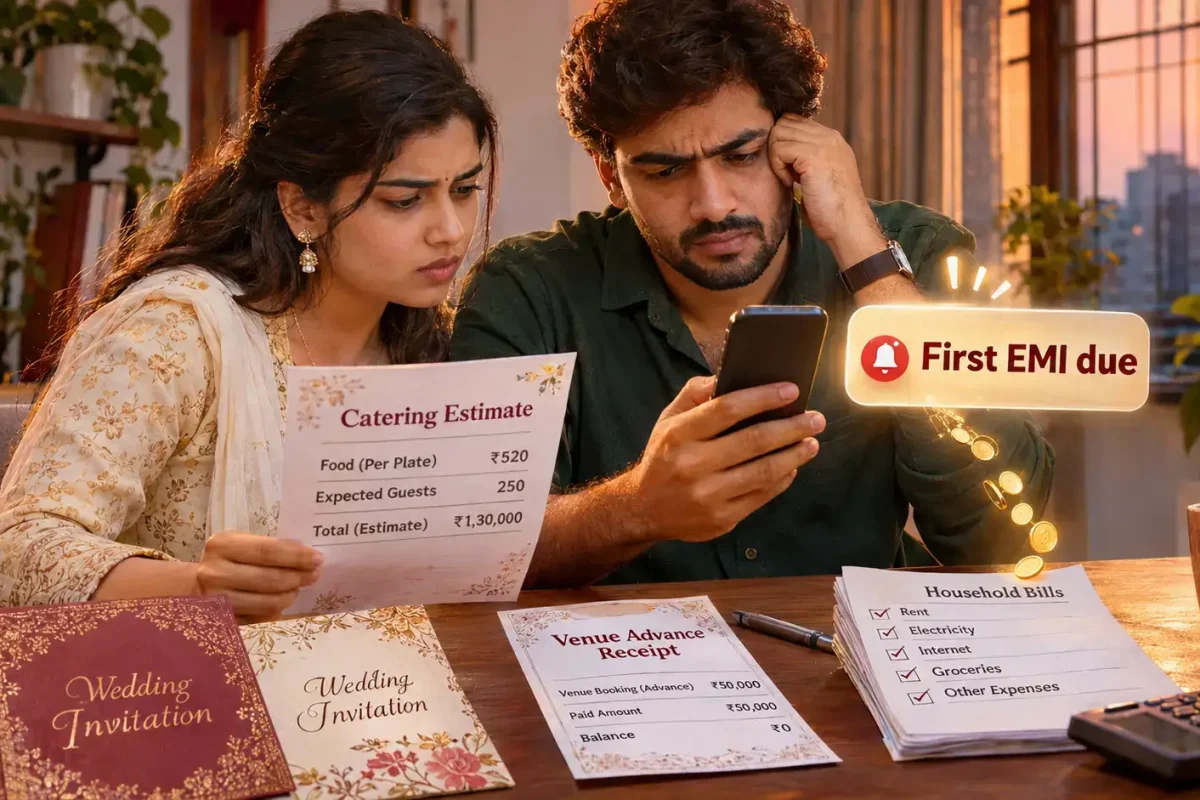
The venue wants its advance by Friday. Relatives are asking about the guest list. The caterer’s quote is already higher than the first estimate. A personal loan can make the gap look manageable—until the first EMI arrives after the wedding.
The wedding loan repayment burden India households face is not just the monthly instalment. It is the income left after that instalment, other debt payments and regular bills are paid.
This guide shows you how to estimate the full cost, stress-test the EMI against your monthly budget and compare loan offers. A bank’s maximum eligibility is not a sensible borrowing target.
Key Takeaways
- Start with the amount still unfunded after savings and confirmed family contributions—not the full wedding budget.
- Compare the EMI with take-home income after rent, household costs and existing debt payments.
- Use the interest rate, loan term, fees and total repayment to compare offers; a smaller EMI can mean a longer and costlier loan.
- Keep a buffer for ordinary expenses and surprises rather than treating every rupee of salary as available for the wedding.
- Stress-test the repayment plan for a delayed bonus, reduced income or a new household expense.
- Check the lender’s current terms and written fee disclosures before deciding; rates and charges can change.
Start with the gap, not the wedding budget
Separate the planned spend from the amount you need to borrow
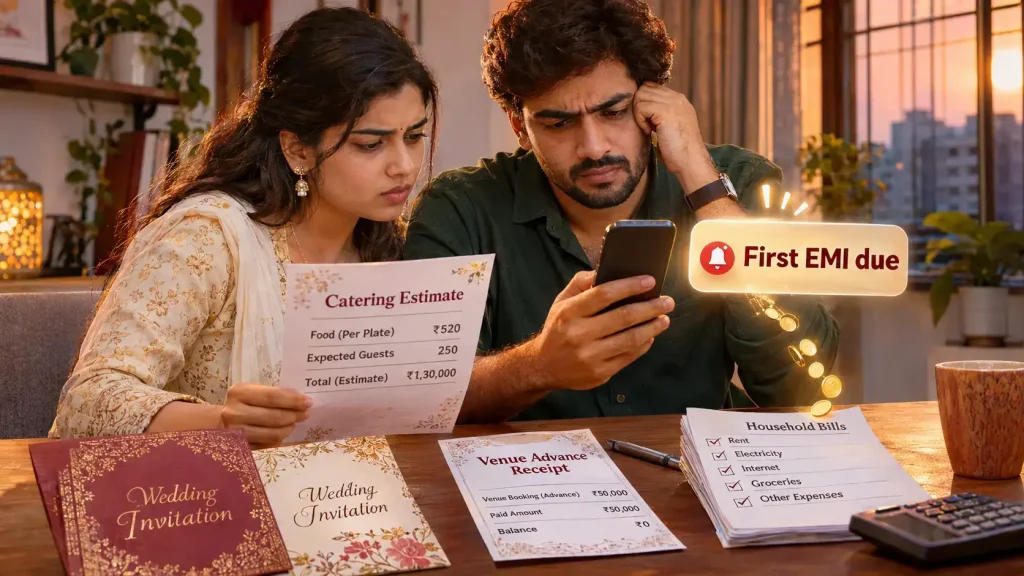
A ₹10 lakh wedding does not automatically mean a ₹10 lakh loan. Some costs may already be covered by savings or contributions. The borrowing question is about the remaining gap—and whether that gap can be repaid without turning the next few years into a monthly scramble. Estimating the wedding loan repayment burden India families may face starts with this actual funding gap, not the total event budget.
Take Saravanan, a nurse in Tirunelveli. His family has set a wedding budget of ₹8 lakh. They have ₹3 lakh set aside and a confirmed contribution of ₹1 lakh, leaving a ₹4 lakh funding gap.
That’s the number to test—not the headline budget.
Try it yourself: list each expected source of payment and mark whether the money is already available or only hoped for. A promised contribution that may arrive later is not the same as money in hand when the venue asks for an advance.
Include the costs that arrive after the main event
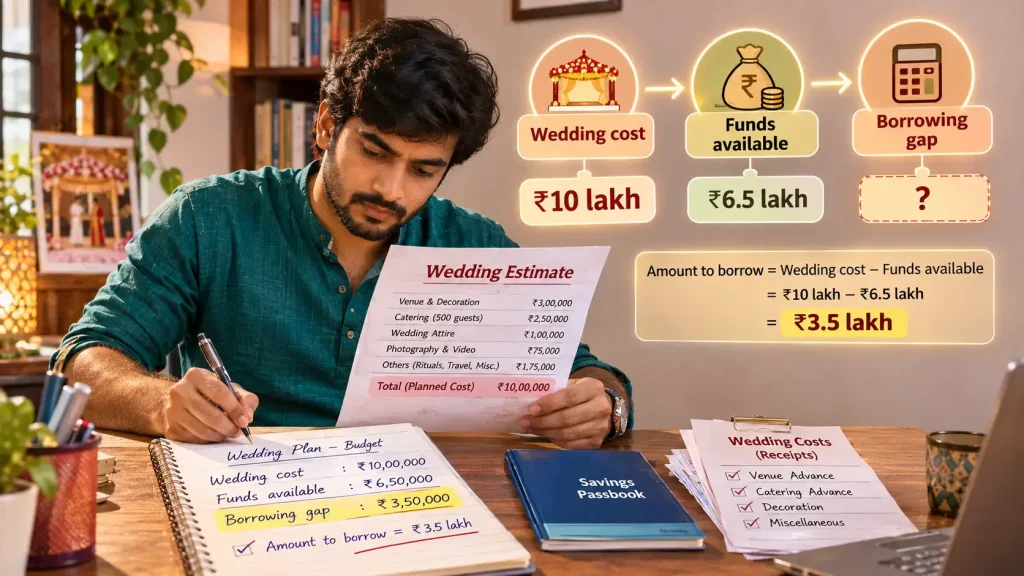
Clothing alterations, travel, accommodation, gifts and last-minute guest changes can push spending beyond the first plan. A budget that uses every available rupee for the event leaves no room for those additions—or for rent, groceries and electricity bills in the same month. This is one reason the wedding loan repayment burden India borrowers calculate should include more than the ceremony costs.
Disha, a school administrator in Ahmedabad, is planning a ₹6 lakh event. Her spreadsheet lists the venue, food, travel and clothing separately. She also tracks deposits already paid, so she doesn’t count the same amount twice.
That small check ties the loan estimate to the actual shortfall.
Do not borrow against money that is uncertain
Expected gifts, a future bonus or a family member’s possible contribution may feel likely. They are not reliable repayment sources until they are confirmed and available. If the plan only works when every uncertain payment arrives on time, the plan is fragile. A careful view of the wedding loan repayment burden India households take on treats uncertain funds as a bonus, not as the basis for repayment.
The Debt Freedom Center is a useful place to explore loan and repayment topics. For this decision, keep the focus narrow: how much you need, what repayment will cost and what remains in the household budget each month.
Calculate what the EMI really does to your monthly budget
Look at take-home pay after existing commitments
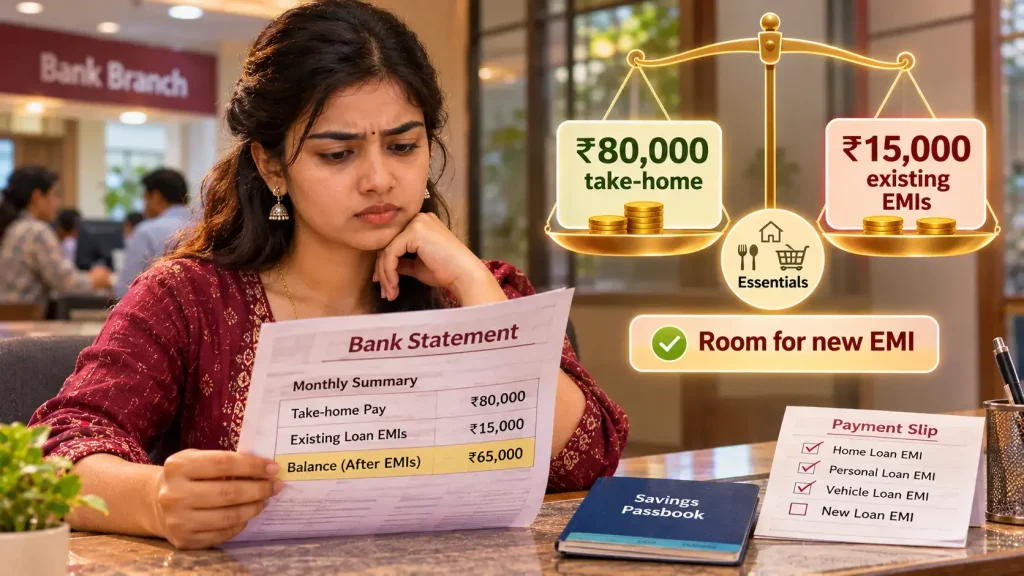
Gross salary is not spendable income. Start with the amount that reaches your bank account, then subtract essential household costs and current EMIs or loan payments. The leftover amount is the space a new wedding loan would have to fit into. This monthly calculation makes the wedding loan repayment burden India borrowers experience easier to assess in practical terms.
Say your household brings home ₹80,000 and already pays ₹15,000 in loan EMIs. You can’t assess a new loan as if the full ₹80,000 were free. Rent, food, transport, school fees and medical costs still need to be paid.
There’s no universal percentage to follow. Look at the real cash left after your actual commitments.
Try it yourself: check three recent months of bank statements. Include irregular but predictable costs, such as annual insurance premiums or school expenses, by setting aside a monthly equivalent.
One month can make your budget look roomier than it is.
Use the loan amount, rate and term together
The EMI depends on the principal, interest rate and repayment period. A longer term can lower the monthly instalment while increasing the total interest paid. A shorter term can raise the instalment, which may make the monthly budget tighter. Neither number tells the whole story on its own. That trade-off is central to understanding the wedding loan repayment burden India borrowers need to manage.
Here’s a worked illustration: a ₹3 lakh personal loan at 12% a year for 36 months has an EMI of roughly ₹9,964. Total repayments come to about ₹3.59 lakh before any fees.
The 12% rate is only there to demonstrate the calculation; it is not a quoted offer. Actual lender terms, fees and EMI schedules can differ.
Saravanan can compare that estimated instalment with his existing monthly commitments and the expenses he expects after the wedding. If too little is left for routine bills, a lender’s approval does not make the repayment comfortable.
Compare the total repayment, not just a low-looking EMI
A lower EMI can be tempting when you are already juggling wedding payments. But ask what term produced it and what the full repayment becomes. Also check processing charges and any other listed fees in the lender’s written offer. A headline interest rate alone does not show the complete borrowing cost. Comparing these details helps keep the wedding loan repayment burden India borrowers face from being underestimated.
Compare offers using the same loan amount and comparable repayment periods. SBI, Axis Bank, ICICI Bank, HDFC Bank and Kotak Mahindra Bank publish product information on their official pages, but offers and eligibility differ.
The supplied rate tracker last verified several entries on 14 September 2026. Check each lender’s current official terms before relying on any figure.
Stress-test the wedding loan repayment burden India households may face
Ask what happens if income or expenses change
Can the EMI still be paid if a bonus does not arrive? What if a family member needs medical care, or household costs rise just after the wedding? These are not pessimistic questions. They are the difference between a plan that works only on paper and one that can absorb a difficult month. Stress-testing the wedding loan repayment burden India households could face means checking whether the instalment remains manageable under these changes.
Domnic, a hospitality supervisor in Panaji, is reviewing a loan estimate and accounting for a move after the wedding. He compares his budget with and without the new monthly housing cost.
That second version matters. A new home expense can make an EMI that looked affordable before the wedding feel heavy afterward.
Try it yourself: write down your monthly budget under two versions—expected income and a less comfortable month. You don’t need a precise forecast. Identify which bills stay fixed and which costs can vary.
If repayment depends on everything going perfectly, that’s a warning sign.
Keep a visible margin for ordinary life
A wedding is a major event, but it does not pause subscriptions, fuel costs, groceries or family responsibilities. A repayment plan that consumes all of the apparent monthly surplus leaves no room for a ₹20 chai with a colleague, a Swiggy order on a late workday or an unexpected pharmacy bill. Small purchases are not the central issue; having no margin is. Keeping that margin can reduce the day-to-day pressure of the wedding loan repayment burden India borrowers take on.
Don’t count a credit-card limit as spare income. If the loan EMI takes up your cash and you use a card for routine expenses, you’re shifting the pressure—not solving it.
A bounced payment or repeated borrowing can leave stress that lasts far longer than the celebration.

Check the lender and the written terms
Before accepting an offer, verify the lender’s identity, the final interest rate, repayment schedule, fees, late-payment consequences and any conditions for early repayment. Read the sanction or loan documents, not just a salesperson’s summary or a message forwarded in a family WhatsApp group. If a term is unclear, ask the lender to explain it in writing. Clear terms help you understand the wedding loan repayment burden India borrowers will be responsible for throughout the loan period.
RBI is a relevant official source for information about regulated lending and consumer protections. Don’t treat an unofficial app’s or agent’s claim as proof that a loan is approved or a fee is mandatory. Verify the details directly with the lender through its official channel.
FAQs
How much wedding loan can I afford on my salary?
There is no single salary figure that determines affordability. Compare the estimated EMI with take-home pay after essential costs and current debt payments, then check whether a reasonable monthly margin remains.
Is a longer wedding loan tenure better?
A longer term may reduce the monthly EMI, but it can increase total interest paid. Compare both the monthly payment and the total repayment shown in the lender’s offer.
Should I include a bonus when calculating a wedding loan EMI?
A bonus that is not confirmed and available is uncertain income, not a dependable source for a fixed monthly EMI. Check whether the plan still works without it.
What should I compare between wedding loan offers?
Compare the interest rate, loan term, EMI, total repayment, fees and written repayment conditions for the same borrowing amount. Verify current details with each lender because offers can change.
Final Thoughts
You can revise a wedding budget before the event. A loan agreement is a longer commitment. The most useful number isn’t the maximum amount a lender is willing to offer. It’s the payment your household can manage without relying on perfect timing or constant sacrifices.
This week, put the funding gap, existing EMIs and essential monthly costs on one page. Then compare the loan’s full repayment against that picture, using current written lender terms. The example figures in this article are illustrations, not a quote or recommendation.
The examples above are simplified, and their figures are assumptions used to show how the numbers work.
Not Sure What to Do Next?
Every situation is different. Get a short list of guides and calculators for debt, in a sensible order, with no sign-up. It is for learning, not personal advice.

This article is for educational purposes only and does not constitute financial advice. Figures, examples, and outcomes are illustrative and vary based on individual circumstances and lender policies. Always consult a certified financial advisor before making major financial decisions.
One Email a Week. Five Things Worth Knowing.
- One important financial change that actually affects you
- One practical money lesson
- One useful calculator
- One common mistake to avoid
- One guide worth reading